



Use Wozber and land your dream job
Create CV
No registration required
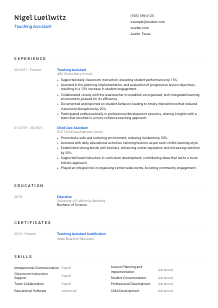
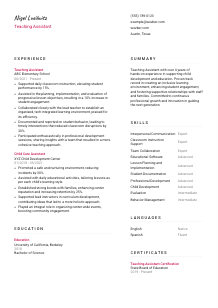
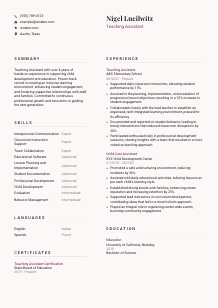
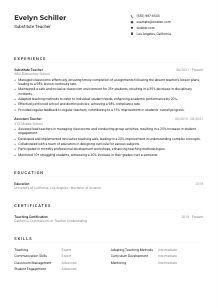
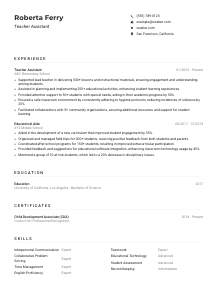
Supporting classrooms, but your CV needs a little guidance? Check out this Teaching Assistant CV example, created with Wozber free CV builder. Learn how to match your supportive skills with job expectations, paving your way to an educator's helper highlight reel!
Teaching Assistant hiring often turns on the details that make a classroom run well when the lead teacher is managing instruction, behaviour, and pacing at the same time. Schools want to see whether you can support students one-on-one, keep routines steady, document what matters, and contribute to a learning environment that stays organised under real daily pressure.
That is why your CV needs to surface classroom support, student progress, and collaboration with teachers in language that is easy to read in both human review and ATS screening. Wozber's free CV builder helps you shape an ATS-compliant CV around the actual priorities in the posting, so a principal or hiring team can quickly see where you have already handled instruction support, student documentation, and day-to-day classroom responsibility.
Schools usually scan the header first for practical information they need before they spend time on classroom experience. Your Personal Details section should confirm who you are, how to reach you, and whether you meet basic location or communication requirements without adding anything that distracts from your education background.
Use your full name as the clearest visual anchor at the top of the page. Keep it larger than the rest of the text so administrators can spot it immediately when reviewing several applications for classroom support roles.
Place the job title directly below your name and match the wording in the posting when it fits your background. For this opening, using "Teaching Assistant" makes your intent clear right away and aligns your CV with the role being searched in the ATS.
Schools need a straightforward way to contact candidates for interviews, reference checks, or follow-up questions about availability. Use a reliable phone number and a professional email address, and double-check both for typos before sending your application.
Some school roles have district, commute, or state-based requirements, so location can matter early in the screening process. Here, listing "Austin, Texas" directly addresses a stated requirement and removes avoidable uncertainty about local eligibility.
Include a website, portfolio, or LinkedIn profile only if it supports your candidacy with useful information, such as education experience, volunteer work, classroom projects, or professional development. If you share a link, make sure the content is current and appropriate for school hiring.
You do not need to include age, marital status, photo, or other unrelated personal information. Keep this section focused on contact, location when relevant, and role alignment so the reader moves quickly to your classroom experience.
A well-built header removes basic questions before they arise. When your contact details, title, and location are clear, the hiring team can move straight to what matters most for a Teaching Assistant: your work with students, teachers, and daily classroom routines.




For a Teaching Assistant, experience is where schools look for proof that you can contribute inside a real classroom or child care setting. Focus less on broad statements about being helpful and more on the actual work: supporting instruction, assisting with lesson delivery, tracking behaviour or attendance, using educational tools, and helping students stay engaged.
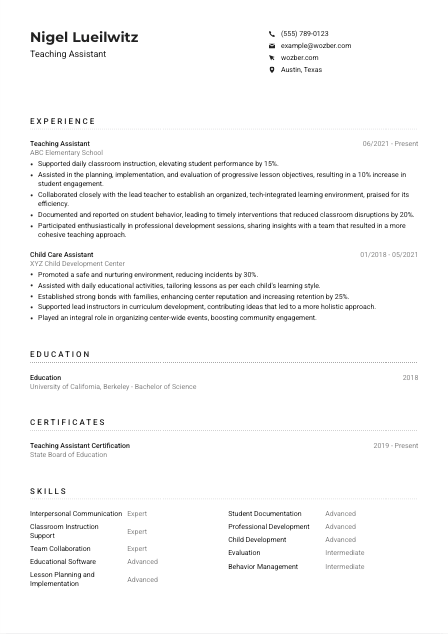
Read the responsibilities closely and make sure your bullets reflect the same kinds of classroom tasks when you have done them. If the role calls for small-group support, lesson implementation, documentation, and teacher collaboration, those themes should appear clearly in your experience section. The sample CV does this well by naming classroom instruction, lesson objectives, and student behaviour reporting instead of relying on vague education language.
Use reverse chronological order and include job title, school or centre name, and dates for every role. That structure helps reviewers quickly track your progression from child care or support roles into more direct classroom responsibility, which is especially useful when the posting asks for at least 2 years in an educational or child care setting.
A hiring team already knows a Teaching Assistant helps students and supports teachers. What makes your CV stronger is showing what changed because of your work. Write bullets that connect your actions to student engagement, classroom organisation, behaviour improvement, or smoother lesson delivery. In the example, "elevating student performance by 15%" gives a clearer picture than simply saying "assisted students."
Numbers are useful when they reflect how schools measure progress. Improvement in engagement, fewer disruptions, stronger attendance follow-up, better lesson participation, or higher family retention in a child care setting all make sense here. The example's 10% increase in engagement and 20% reduction in disruptions are strong because they connect directly to classroom function.
If you have held several jobs, prioritise the ones that show direct support of learning environments, child development, behaviour management, or collaboration with instructors. Even related experience outside a school can work if it demonstrates supervision, documentation, communication with families, or adapting activities to different learning needs.
Your experience section should let a school picture you in the room: supporting instruction, helping students stay on track, and keeping the teacher informed. When each bullet shows action plus outcome, your background reads as classroom-ready rather than generally education-adjacent.
Teaching Assistant postings often set a clear academic baseline, especially when schools want candidates who understand child development, instructional support, and classroom practice. Present your degree in a way that confirms you meet that baseline quickly, then add detail only when it strengthens your case.
If the posting asks for a bachelor's degree in Education, Child Development, or a related field, make that connection obvious. Lead with the degree and field exactly as they appear on your CV so the hiring team can immediately confirm academic eligibility.
For most Teaching Assistant applications, you only need the essentials: degree, field of study, and school name. A clean entry is easier for both ATS parsing and school reviewers who are moving quickly through required qualifications.
If your studies line up well with classroom support, early childhood learning, literacy development, or special education foundations, let that relevance come through naturally. In this example, a Bachelor's in Education clearly supports the role without needing extra explanation.
Extra academic detail is most useful when you are early in your career or when the role has a specific focus, such as child development, educational technology, or literacy support. If your coursework included classroom observation, developmental psychology, or instructional design, those can help, though they are not required in every application.
Academic awards, tutoring programs, or education clubs can be worth adding when they reinforce your readiness to work with students or support teachers. Once you have several years of hands-on experience, these details become secondary to your classroom record.
Your education section does not need to carry the whole application. It simply needs to confirm that you meet the school's stated degree requirement and, where useful, show that your studies connect to student learning and child development.
Certification matters differently depending on the state, district, and school system, but when a posting names it, treat it as a priority. List any Teaching Assistant or education-related credential clearly so reviewers can confirm eligibility without searching through the rest of the CV.
When a posting states that a valid Teaching Assistant certification may be required by state or district regulations, include that credential in its own section and use the official name. This keeps a compliance item from getting buried inside your experience or education details.
Focus on certifications that support your employability in educational settings, such as Teaching Assistant credentials, child development qualifications, first aid if relevant, or training tied to student support. In the provided CV, the State Board of Education certificate is the strongest item because it directly maps to the role.
Schools may need to know whether a certificate is current, recently earned, or due for renewal. Adding the issue date or validity period makes this simple to verify and keeps your application from stalling on an administrative question.
Beyond formal certification, recent workshops or district training can reinforce that you stay engaged with classroom practice, student support strategies, and education technology. This is especially useful when the job values professional development and school-wide participation.
A clear certification section helps schools confirm that you meet formal requirements and stay active in professional learning. That matters in roles where classroom support, student supervision, and district expectations all depend on current qualifications.
A Teaching Assistant skills section should reflect what happens during the school day, not just general strengths. The most useful skills combine student-facing support, classroom coordination, communication, and practical tools such as educational software or documentation systems.
Start with the language the employer already used. Here, that includes interpersonal communication, educational software, lesson support, documentation, and collaboration with faculty. If those skills match your experience, use similar wording so both the ATS and the reader can connect your background to the role quickly.
Lead with capabilities that matter in real instruction settings, such as supporting individual and small-group learning, managing classroom routines, helping implement lesson plans, and communicating clearly with teachers and students. Save broader traits for your summary or interview.
Group or order skills so the most relevant ones appear first, and avoid padding the section with tools or traits you cannot support elsewhere in the CV. For this role, educational technology belongs here because the posting specifically asks for proficiency with educational software.
A focused skills section helps schools connect your background to daily classroom demands. When the mix includes instruction support, communication, documentation, and technology use, your CV looks grounded in the actual work of a Teaching Assistant.
Language ability can matter a great deal in education, especially in diverse school communities where clear communication supports students, families, and staff. Keep this section honest and useful, with emphasis on the languages that affect instruction, documentation, or parent communication.
If the posting specifies English writing ability, make sure English appears clearly with an accurate proficiency level. This matters for classroom communication, written student notes, attendance records, and collaboration with faculty.
Place the required language first so the reader does not need to search for it. In this example, listing English as Native directly supports the school's need for strong written and spoken communication.
Additional language ability can strengthen your CV when it supports student connection, family communication, or a multilingual classroom environment. Spanish, for example, can be valuable in many communities, but it should be presented as an added asset rather than a substitute for the required English proficiency.
Choose levels that reflect what you can actually do in conversation, writing, and school communication. Overstating language ability can create problems later if the role involves parent updates, classroom support, or written records in that language.
Only expand on language value if it clearly supports the environment you are applying to. In education, multilingual ability is most useful when it improves student support, family trust, or communication across the school community.
When listed clearly and honestly, languages show how you communicate across students, staff, and families. For Teaching Assistant roles, that can strengthen your CV most when it supports instruction, documentation, or family engagement.
Your summary should give a school a quick, credible picture of the kind of support you provide in educational settings. Keep it short, specific, and grounded in classroom contribution, student outcomes, and the parts of the role you already handle well.
Before writing, identify the few ideas the school emphasizes most. For this role, those include classroom support, lesson assistance, communication, educational technology, and student documentation. Build your summary around two or three of those priorities rather than trying to mention everything.
Start with your professional identity, total years in educational or child care environments, and the kind of settings you have supported. The sample CV does this effectively by stating more than 4 years of hands-on experience in child development and education.
Use the next sentence to mention the work you are known for, such as improving student engagement, supporting inclusive classrooms, collaborating with teachers, or maintaining organised learning environments. Tie these strengths to outcomes that matter in schools whenever possible.
Aim for a short paragraph that a hiring manager can absorb in seconds. Strong summaries avoid generic enthusiasm and instead give a compact view of your classroom experience, practical strengths, and the kind of contribution you can make from day one.
A Teaching Assistant summary should sound grounded in real school work, not broad career language. If those first lines make your instructional support, student focus, and classroom reliability clear, the rest of the CV has a stronger frame.
When each section reflects the actual work of supporting instruction, tracking student progress, collaborating with teachers, and helping maintain an organised learning environment, your CV becomes much easier for schools to trust. Use Wozber's free CV builder to structure those details clearly and strengthen ATS optimisation around the language schools already use in their postings.
Finish with a final pass through an ATS CV scanner, tighten any vague wording, and make sure every section supports the same message. Your CV should leave a school with a clear read on one thing: you can step into the classroom and contribute from the start.