



Use Wozber and land your dream job
Create CV
No registration required
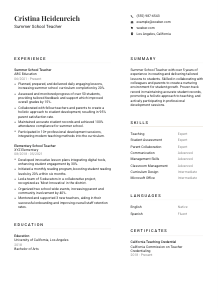
Exploring academics and popsicles, but your CV feels too melted? Check out this Summer School Teacher CV example, created with Wozber free CV builder. It shows how to shape your educational expertise to fit summer sessions, guiding your career as bright as a sunny A+!
Summer teaching moves quickly. Schools need someone who can step into a shorter academic window, build momentum from day one, and keep students engaged while still covering clear learning objectives. Your CV should make that practical teaching range visible, especially how you plan lessons, manage the classroom, track progress, and support students who may need targeted reinforcement over a compressed term.
A tailored CV helps a school see, early on, whether your background matches the actual summer-school workload rather than general classroom experience alone. Using Wozber's free CV builder and an ATS-friendly CV format makes it easier to align your language with the posting, surface requirements such as certification and lesson planning, and show that you can deliver structured instruction, feedback, and student support without a long ramp-up.
School administrators often make quick early checks before they ever reach your teaching experience. If your contact details, title, and location line up cleanly with the role, they can move straight to your classroom background instead of pausing over preventable questions.
Use your full name in a clear, readable font at the top of the page. Keep it slightly larger than the rest of the text so the document feels organised right away, much like a well-structured lesson plan with clear headings and flow.
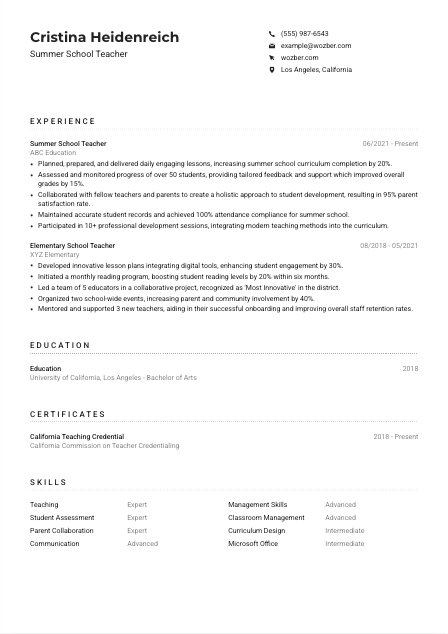
Place "Summer School Teacher" directly under your name when that is the job you are applying for. This immediately connects your CV to the opening and helps distinguish your application from broader K-12 teaching CVs that may not speak directly to summer instruction.
Your phone number and email should be easy to spot and fully accurate. Schools move fast when filling seasonal teaching roles, and an unreachable number can stall an interview just as quickly as a missing attendance record.
If the posting specifies a city or state, list it clearly in your personal details. In the example, "Los Angeles, California" helps address the employer's stated location need without taking space away from teaching accomplishments.
Include LinkedIn or a professional teaching profile only if it strengthens your application with consistent information, extra context on your school experience, or visible contributions such as curriculum work, classroom projects, or professional development activity.
This section should remove friction. When your title, contact information, and location are accurate and aligned, the reader can focus on what matters next: how you teach, support students, and handle the pace of summer school.




For a Summer School Teacher, experience is where schools look for practical proof. They want to see that you can run instruction day by day, adapt to student needs, communicate with families, and keep records in order while working within a short program window.
Read the responsibilities line by line and build your bullets around those classroom realities. For this role, that means lesson delivery, student progress monitoring, parent and colleague collaboration, recordkeeping, and participation in school activities. One of the sample bullets works well because it mirrors the job language directly: planning and delivering daily engaging lessons tied to curriculum completion.
List your positions in reverse chronological order, starting with the job that best reflects the environment you are targeting. If you have direct summer school experience, put that front and centre. If not, highlight teaching roles where you handled intervention, accelerated instruction, mixed ability groups, or short-cycle assessment.
Avoid repeating generic tasks like "taught students" or "managed classroom." Show what your instruction changed. The sample CV does this well by tying tailored feedback to a 15% grade improvement and parent collaboration to a 95% satisfaction rate. Those results say more than a plain duty list ever could.
Numbers help hiring teams understand scope and impact quickly. Strong examples include student count, curriculum completion, reading-level growth, attendance compliance, parent satisfaction, or improvement in grades and engagement. Metrics such as "supported over 50 students" or "increased engagement by 30%" give concrete shape to your teaching effectiveness.
Keep the emphasis on lesson planning, differentiated support, assessment, communication, and classroom management. Even strong accomplishments from other settings should earn their place by connecting back to student learning, instructional leadership, or school collaboration. Your experience section should read like a teacher ready to contribute this term, not a general professional profile.
When this section is tailored well, a hiring team can quickly picture you managing daily lessons, tracking progress, and supporting summer learners with structure and consistency. That is the standard they need to see.
Teaching roles have clear academic expectations, and schools often confirm them early. Your education section should make it easy to see that you meet the degree requirement without forcing the reader to search for it.
When the posting asks for a bachelor's degree in Education or a relevant subject area, list that degree clearly and without extra wording. In the example, a Bachelor of Arts in Education from UCLA directly satisfies the requirement and belongs near the top of the section.
Include the degree, school, field of study, and graduation year or date. That is usually enough for an experienced teacher. A clean entry helps the school confirm your academic background quickly during initial review.
If your degree is in Education, that connection is already strong. If it is in a teachable subject, make sure your experience and certification reinforce the grade level or content area you are targeting. The education entry should support your classroom credibility, not sit in isolation.
Early-career teachers can include coursework, student teaching, literacy intervention training, or honors if those details help explain instructional preparation. For more experienced educators, these extras matter less unless they directly support the summer program's focus.
Honors, scholarships, or notable academic awards can be useful if they are relevant and recent enough to add context. Keep them brief. In most teaching CVs, classroom results and certification carry more weight than long academic descriptions.
This section does not need decoration. It needs to show, clearly and quickly, that you have the educational foundation expected for the classroom you want to lead.
For teaching jobs, certification is not a nice-to-have detail tucked at the bottom of the page. It is a threshold requirement. Schools need to know you are authorized to teach the relevant grade level or subject before they spend time evaluating the rest of your background.
If the posting asks for a valid state teaching certification or license, list it prominently and use the official name. The sample's California Teaching Credential is exactly the kind of credential the employer needs to see without extra interpretation.
Add certifications in areas such as special education, ESL, literacy intervention, educational technology, or curriculum design when they reflect real training. These can strengthen your application, especially for summer programs serving diverse learning needs or recovery-focused instruction.
Include the date earned and, when relevant, a current validity range. This helps schools confirm that the credential is active and recent enough for compliance purposes. If your license is up for renewal soon, make sure the status is accurate.
Summer programs often value teachers who stay current on instructional methods, assessment practices, and classroom tools. Recent coursework or renewal-related training can reinforce that you continue to develop your practice rather than relying only on past experience.
A clear certification section tells the school you meet the formal teaching requirement and are ready to step into the classroom on schedule. That clarity matters in fast seasonal hiring.
The best skills sections for teachers are focused and recognizable. They should echo the instructional, behavioral, and communication demands of the role, not read like a broad list copied from multiple jobs.
Start with the posting and extract the abilities tied to daily teaching work. Here, that includes lesson planning, student assessment, classroom management, communication, parent collaboration, and support tailored to individual needs. These are operational skills, not filler keywords.
Choose skills you can back up elsewhere in the CV. The example supports "Student Assessment," "Parent Collaboration," and "Classroom Management" with concrete bullets on grade improvement, family satisfaction, and attendance compliance. That kind of alignment makes the skills section credible.
Prioritise teaching and student-support skills over generic software or broad business traits. Tools such as Microsoft Office can stay if they matter to recordkeeping or reporting, but they should not crowd out more important competencies like differentiated instruction, curriculum delivery, or behaviour management.
A focused skills section helps the reader connect your CV to the real classroom demands of summer school. Every item should support instruction, student progress, or effective school communication.
Language ability matters most when it affects instruction, family communication, or access for students in a diverse school community. If language skills are relevant, present them clearly and honestly.
When the role requires English for professional interaction, list English with an accurate proficiency level. For a teaching role, this reflects classroom instruction, parent communication, written feedback, and coordination with colleagues and administrators.
A second language can be highly useful in school environments with multilingual students and caregivers. In the example, Spanish adds practical value for family communication and relationship-building, especially in communities where bilingual interaction is common.
Use levels you can stand behind in conversation, written communication, and school interactions. If you claim fluency, be prepared to use that language with parents, colleagues, or students in a real educational setting.
Additional languages are most helpful when they improve communication, trust, and access to learning. For teachers, that may mean explaining progress, clarifying assignments, or helping families stay engaged with summer attendance and goals.
If you are actively improving a second language, that can still be worth noting when it supports the school community. Ongoing language growth also reflects cultural awareness and a willingness to communicate effectively across student and family backgrounds.
This section works best when it reflects practical teaching value. The right language entry can reinforce your ability to support students and communicate with families in the setting you hope to join.
Your summary should give a school a quick read on your teaching background, instructional strengths, and relevance to the role. Keep it specific enough to sound like a working teacher, not a generic education applicant.
Before writing, identify the few points that matter most for this opening. Here, those include teaching experience, engaging lesson delivery, student progress monitoring, collaboration, and classroom management. Build your summary around that combination rather than broad enthusiasm for education.
Your first line should establish who you are professionally. The sample does this well by leading with more than 5 years of experience and a focus on tailored lessons. That immediately places the candidate in a real instructional context instead of opening with vague personal traits.
Include capabilities the school actually needs, such as differentiated instruction, parent collaboration, accurate student records, or active participation in professional development. Pull these from both the job description and your experience bullets so the summary reflects the rest of the CV.
Aim for 3 to 5 lines that can be scanned quickly. Every phrase should earn its place by clarifying your teaching scope, your classroom approach, or your measurable results. If a sentence could apply to almost any profession, cut it and replace it with something rooted in instruction or student outcomes.
A well-written summary helps the school understand, in seconds, whether you bring the classroom experience and student-support approach the program needs. That quick clarity is valuable in summer hiring.
When each section points to the same hiring story, your CV becomes much easier for a school to review. Degree, credential, lesson planning, student progress, classroom management, and family collaboration should all reinforce one another so the reader can see a teacher who is ready for a fast-moving summer program.
Wozber's free CV builder can help you organise that story in an ATS-compliant CV, and tools such as its ATS CV scanner make it easier to match your wording to the posting while keeping the content grounded in real teaching experience. The finished CV should make one thing easy to judge: you can step into the classroom, teach with structure, and support student growth from the first day of summer session.




