



Use Wozber and land your dream job
Create CV
No registration required
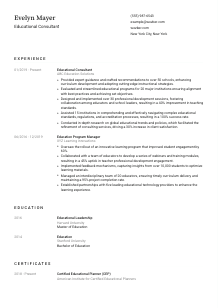
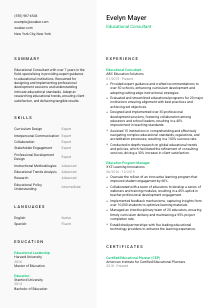
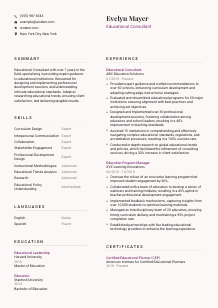
Guiding academic paths, but your CV feels off-course? Check out this Educational Consultant CV example, made with Wozber free CV builder. It shows how to match your scholarly insights with job criteria, making your career journey as enlightening as a light bulb moment in the classroom!
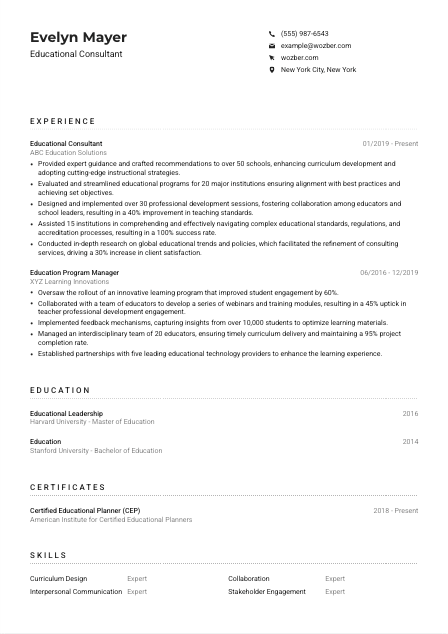
Educational consulting work is judged in the real world by whether your recommendations improve teaching practice, strengthen curriculum decisions, and help institutions navigate standards with confidence. A CV for this field needs to make that operating range visible quickly, especially your mix of program evaluation, professional development, stakeholder collaboration, and current knowledge of instructional methodology.
When those strengths are tailored to the posting, the CV is easier to sort from adjacent profiles such as academic coordinators, program managers, or school administrators. Wozber's free CV builder helps you align your language with the role and build an ATS-compliant CV that surfaces the right terms, from curriculum development to accreditation support, so hiring teams can see where your consulting work has already delivered results.
Educational consultants often work across schools, districts, leadership teams, and external partners, so the top of the CV should feel clear and credible from the first line. This section does not need personality flourishes. It needs accurate identification, a clean professional title, and any detail that removes friction for the employer.
Make your name the most visible text in the header and keep the styling clean. In consulting work, presentation matters, but clarity matters more. A simple, readable header sets the same tone you would want in a client-facing report or workshop deck.
Place "Educational Consultant" directly under your name when that is the role you are pursuing. Matching the title helps both ATS screening and human review, especially when employers are comparing candidates from related backgrounds such as instructional coaching, academic leadership, or education program management.
List a working phone number and a professional email address, ideally in a straightforward format such as firstname.lastname@email.com. Since this role depends on communication with educators, administrators, and institutional stakeholders, even small details like contact accuracy reinforce professionalism.
If the employer specifies a location, reflect it clearly in your header. Here, listing "New York City, New York" immediately addresses a stated requirement and removes questions about availability. Use this only when location is relevant to the role, not as filler on every application.
A LinkedIn profile or professional website can strengthen this section if it supports your consulting work with matching titles, roles, publications, presentations, or school improvement projects. Make sure the information aligns with your CV, especially if you highlight curriculum work, training delivery, or policy expertise there as well.
This section should make basic logistics easy to confirm. When your title, contact information, and location are cleanly presented, the reader can move straight to your consulting experience and educational impact.




For educational consultants, experience carries the most weight when it shows what changed because of your work. Hiring teams look for proof that you can evaluate programs, advise on curriculum, support educator development, and work across different stakeholder groups without losing sight of standards or outcomes.
Read the job description closely and identify the core work being hired for. In this case, that includes curriculum development, instructional strategy, program evaluation, professional development, standards navigation, and educational research. Your bullets should mirror those priorities using language that reflects your actual work, not generic education wording.
List your most recent position first and include title, organisation, and dates for each role. Educational consulting careers often blend consulting, school leadership, and program management experience, so a clear timeline helps the reader understand how your responsibilities expanded from implementation to advisory work.
Replace broad task descriptions with concrete consulting contributions. The sample CV does this well with points such as evaluating programs for 20 institutions and designing more than 30 professional development sessions. That kind of phrasing shows scope, client type, and deliverable, which is far more useful than simply saying you "supported schools" or "led training."
Use numbers that fit the work: number of schools served, educators trained, programs reviewed, improvement rates, satisfaction gains, adoption rates, or accreditation outcomes. Metrics like a 40% improvement in teaching standards or a 100% success rate in accreditation support give hiring teams a clearer picture of your consulting effectiveness.
Not every education role belongs on the page in equal detail. Prioritise experience that shows advisory work, curriculum judgment, instructional improvement, policy understanding, stakeholder facilitation, or measurable program results. If an earlier role was more operational, keep it concise and emphasize the parts that connect to consulting, as the program manager example does through training engagement and curriculum delivery results.
Your experience section should read like a record of school and institutional improvement, not a job description archive. When each bullet shows scope, action, and measurable results, your consulting background becomes much easier to trust.
In educational consulting, academic credentials do more than satisfy a requirement. They help explain the lens you bring to leadership, curriculum, pedagogy, and system-level decision-making. Keep this section straightforward, but make sure it supports the level of advisory work you want to do.
If the role asks for a master's degree in Education, Educational Leadership, or a related field, place that credential first and make it easy to spot. A "Master of Education in Educational Leadership" directly addresses the requirement here and reinforces your grounding in school improvement and leadership practice.
List degree, field, institution, and graduation year in a simple structure. Hiring teams should be able to confirm your qualifications in seconds without decoding the layout. Clean formatting matters even more for senior education roles where the review moves quickly to experience and credentials.
Use the full degree and field names when they match the posting naturally. If your background includes Educational Leadership, Curriculum and Instruction, Higher Education, or a closely related discipline, spell that out rather than shortening it. The example's master's degree aligns well because it reflects both education expertise and leadership orientation.
For experienced candidates, this section usually stays lean. Include coursework, capstones, or research only when they directly support the target role, such as accreditation studies, curriculum design, instructional leadership, or education policy analysis. Otherwise, let your consulting record carry the detail.
Honors, scholarships, and relevant research can add value if they reinforce your authority in education. Keep them brief and relevant. For a role centered on consulting schools and institutions, they should support your subject-matter depth rather than distract from your professional results.
This section should confirm that your advisory work rests on solid preparation in education. Once the degree requirement is clear, the employer can focus on how you have applied that knowledge in schools, programs, and consulting engagements.
Certifications are especially useful in educational consulting when they point to recognized expertise, ongoing professional development, or a specific advisory niche. They are rarely the whole hiring decision, but they can strengthen your profile when they connect directly to planning, standards, or institutional guidance.
If the job mentions a credential such as Certified Educational Planner, surface it clearly. That immediately shows you read the requirements carefully and meet a preferred qualification without making the reader search for it.
List certifications that support the actual scope of the role, such as educational planning, instructional leadership, curriculum design, accreditation, or specialised advising. The CEP in the sample is a strong inclusion because it supports a consulting identity rather than sitting off to the side as a general professional development item.
Add the issue date and, if relevant, the active period. In education, where standards, policy expectations, and advising practices change over time, current credentials can carry more weight than older ones with no time context.
Use this section to reflect current learning when it adds substance. Recent credentials in areas such as standards implementation, assessment design, or instructional coaching can help show that your advice is informed by current practice rather than past experience alone.
A focused certifications section adds another layer of professional trust. Keep it relevant, current, and tied to the kind of educational guidance you want to be hired for.
The skills section should capture the tools of your consulting practice, not just broad strengths. For educational consultants, that usually means a mix of curriculum expertise, instructional judgment, stakeholder facilitation, research, and the communication skills needed to move recommendations into implementation.
Start with the language used in the posting. Here, that includes curriculum design, instructional methodologies, educational trends, collaboration, and communication. These are not filler keywords. They describe the real areas where your consulting judgment needs to be credible.
Combine subject-matter expertise with the abilities needed to work across institutions. Skills such as Curriculum Design, Professional Development Design, Educational Policy Understanding, Stakeholder Engagement, and Interpersonal Communication work well together because they reflect both what you know and how you deliver it.
Choose the skills that most directly support the target work instead of trying to catalogue everything. The sample list is effective because it stays close to the job's needs, emphasizing curriculum, instructional methodologies, research, and collaboration rather than generic workplace traits. That keeps the section useful for ATS matching and for human review.
When chosen well, these skills reinforce the same consulting strengths shown in your experience and summary. The reader should come away with a consistent picture of how you improve programs, support educators, and guide institutional decisions.
Educational consultants spend a great deal of time explaining, facilitating, presenting, and translating complex guidance into practical action. Language proficiency matters when the role requires clear communication with educators, leaders, families, or external partners, so present this section with the same accuracy you would use in a client-facing recommendation.
If the job specifies English proficiency, list English at the top with an accurate level such as Native or Fluent. Since this posting explicitly requires strong English, that should be immediately visible rather than buried below secondary languages.
Additional languages can be valuable when consulting work touches diverse school communities or multilingual stakeholders. Spanish, for example, may strengthen your profile in many education settings, but it should appear as an added asset rather than overshadow the required language.
Choose ratings that reflect how well you can actually present, facilitate, write, or advise in each language. Clear labels such as Native, Fluent, Intermediate, or Basic are enough. Precision matters more than flattering yourself here, especially in roles built on communication.
If your language skills support family engagement, cross-cultural communication, community partnerships, or work with international programs, they can add meaningful value. Keep that relevance in mind rather than listing languages as a decorative extra.
For some educational consultant roles, English alone may be enough. For others, additional languages can support district outreach, community-facing initiatives, or international education work. Tailor this section to the audience and context of the role rather than treating every language the same.
This section should clarify how you communicate in real educational settings. Lead with the required language, add others that support the work, and keep the ratings honest enough to hold up in conversation.
The summary is where you frame your background before the reader reaches the detailed evidence below. For educational consultants, that means quickly establishing your years in the field, the kind of institutions or programs you have supported, and the areas where your advice produces measurable improvement.
Before writing, identify the few themes that define the position. In this case, those themes are curriculum guidance, instructional strategy, professional development, standards navigation, and research into current educational practice. Your summary should centre on that mix rather than offering a broad statement about passion for education.
Start with your title, years of experience, and main consulting strengths. The sample does this effectively by leading with more than 7 years in the field and a focus on guidance for educational institutions. That opening quickly places the candidate at the right seniority level for a role asking for 5+ years of experience.
Follow the opening with the areas where you deliver value. Good options here include designing professional development, improving curriculum quality, interpreting standards and regulations, or increasing client satisfaction through research-backed recommendations. Keep these claims tied to work you can support in the experience section.
Aim for three to five lines with no filler. A summary should be dense with useful information, not broad promises. If every phrase could apply equally to a teacher, coordinator, and consultant, tighten it until the advisory nature of your work is unmistakable.
A well-written summary tells the reader what kind of educational consultant you are before they review the rest of the page. It should make your specialization, experience level, and institutional value clear in a few lines.
A polished Educational Consultant CV should make three things easy to see: your command of curriculum and instruction, your ability to improve programs and professional learning, and your credibility with schools or institutions navigating standards and change. When those points are clear across the header, experience, education, skills, and summary, the document starts working like a consultant's brief instead of a general education CV.
Use Wozber's free CV builder to tighten structure, align wording with the posting, and move your content into an ATS-friendly CV format. Wozber's ATS CV scanner can also help you spot missing requirements and strengthen ATS optimisation before you apply. The finished CV should make it easy to judge whether you can step into the consulting work from day one.




