



Use Wozber and land your dream job
Create CV
No registration required
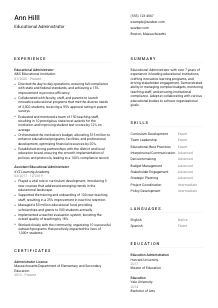
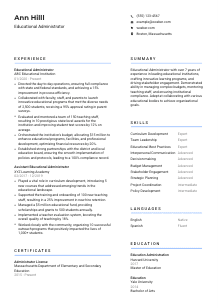
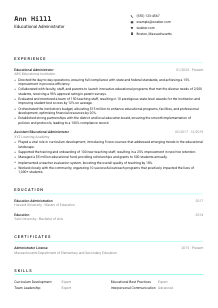
Guiding schools, but your CV feels a bit absent in class? Browse through this Educational Administrator CV example, created with Wozber free CV builder. Learn how to effortlessly outline your educational leadership to match job criteria, setting your career on a path to scholastic success!
Educational administrators are trusted with the daily health of a school or institution. Hiring teams look past broad leadership claims and look for proof that you can run compliant operations, support instructional quality, manage budgets responsibly, and work across faculty, families, and governing bodies without losing momentum.
A tailored CV makes that leadership scope visible quickly, especially when screening starts in an ATS. Wozber's free CV builder helps you align your language with the posting, organise it in an ATS-friendly CV format, and surface the mix of school operations, staff development, and policy oversight that shows you can step into the role with confidence.
School leadership starts with credibility, and that shows up even in the header. Your personal details should confirm that you are easy to contact, professionally presented, and available for the setting described in the posting.
Use your full name as the most visible text at the top of the page. Keep it simple and professional so the focus stays on your leadership background, not on styling choices.
Place "Educational Administrator" directly under your name when that is the role you are pursuing. Matching the posted title helps position your background immediately, especially if your current role uses a nearby title such as Assistant Educational Administrator or School Operations Leader.
Include a phone number and a professional email address you check regularly. Leadership hiring often moves through scheduling calls with district staff, school boards, or search committees, so accuracy matters.
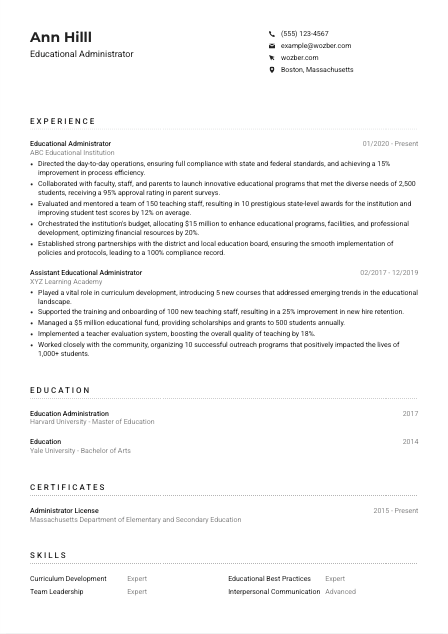
If the posting requires local availability, say so plainly. Here, listing Boston, Massachusetts supports the employer's Greater Boston area requirement and removes an avoidable question early in the review.
If you maintain a LinkedIn profile or professional page that reflects your leadership history, certifications, and institutional results, include it. Make sure it matches your CV on titles, dates, and school-related accomplishments.
This section should confirm the basics without distractions. For an educational administrator, that means professional presentation, accurate contact information, and any location detail the employer has explicitly asked for.




This is where school leadership becomes concrete. Hiring teams want to see how you have run programs, supported teaching quality, managed resources, and kept an institution aligned with policy and performance expectations.
Read the job description for the work that defines success in the role. In this case, the priorities are day-to-day operations, educational program development, teacher support, budget oversight, and liaison work with the district or local board. Those themes should shape the bullets you keep and the wording you use.
List positions in reverse chronological order and make the leadership path easy to follow. Moving from an assistant-level school leadership role into a full Educational Administrator position tells a useful story about increased scope, decision-making authority, and institutional responsibility.
Write bullets that show what changed because of your work. "Directed day-to-day operations" becomes stronger when it includes a result such as improved process efficiency, higher compliance rates, stronger parent satisfaction, or better student performance. The sample CV does this well by linking operations, mentoring, and program work to measurable outcomes.
Educational leadership is often measured through student reach, staff size, budget scale, compliance performance, retention, survey results, and academic improvement. Figures like supporting 2,500 students, mentoring 150 teachers, or managing a $15 million budget give hiring teams a much clearer sense of your scope than general claims ever will.
Prioritise experience that reflects curriculum support, instructional leadership, resource allocation, staff evaluation, community engagement, and policy execution. If a bullet does not help explain your effectiveness in running an educational institution, leave it out and use the space for a stronger example.
Your experience should show that you can lead an institution, not just work within one. By the end of this section, a hiring team should be able to see your scope, your decision-making, and the results of your leadership in school operations.
For educational administrator roles, academic background is often a formal threshold as well as a credibility marker. Present it in a way that makes your qualification level easy to confirm at a glance.
When a posting asks for a master's degree in Education Administration or a related field, make that credential highly visible. A Master of Education in Education Administration directly addresses the requirement and should appear before older degrees.
List the degree, field of study, school, and graduation year in a clean, consistent format. Hiring committees reviewing several school leaders should not have to search for the exact credential or completion date.
If your academic path directly supports school leadership, let that show. In the example, a master's in Education Administration backed by an undergraduate degree in Education creates a strong foundation for work in curriculum oversight, staff development, and institutional management.
Most experienced administrators do not need to list coursework. Include it only if it sharpens your case for a specialised role, such as experience with assessment design, instructional leadership, special education administration, or school finance that is not yet obvious elsewhere on the CV.
Honors, leadership roles, or major projects can help if they connect to education leadership, policy, research, or program design. Keep them brief and relevant, especially if you already have more than 5 years of leadership experience.
This section should quickly confirm that you meet the education requirement and have the academic grounding for institutional leadership. Clear degree alignment is especially important when a master's credential is explicitly required.
In educational leadership hiring, credentials are often operational requirements, not optional extras. If a role calls for an administrator license or state certification, this section needs to answer that requirement directly.
List your state-level Administrator license or equivalent credential first when the posting calls for it. That is one of the clearest gatekeeping requirements in this kind of search, so do not bury it beneath less relevant professional development items.
Prioritise certificates that support your work in administration, compliance, curriculum oversight, instructional leadership, or school operations. Each item should strengthen your case for leading an educational institution, not simply show general participation in training.
If the credential is active, include the issue date and present status or validity range. The sample's Massachusetts administrator license is a good example of how to show that the credential is current and usable for the role.
Additional certifications can support your candidacy when they relate to school improvement, leadership coaching, assessment systems, special populations, or policy implementation. This helps show that your administrative practice keeps pace with evolving standards and educational expectations.
For many educational administrator openings, licensure is a screening requirement before experience is even reviewed in depth. Make your active credentials easy to find and easy to understand.
Educational administration calls for a mix of instructional judgment, people leadership, and operational control. Your skills section should reflect that balance instead of reading like a generic management list.
Use the posting to identify the skills that matter most. Here, that includes curriculum development, assessment knowledge, educational best practices, communication, decision-making, and budget management. Mirroring that language helps both hiring readers and ATS screening connect your background to the role.
Choose skills that show how you run a school or educational organisation. Strong examples include team leadership, stakeholder engagement, strategic planning, policy development, staff evaluation, and resource allocation. The sample CV balances instructional and operational skills well, which is exactly the mix this role calls for.
Put the most role-critical strengths near the top and use proficiency labels only if they are consistent and believable. If you rate curriculum development or team leadership as expert, the experience section should back that up with clear examples such as launching programs, mentoring staff, or improving teaching outcomes.
This section should read like the operating toolkit of an educational leader. A hiring team should be able to scan it and immediately recognize instructional knowledge, staff leadership, and institutional management capability.
Language ability matters in school leadership because the role depends on clear communication with staff, families, district partners, and boards. Keep this section practical and tied to the communication demands of the job.
If the posting requires fluent English, list English prominently and label your level accurately. That requirement is explicit here, so do not leave it implied elsewhere on the page.
Order languages by job relevance. English should appear first for this role because it is a stated requirement and central to policy communication, staff evaluation, and family engagement.
Additional language skills can strengthen your profile when they help you communicate with multilingual families, community groups, or diverse student populations. Spanish, for example, can be valuable in many school settings, though it is an added asset rather than a universal requirement.
Choose clear labels such as Native, Fluent, Intermediate, or Basic. Leadership roles rely on high-stakes communication, so overstatement here can create problems quickly during interviews or on the job.
Extra languages matter most when they improve family engagement, community trust, or cross-cultural communication in the institution. If that has been part of your leadership work, reflect it in your experience bullets as well as in this section.
List the languages you can truly use in professional settings and make the required English fluency unmistakable. For school leadership roles, communication range can directly support stronger relationships across the community.
Your summary should frame you as an educational leader with the right combination of operational oversight, instructional understanding, and people management. Keep it focused on the kind of institution-level responsibility the role requires.
Before writing, identify the two or three themes the job cares about most. For this opening, that means leading school operations, supporting curriculum and teaching quality, and managing resources and stakeholder relationships. Let those themes guide the summary instead of writing a generic leadership statement.
A direct opening such as "Educational Administrator with over 7 years of experience" works because it quickly establishes seniority and relevance. Follow it with one or two areas of proven responsibility, such as institutional operations, staff development, or educational program leadership.
Highlight qualifications that connect closely to the employer's priorities. In the example, innovative learning programs, budget management, staff mentoring, and collaboration with educational bodies all reinforce the requirements in the job description without repeating it word for word.
Aim for three to five lines with concrete language. A school leader's summary should read with the same discipline expected in board communication or institutional reporting: clear, focused, and supported by the rest of the CV.
Your summary should give a quick, credible picture of the scale and kind of leadership you bring. By the time a reader finishes it, they should already understand why your background fits educational administration.
A well-tailored Educational Administrator CV should make four things easy to see: your leadership scope, your command of school operations, your ability to support teaching and learning, and your readiness to meet formal requirements such as graduate education and licensure.
Use Wozber's free CV builder to shape that experience into an ATS-compliant CV, refine the language with role-specific terminology, and present it in an ATS-friendly CV template that keeps your qualifications easy to review. The finished CV should leave no doubt that you can lead an educational institution with sound judgment and measurable results.




