



Use Wozber and land your dream job
Create CV
No registration required
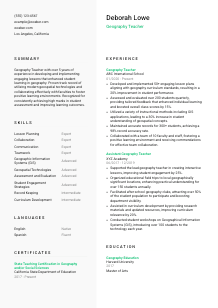
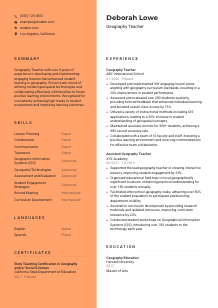
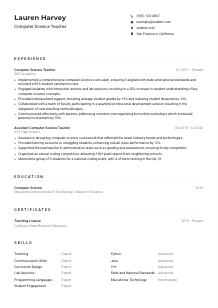
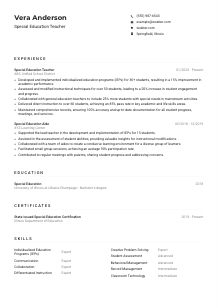
Charting terrains, but your CV seems lost? Follow this Geography Teacher CV example, created with Wozber free CV builder. It shows how to map your geographic expertise to match the job, guiding students' knowledge as accurately as their compasses!

Geography teaching is practical, not abstract. Schools want teachers who can turn maps, place, environment, and human systems into lessons students can actually grasp, whether that happens through discussion, field-based examples, data interpretation, or GIS-supported instruction. Your CV needs to show that classroom translation clearly, along with the student progress and curriculum ownership behind it.
A tailored Geography Teacher CV changes what gets noticed first. When the wording reflects the posting's priorities, such as lesson planning, assessment, geospatial tools, and faculty collaboration, Wozber's free CV builder helps you shape an ATS-compliant CV that surfaces the right teaching evidence early. That makes it easier for a school to see where you have already delivered strong instruction and measurable student outcomes.
School hiring starts with practical checks. Can they contact you quickly, do you present yourself as a Geography Teacher right away, and do basic requirements such as location line up with the role? Keep this section clean, accurate, and aligned with the posting.
Use your full name at the top in a clear, readable format. It should be the most visible text on the page so administrators can immediately connect your application, interview notes, and teaching record without confusion.
Place "Geography Teacher" directly below your name. Matching the posted title helps frame your experience correctly from the first line, especially when schools are sorting applicants across several social studies or subject-area openings.
Add a professional email address and a phone number you answer regularly. Hiring teams often move quickly when scheduling demo lessons, panel interviews, or credential follow-ups, so your contact information should remove any friction.
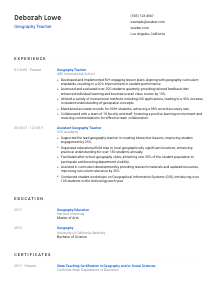
If the posting asks for a specific location or local availability, include your city and state. In the example, "Los Angeles, California" directly supports a stated requirement, which helps prevent avoidable screening questions early in the process.
Include LinkedIn or a teaching portfolio if it reinforces your classroom practice. A useful profile might show curriculum projects, field-based learning work, GIS-related instruction, or student-centered teaching materials. Skip links that do not add professional value.
Your personal details do not need personality copy. They need to confirm who you are, how to reach you, and whether you meet obvious logistics for the role before the school turns to your teaching record.




For a Geography Teacher, experience is where schools look for proof of instruction, student growth, and subject-specific teaching skill. This section should show how you plan lessons, assess learning, use geography tools, and contribute to the wider school community.
Read the job description closely and mark the responsibilities that define the role. For geography teaching, that often includes curriculum-aligned lesson planning, student assessment, record keeping, instructional variety, collaboration with faculty, and sometimes GIS or geospatial technology. Those priorities should guide which bullets you keep and how you phrase them.
Start with your most recent teaching position and work backward. For each role, include school name, title, and dates. If you held a supporting position such as Assistant Geography Teacher, keep it. It helps show progression from support, curriculum assistance, or club leadership into full classroom ownership.
Move past generic statements like "taught geography" or "supported students." Show what you implemented and what changed. The example does this well by tying lesson planning to a 20% improvement in student performance and GIS-based instruction to stronger understanding of geospatial concepts. That kind of detail is far more convincing than a task list.
Education metrics matter when they are tied to real work. Student count, assessment cycle, lesson volume, score improvement, participation rates, record accuracy, and faculty collaboration scope all help. "Assessed over 200 students quarterly" or "maintained records for 300+ students" tells a school how much responsibility you handled and how consistently you managed it.
Prioritise experience that strengthens your case as a Geography Teacher. Geography instruction, social studies teaching, GIS workshops, curriculum development, field trips, assessment design, and inclusive classroom collaboration all belong here. Less relevant work can be shortened or removed so the hiring team sees your subject expertise first.
This section should leave no doubt that you can plan standards-based instruction, track student progress, and use geography-specific methods effectively. If a principal can picture your classroom practice from these bullets, the section is doing its job.
Schools expect Geography Teachers to meet the degree baseline, but the education section can do more than clear that requirement. It can also reinforce your subject depth, your teaching preparation, and your connection to geography as an academic discipline.
List your highest or most relevant credential first, especially if it strengthens your teaching specialization. A master's in Geography Education, for example, signals focused preparation for curriculum, pedagogy, and subject instruction beyond the minimum bachelor's requirement.
For each degree, include the degree type, field of study, school name, and graduation year. Keep the structure consistent so a hiring manager can scan it quickly while checking whether your academic background aligns with geography, education, or a related field.
If the role asks for a bachelor's degree in Geography, Education, or a related discipline, your listed degree should make that connection obvious. In the example, "Bachelor of Science in Geography" answers the requirement directly, while the graduate degree adds teaching specialization.
Most experienced teachers do not need to list classes. Still, if coursework in GIS, human geography, environmental systems, curriculum design, or adolescent learning helps explain your fit, it can be worth including, especially earlier in your career.
Honors, research projects, field study, or thesis work can add value when they support your teaching profile. Keep it relevant. A geography education thesis, cartography research, or field-based geographic study says more than unrelated campus activities.
Your degrees should quickly confirm that you meet the academic requirement and understand the discipline you teach. When the field of study and the role line up cleanly, the rest of the CV gains credibility.
For teaching roles, certification is often a hiring gate, not a bonus. This section should make your licensure status easy to find and show any added credentials that strengthen your value in geography instruction.
Look for the certifications the posting names directly and place those first. For many Geography Teacher openings, state teaching certification or licensure in Geography, Social Sciences, or a related area will be essential. If you hold it, make it visible immediately.
List certificates that support classroom eligibility or subject-specific expertise. A state teaching credential belongs here. So can a GIS-related professional certification if the role mentions geospatial technology. Avoid filling the section with unrelated workshops or expired short courses.
If a certification is current, renewable, or tied to active standing, include the dates. That helps schools understand whether your credential is valid now. In the example, the ongoing state certification and GISP dates do that cleanly.
Additional credentials can strengthen your profile when they connect to the classroom. GIS, curriculum design, technology integration, or subject-area professional development can all help if they support how you teach geography and not just what you studied.
A school should be able to scan this section and know whether you are licensed, current, and professionally active in the areas the role values. Put the essentials first and keep the section tightly relevant.
A Geography Teacher skills section should read like a classroom and curriculum profile, not a generic list of traits. Include the teaching abilities, subject tools, and student-learning skills that matter in geography instruction.
Start with the abilities named or clearly implied in the posting. For this profession, that often includes lesson planning, assessment, classroom communication, collaboration, curriculum development, GIS, and geospatial technologies. These are stronger than broad filler terms because they connect directly to daily school practice.
Choose skills that affect instruction and outcomes first. Geography-specific tools like GIS should sit alongside teaching skills such as student engagement strategies, assessment and evaluation, and standards-aligned planning. In the example, that mix makes the profile feel credible for both subject knowledge and classroom delivery.
Group related skills where possible. Technical items such as GIS and geospatial technologies can sit near one another, while communication, teamwork, and collaboration can form a separate teaching-practice cluster. A tidy structure helps both ATS parsing and human review.
If a skill does not help explain how you teach geography, support students, or work within a school team, it probably does not belong. The best lists make your teaching profile clearer in seconds.
Language ability can matter in schools for instruction, family communication, and classroom inclusion. For Geography Teachers, it is especially useful when it supports clearer explanation of complex topics and stronger connections with a diverse student community.
If the posting names a language requirement, list it first with an accurate proficiency level. Here, strong English use is essential, so English should be clearly presented in a way that confirms you can teach, assess, write feedback, and communicate professionally.
Place English at the top if it is the required language for instruction. Label it honestly, such as "Native" or "Fluent," based on your actual ability to teach, write reports, and communicate with students, families, and staff.
Additional languages can strengthen your profile, especially in multilingual communities. Spanish, for instance, may be useful for student support or family engagement in some schools, but it should remain an added value rather than a substitute for the required classroom language.
Choose simple, standard labels like Native, Fluent, Intermediate, or Basic. Schools need an honest sense of whether you can teach in the language, hold parent conversations, or simply provide limited support when needed.
If a second language has practical relevance, let it support your teaching profile. In geography classes, multilingual ability can help when discussing place, culture, migration, and global perspectives, especially with students from varied backgrounds.
This section works best when it clarifies how you communicate in the school environment. Lead with the required language, add useful extras, and keep proficiency levels accurate.
The summary is your opening teaching profile. It should quickly tell a school how long you have taught, what kind of geography instruction you deliver, and which results or strengths make you worth interviewing.
Before writing, pull out the two or three themes the school cares about most. For a Geography Teacher, that may be standards-based lesson planning, student assessment, GIS integration, or collaborative work with faculty. Those themes should shape the summary instead of a generic statement about being passionate about education.
Start with a direct line such as your title and years of experience. "Geography Teacher with 5+ years of experience" works because it immediately places you in the right subject area and gives the reader a sense of classroom depth.
Use the next sentence or two to show how you teach and what results followed. The example summary works because it mentions engaging lessons, modern geospatial technologies, collaboration with faculty, and improved learning outcomes. Those details make the profile feel grounded in school practice.
Aim for a short paragraph that can be read in a few seconds. Focus on what a principal or department head needs to know first: your teaching background, your geography-specific capability, and your impact on student learning. Save finer detail for the experience section.
Your summary should position you as someone who can teach the subject well, manage the classroom responsibly, and contribute to student progress from day one. If it sounds specific to geography instruction, it is working.
A Geography Teacher CV should show more than subject interest. It should show classroom ownership, standards-aligned lesson planning, student assessment, geospatial teaching tools where relevant, and steady collaboration with the wider school team.
Use Wozber's free CV builder to organise that experience into an ATS-friendly CV format, strengthen wording with role-specific terminology, and check alignment with an ATS CV scanner. The final result should make it easy for a school to see that you can step into the classroom and teach geography with confidence and structure.