



Use Wozber and land your dream job
Create CV
No registration required
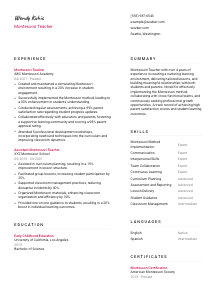
Guiding little minds, but your CV doesn't pass the test? Check out this Montessori Teacher CV example, created with Wozber free CV builder. Learn how to align your child-centered approach with job requirements, creating a career narrative as engaging as circle time stories!
Montessori teaching is closely observed work. Schools look past warm language and want to see how you prepare the environment, guide children without over-directing them, track development, and communicate progress with families. Your CV should make that daily practice visible, not just say you are passionate about child-centered learning.
When a Montessori CV is tailored well, the hiring team can quickly separate general early childhood experience from real Montessori classroom work. Using Wozber's free CV builder helps you align your wording with the posting, keep an ATS-friendly CV format, and surface the details that matter first, such as prepared environment experience, individualized lessons, parent reporting, and Montessori training.
This section is brief, but it still carries practical hiring information. For Montessori schools, clear contact details, a precise title, and the right location cues remove friction and keep the focus on your classroom experience, certification, and communication with families.
Place your full name at the top in a clean, readable format. School leaders often move quickly between CVs, interview notes, and teaching references, so your name should be immediately visible and easy to match across documents.
Add "Montessori Teacher" directly under your name when that matches your background and the role you are applying for. This helps frame your experience around Montessori classroom leadership rather than broader early childhood support work or assistant positions.
List a current phone number and a professional email address, ideally one built around your name. Montessori hiring often includes follow-up conversations about classroom fit, lesson planning style, or parent communication, so accuracy here matters more than decoration.
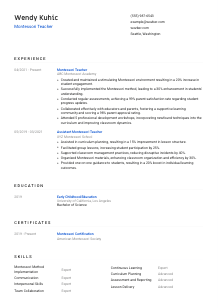
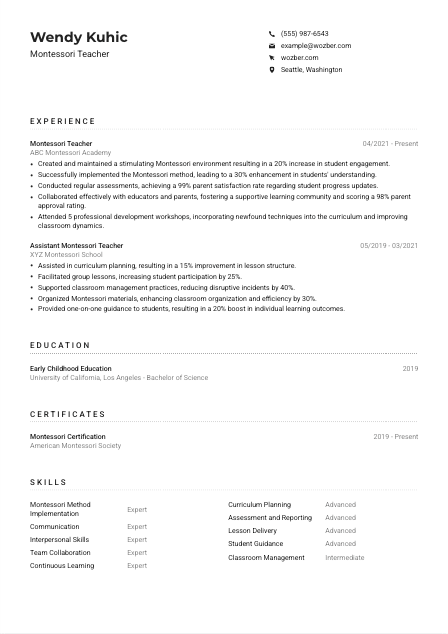
If the school wants someone based in a specific area, state your city and state clearly. In the example, "Seattle, Washington" directly addresses a stated requirement and saves the school from guessing about relocation or commuting logistics.
A LinkedIn profile, teaching portfolio, or school-facing website can strengthen this section if it shows classroom philosophy, professional development, or examples of educational work. Keep it relevant. A link is useful when it supports your Montessori practice, not when it sends readers to unrelated content.
This section should answer basic logistics in seconds so the school can move straight to your prepared environment experience, Montessori training, and work with children and parents.




For Montessori roles, experience needs to show more than time served in a classroom. Hiring teams want to see how you shaped the environment, guided mixed needs, documented development, and collaborated with families and colleagues. Your bullets should sound like real classroom practice with outcomes attached.
Put your most relevant teaching roles first and make the Montessori setting unmistakable. If the posting asks for at least 2 years in a Montessori environment, highlight positions where you prepared materials, delivered individualized lessons, and supported child-led learning rather than only general childcare duties.
For each job, include your title, school name, and dates. Start with the most recent position. This gives directors and principals a fast read on your progression from assistant or support roles into fuller classroom responsibility.
Focus each bullet on a concrete part of the work: maintaining the prepared environment, planning lessons for different developmental stages, recording progress, or building parent trust. The example does this well by linking classroom actions to results such as stronger student engagement and high parent satisfaction.
Numbers work well when they reflect classroom realities. Use metrics tied to engagement, participation, learning outcomes, parent feedback, classroom organisation, or reduced behaviour issues. For instance, a bullet about a 20% increase in student engagement or a 99% parent satisfaction rate is much stronger than saying you "supported student growth" without context.
Trim bullets that do not support Montessori teaching. Keep the work that shows curriculum implementation, observation-based assessment, family communication, and collaboration with other educators. If you have projects outside a classroom setting, include them only when they clearly connect to child development, independence, hands-on learning, or community-building in a Montessori environment.
A strong experience section lets a school picture you managing a prepared environment, guiding lessons with intention, and communicating progress with families.
Montessori schools usually expect a clear academic base in early childhood education or a related field. Your education section should confirm that foundation quickly, then add any details that strengthen your understanding of child development, classroom practice, or learner-centered teaching.
If you hold a bachelor's degree in Early Childhood Education or a related field, make it easy to spot. That requirement is explicitly listed in the job description, so your degree should not be buried under extra detail.
List your degree, field of study, school name, and graduation year. A straightforward structure helps hiring teams scan qualifications quickly, especially when they are comparing certification, teaching experience, and educational background side by side.
When your degree is closely connected to early childhood education, call that out through the field name itself. In the example, a Bachelor of Science in Early Childhood Education clearly supports the classroom responsibilities in the posting without needing extra explanation.
Relevant coursework can help if you are earlier in your career or if your degree title is broader than the role. Include classes that connect to observation, developmental stages, classroom management, curriculum design, or child-centered learning only if they add information not already obvious from your degree.
Honors, projects, or student teaching details are worth adding when they reinforce your readiness for Montessori work. A project on individualized learning plans or a practicum in early childhood classrooms is useful. Generic campus activities are not.
This section should show that your teaching practice rests on formal study in early childhood learning, with any extra detail chosen for its relevance to Montessori classroom work.
In Montessori hiring, certification is often a deciding qualification rather than a nice extra. This section should show recognized Montessori training first, then any supporting credentials that matter in a school setting, such as safety or child care compliance.
If the role requires Montessori certification from a recognized training centre, list it at the top of this section. That is one of the clearest indicators that your classroom approach is grounded in Montessori practice rather than only general early childhood methods.
Prioritise certifications that relate directly to teaching, child safety, classroom care, or developmental support. A shorter list with strong relevance is more effective than a long list of loosely connected training.
Show the year earned and, when relevant, whether a credential is active. This helps schools understand whether your training is current. In the example, ongoing dates for Montessori certification and CPR and First Aid reinforce both specialization and classroom readiness.
Montessori schools often value teachers who stay current with pedagogy, observation methods, and classroom practice. If you have recent workshops, advanced Montessori training, or related child development certifications, include them when they sharpen your profile for the role.
Your certifications section should quickly confirm Montessori training, then support it with current credentials that matter in a classroom and family-facing school environment.
A Montessori skills section should read like a practical teaching toolkit. Schools are looking for method knowledge, observation, lesson planning, record keeping, and parent communication, not a generic list of soft skills with no classroom context.
Start with the language used in the job description. Here, that includes implementing the Montessori method and curriculum, planning individualized and group lessons, conducting assessments, maintaining records, and collaborating with parents and staff. Those phrases point you toward the exact skills to surface.
Combine Montessori-specific strengths with the day-to-day skills that make a classroom run well. Skills like Montessori method implementation, curriculum planning, assessment and reporting, classroom management, communication, and team collaboration work well together because they reflect both pedagogy and execution.
Do not overload this section. Choose the skills that best support your experience and certification, then present them in a clean format. The example works because the skills connect directly to the job's teaching, reporting, and collaboration responsibilities rather than drifting into vague descriptors.
By the end of this section, the school should have a clear picture of how you run a Montessori classroom, support child development, and communicate with families and colleagues.
Language ability matters in Montessori settings because teachers explain observations, guide children clearly, and communicate progress with families. This section should confirm required proficiency first, then show any added language capability that could support an inclusive school community.
If the role requires English competency, place English at the top with an accurate proficiency level. That makes it easy for the school to confirm you can teach, document progress, and communicate with parents in the language expected for the role.
Additional languages can be valuable, especially in diverse communities or family-facing environments. In the example, Spanish is a useful secondary skill because it may help with parent communication or create stronger connections with multilingual students and caregivers, even when it is not a formal requirement.
Use honest labels such as native, fluent, advanced, intermediate, or basic. Schools need a realistic sense of whether you can lead instruction, hold parent conversations, or simply offer limited support in another language.
For Montessori educators, language skills are most useful when they improve communication, inclusion, and trust. Keep the focus there. A second language matters because it can support children and families more effectively, not because it makes the CV look more impressive.
This section should confirm you can handle classroom instruction and family communication, while also showing any added language range that supports an inclusive learning environment.
Your summary should quickly establish that you understand Montessori classroom work and can deliver it consistently. Use a few lines to connect your years of experience, core strengths, and strongest outcomes without repeating every detail from the rest of the CV.
Before writing, identify the main needs in the posting. For a Montessori teacher, that usually means certified Montessori practice, classroom experience, individualized lesson delivery, assessment and reporting, and strong parent collaboration. Let those priorities shape what you mention first.
Begin with a direct line that names your role and years of experience. A phrase like "Montessori Teacher with 4+ years of experience" works because it gives the reader immediate context and aligns with the requirement for prior Montessori teaching experience.
Choose highlights that connect to the role's core work. You might mention building a prepared learning environment, improving student engagement, delivering individualized lessons, or maintaining strong parent communication. The example summary is effective because it pairs Montessori method implementation with measurable parent satisfaction and student outcomes.
Aim for a short paragraph, not a biography. Every sentence should add something concrete about your classroom practice, training, or results. If a line could apply to any teacher in any setting, revise it until it sounds clearly Montessori-specific.
Your summary should leave no doubt that you can step into a Montessori classroom, maintain the environment with intention, and communicate student progress with confidence.
Your CV should now show the work behind the title: a prepared environment, observation-based teaching, clear records, and trusted communication with families and colleagues.
Use Wozber's free CV builder to organise that experience into an ATS-compliant CV, and refine it with the ATS CV scanner so the language matches the school's priorities without sounding forced.
That gives hiring teams a clearer read on whether you are ready to lead learning in a Montessori classroom from day one.