



Use Wozber and land your dream job
Create CV
No registration required
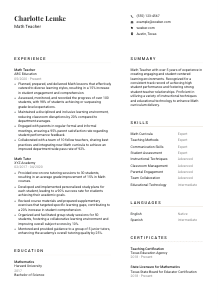
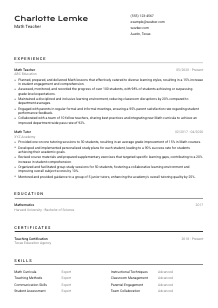
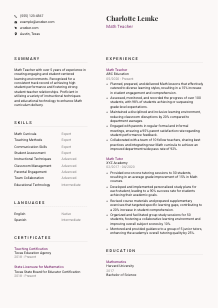
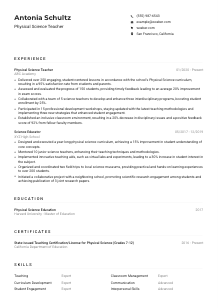
Simplifying equations, but your CV feels complex? Check out this Math Teacher CV example, created with Wozber free CV builder. Learn how to match your numerical knack with job criteria, ensuring your teaching journey is as logical as an elegant proof!
Math teaching CVs are read through the lens of classroom practice. Schools want to see how you turn curriculum standards into lessons students can follow, how you track progress across a full roster, and how you manage a room where different skill levels and learning styles show up in the same period. Your CV should make that teaching range visible, not just list that you taught math.
When the CV mirrors the posting's language around lesson planning, assessment, classroom management, and parent communication, the hiring team can quickly connect your background to their schedule, student needs, and reporting expectations. Wozber's free CV builder helps shape that into an ATS-compliant CV with clearer role-specific wording, so your application reads like someone ready to teach this math assignment from day one.
School hiring moves quickly, and the top of the CV should answer practical questions without effort. For a Math Teacher, that means showing the exact role you want, professional contact details, and any location detail the posting specifically requires.
Use your full name in a larger, clean font so it anchors the CV immediately. This is a simple formatting move, but it matters when principals or department leads are scanning a stack of applications between classes, lesson planning, and student meetings.
Place "Math Teacher" directly under your name if that is the role you are pursuing. Matching the posted title helps both ATS filters and human reviewers sort you into the right candidate pool right away, especially when schools are hiring across several subject areas at once.
List a phone number you answer, a professional email address, and check both carefully for errors. In teaching searches, interview scheduling often happens fast, and a typo in your contact line can cost you a classroom visit or demo lesson.
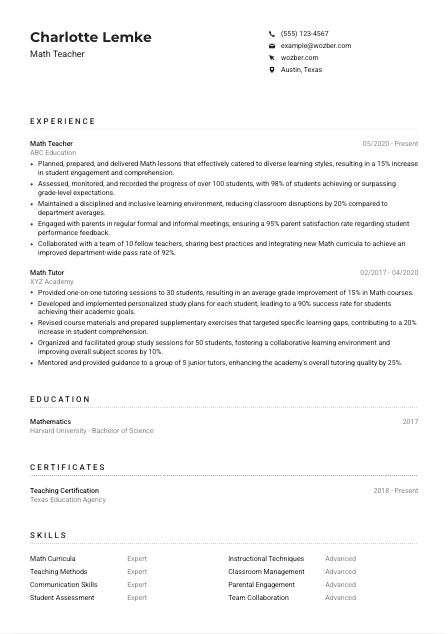
If the school requires local availability or relocation, show that clearly in your personal details. In the example, listing Austin, Texas directly supports the stated requirement and removes a common point of uncertainty before the school invests time in screening.
A LinkedIn profile or professional website can strengthen this section when it reflects your current teaching record, certifications, or curriculum work. Keep it current and aligned with the CV so it supports your classroom experience rather than creating inconsistencies.
This section should confirm that you are easy to contact, correctly aligned to the teaching opening, and available for the school's stated location needs. That gives the hiring team a clean start before they review your instructional background.




For Math Teachers, experience carries most of the hiring weight because it reveals what happens in your classroom. Schools look for proof that you can plan instruction, improve student understanding, manage behaviour, communicate with families, and work within a grade-level or department team.
Start by identifying the teaching work the school actually needs covered. In this description, the priorities include planning math lessons, adapting instruction, assessing progress, maintaining classroom discipline, collaborating with colleagues, and speaking with parents or guardians. Your bullets should map to those responsibilities in direct language.
List your positions in reverse chronological order and include job title, school or organisation, and dates. For educators, that timeline helps reviewers understand your progression from support or tutoring work into full classroom responsibility, grade-level ownership, or broader departmental contribution.
Math teaching impact is easier to trust when you include numbers tied to student learning or classroom performance. That might mean grade-level attainment, pass rates, parent satisfaction, student growth, intervention results, or reduced behaviour incidents. In the sample CV, outcomes like 98% of students meeting or exceeding expectations and a 20% drop in disruptions give real shape to the candidate's classroom results.
Revise accomplishment bullets so they reflect the language of the job description without copying it blindly. A bullet such as "Planned, prepared, and delivered Math lessons that effectively catered to diverse learning styles" works well because it echoes the school's needs while adding a measurable result. That combination reads well in both ATS screening and principal review.
Keep the focus on work that supports your ability to teach mathematics, manage learners, and contribute to school outcomes. Tutoring, intervention, curriculum support, or mentoring junior educators can all help when framed around instruction and results. Leave out unrelated material unless it adds something directly relevant to student learning or school life.
Your experience section should leave no doubt that you can handle instruction, assessment, behaviour, and communication in a real school setting. When those points are backed by metrics and concrete classroom actions, your background becomes much easier to shortlist.
Math teaching roles usually start with a straightforward academic requirement. The school needs to see that your degree supports subject competence and aligns with certification or licensure expectations for teaching mathematics.
If the posting requires a Bachelor's degree in Mathematics or a related field, make sure that credential is easy to find. For this role, a Bachelor of Science in Mathematics is a direct match and should appear clearly in the education section.
List degree, field of study, institution, and graduation year in a consistent order. Hiring teams are usually checking this section quickly to confirm subject alignment, so clarity matters more than decoration.
When your degree directly supports the subject you teach, name it plainly. "Bachelor of Science in Mathematics" does more work here than a vague or shortened version because it reinforces content knowledge in the exact discipline the school is hiring for.
Most experienced teachers do not need a long course list. Include relevant coursework if you are early in your career, changing into a math teaching track, or applying to a role where specific areas such as statistics, algebra, or secondary math methods strengthen your case.
Honors, math competitions, research projects, or leadership in education or STEM organizations can be useful additions when they reinforce subject commitment or instructional depth. Keep them brief and relevant so the section stays focused on your readiness to teach math well.
This section does not need much space, but it does need to remove doubt. A clearly listed math-related degree helps the school confirm that your subject background supports the classroom responsibilities ahead.
For teachers, certifications are not a decorative extra. They are often a screening checkpoint, especially when a school needs someone who can legally and immediately step into a mathematics classroom.
Put teaching certification and any mathematics licensure front and centre when the posting requires them. In the example, both a Teaching Certification and State Licensure for Mathematics speak directly to the school's baseline requirement.
Keep this section focused on licenses and certifications that matter for math instruction, grade level, or classroom delivery. General training certificates are fine to mention elsewhere only if they clearly support the role, such as special education, ESL, or instructional technology credentials relevant to your target school.
Show whether the credential is current by including dates, renewal periods, or present status where appropriate. That saves the school from guessing whether your license is active and ready for use in the hiring cycle.
Professional development matters in teaching, especially when it improves curriculum delivery, assessment practice, or educational technology use. Update this section as you add new endorsements or role-relevant certifications that reflect how classrooms and standards evolve.
Schools should be able to confirm your certification standing in seconds. A focused, current certifications section helps your CV clear one of the most practical filters in teacher hiring.
The skills section works best when it reflects how math teaching is actually done. That includes subject knowledge, instructional method, assessment practice, classroom management, and the communication skills needed to work with students, families, and colleagues.
Use the job description to identify the exact skills the school values. Here, that includes math curricula, instructional techniques, educational technology, communication, and adapting lessons for different learning styles. If you genuinely have those strengths, mirror that language so your CV connects cleanly to the role.
Prioritise skills tied to lesson delivery and student outcomes over broad descriptors. Math curriculum knowledge, student assessment, classroom management, parent communication, intervention planning, and team collaboration all tell a school more than generic labels such as "hardworking" or "organised."
Place the most important classroom skills near the top. For this opening, math instruction, assessment, teaching methods, and classroom management deserve stronger placement than less central skills. The sample's mix of Math Curricula, Teaching Methods, Student Assessment, and Classroom Management is a solid example of that prioritization.
This section should reinforce the teaching story your experience already tells. When the skills line up with lesson planning, student progress, and classroom execution, the CV reads as one coherent profile rather than a list of disconnected strengths.
Language matters in teaching because instruction, feedback, family communication, and classroom culture all depend on it. For a Math Teacher, this section should confirm required proficiency first and then note any additional languages that may support student and parent engagement.
If the job description calls for advanced English, list English clearly and use an accurate proficiency label such as native or fluent. That tells the school you can teach content, explain problem-solving steps, write progress comments, and handle family communication in the language required for the role.
Lead with the language the school specifically requested, then list others afterward. This keeps the section aligned with hiring priorities and prevents the main requirement from getting buried.
Additional languages can strengthen your profile when they help you connect with multilingual students or families. Spanish, for example, may be useful in some school communities, but it should be presented as an added asset rather than a universal requirement for every Math Teacher role.
Use honest levels such as native, fluent, intermediate, or basic. In a school environment, language ability shows up quickly in parent meetings, classroom explanations, written reports, and team collaboration, so precision matters.
If you speak more than one language, think about where it genuinely helps: parent conferences, student support, bilingual school communities, or clearer relationship-building across families. That is the context hiring teams care about, not the language label by itself.
This section should confirm that you can handle instruction and communication requirements for the role, then show any added language ability that could support student understanding or family engagement.
A Math Teacher summary should quickly establish your classroom level, subject strength, and teaching results. The best ones sound grounded in practice, with a few specifics that prepare the reader for the experience section instead of repeating it line by line.
Before writing the summary, pull out the few themes the school stresses most. In this case, that includes math instruction, adapting to different learning styles, assessment and reporting, educational technology, and communication. Those themes should shape the summary's language.
Start with a direct line that states who you are and how long you have been teaching or supporting math learners. The sample summary begins with "Math Teacher with over 5 years of experience," which works because it immediately establishes subject area and tenure.
Choose strengths that match the posting and reflect real classroom work. Good options here include student-centered math instruction, progress monitoring, differentiated teaching, classroom management, or effective use of educational technology. Keep the wording specific enough to sound credible.
Aim for a compact paragraph of 3 to 5 lines. You can mention strong student performance or engagement if those outcomes are supported elsewhere in the CV, but do not overload the section. The summary should give the school a clear snapshot of the kind of math teacher you are before they move into your detailed experience.
A well-written summary should make the reader expect strong classroom experience, relevant credentials, and measurable student results. When it does that, the rest of the CV has a clear direction from the first few lines.
Your Math Teacher CV should now present a clear picture of how you teach, how you measure learning, and how you contribute to a stable, inclusive classroom. That is the combination schools need when they are hiring someone to take ownership of student progress.
Wozber's free CV builder, ATS-friendly CV template, and ATS optimisation tools can help you tighten wording, match school-facing terminology, and keep the document easy to scan in both ATS and human review. The final result should make it easy to see that you are prepared to step into the math classroom and teach effectively.




