



Use Wozber and land your dream job
Create CV
No registration required
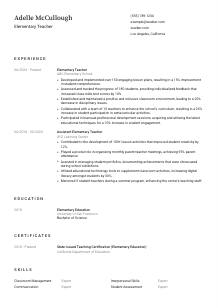
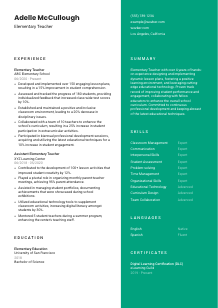
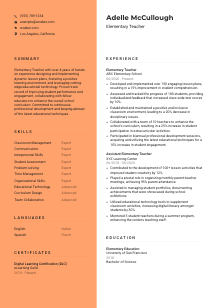
Nurturing young minds, but your CV feels like detention? Check out this Elementary Teacher CV example, created with Wozber free CV builder. It shows how to present your educational magic in line with job expectations, paving the way for a career as bright as a gold star!
Elementary teaching asks for far more than subject knowledge. Schools look for teachers who can turn standards into age-appropriate lessons, keep a classroom steady and inclusive, track student growth, and communicate clearly with families and colleagues. Your CV needs to make that classroom practice visible, especially how you plan instruction, manage behaviour, and help students progress.
A tailored CV changes how quickly a school can place you within its hiring needs. When your language reflects the posting's priorities, such as lesson planning, student assessment, classroom management, and educational technology, an administrator or screening system can immediately connect your background to day-to-day teaching demands. Wozber's free CV builder helps organise that alignment in an ATS-friendly CV format, so your experience reads clearly for both software and school leaders reviewing whether you can step into the classroom with confidence.
School hiring teams need clean, reliable contact details first. For an Elementary Teacher, this section should confirm who you are, what role you are targeting, and whether any practical requirement, such as location in the example posting, is already covered.
Place your name at the top in a clear, readable format. Keep it slightly more prominent than the rest of the header so a principal or HR reviewer can identify your application quickly when scanning a stack of teaching CVs.
Add "Elementary Teacher" directly under your name if that is the role you are pursuing. Matching the posted title helps frame your experience around classroom instruction, student support, and curriculum delivery from the first line.
List only the essentials so school staff can reach you without friction.
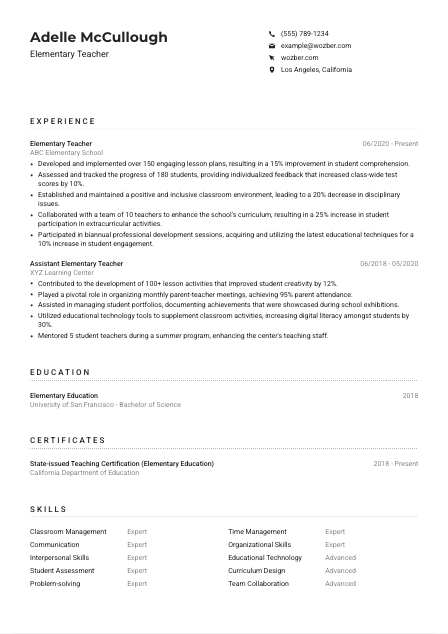
If a school specifies a city or state, include it clearly in this section. In the example, listing Los Angeles, California immediately addresses the local requirement and removes uncertainty about availability.
A LinkedIn profile, teaching portfolio, or classroom resource site can support your application if it shows lesson planning, student work frameworks, technology use, or professional development. Skip it if it is outdated or thin.
Your header should answer the practical questions fast: who you are, what role you want, and how the school can contact you. For teaching roles, that early clarity keeps the focus on your classroom experience instead of missing basics.




This is the section school leaders study most closely. They are looking for evidence that you can run a classroom, deliver instruction against standards, monitor student progress, work with families, and contribute to the wider school community.
Start with the responsibilities named in the posting, then map your experience to them. For elementary roles, that usually means lesson planning, assessment, classroom management, parent communication, collaboration, and educational technology. In the example CV, those priorities show up directly through lesson-plan volume, tracked student progress, and curriculum teamwork.
List positions in reverse chronological order with school name, job title, and dates. That structure helps a reviewer see your progression from support or assistant roles into full classroom responsibility, which matters in K-5 hiring.
Avoid bullets that only restate routine responsibilities. Show what your teaching changed. "Developed and implemented over 150 engaging lesson plans, resulting in a 15% improvement in student comprehension" works because it ties planning to a measurable learning result rather than stopping at the task itself.
Numbers carry weight when they reflect real school outcomes. Include student count, score improvement, engagement gains, reduced disciplinary issues, parent meeting attendance, curriculum contributions, or growth in digital literacy when you can support them. The sample does this well with metrics tied to comprehension, test scores, discipline, and participation.
Prioritise experience that proves you can teach in an elementary setting. If you include adjacent work, frame it through transferable classroom outcomes such as small-group instruction, family communication, behaviour support, or student assessment. Every bullet should strengthen your case for leading learning in an elementary classroom.
By the end of this section, a hiring team should be able to picture you planning lessons, managing a classroom, tracking progress, and working well with staff and families. That is the level of detail that moves a teacher CV forward.
For teachers, education is not a background detail. It confirms that you trained for child development, instructional methods, and curriculum delivery in the age group you want to teach.
If the posting requires a bachelor's degree in Elementary Education or a related field, place that degree clearly and use the exact field name where possible. In the example, "Bachelor of Science in Elementary Education" aligns directly with the stated requirement.
List your degree, school, field of study, and graduation year in a format that is easy to read. Hiring teams do not need extra decoration here. They need to confirm your academic qualification quickly.
If your degree title is close to the posting language, reflect that accurately. Elementary Education, Early Childhood Education with elementary emphasis, or a related teaching field can all work, as long as the wording is truthful and clearly relevant to classroom instruction.
Relevant coursework or academic projects can help if you are early in your career or if the job emphasizes a specific area such as literacy instruction, special education inclusion, or digital learning tools. Keep these additions selective and directly tied to the classroom demands of the role.
Academic honors, distinction awards, or notable capstone work are worth including if they reinforce your preparation as an educator. A reading intervention project or child development research topic adds more value here than a generic campus activity.
This section should quickly show that your academic background supports elementary teaching, not just general study. When the degree and field line up cleanly, schools can move on to your classroom results and certification status.
Certification matters in education because it affects eligibility, compliance, and classroom placement. This section should make your teaching authorization easy to find and show any added training that supports current classroom practice.
Lead with your state-issued teaching certification for Elementary Education when the role requires it. That credential answers one of the school's first screening questions and should never be buried under optional courses or workshop badges.
Beyond licensure, include certifications that relate to instruction, digital learning, classroom technology, literacy, behaviour support, or student needs you are qualified to address. In the example, a digital learning certification adds relevant depth because the posting mentions educational technology.
If the credential is active, renewable, or currently valid, make that visible. Dates help schools understand whether your certification is current and ready for immediate use in the classroom.
Ongoing professional development matters in elementary education because teaching methods, curriculum expectations, and classroom technology keep evolving. Add recent certifications when they reflect real growth in how you teach, assess, or support students.
A school should be able to confirm your legal teaching qualification and see your continued professional development at a glance. That combination supports both eligibility and classroom credibility.
A teaching skills section works best when it mirrors what happens in the classroom. Schools want to see the practical mix of instructional, behavioral, interpersonal, and technology skills that support student learning every day.
Start with the language in the job description, then keep only the skills you can back up elsewhere in your CV. For an elementary teacher, that often includes classroom management, lesson planning, student assessment, parent communication, collaboration, and educational technology. The example skill list reflects this approach well.
Do not fill the section with only soft skills or only tools. Elementary teaching depends on both. Pair classroom skills such as curriculum design or assessment with interpersonal strengths such as communication, relationship-building, and teamwork with colleagues and families.
Put the most role-critical skills first, especially those named in the posting. If educational technology is a priority, move it higher. If behaviour support and classroom management are central to the role, make sure they are near the top rather than buried among generic traits.
Your skills should reinforce the story told in your experience section. When the same themes appear across both sections, schools get a clearer picture of how you teach, manage, and support learning.
In elementary education, language proficiency affects far more than conversation. It shapes instruction, student support, parent communication, documentation, and collaboration across the school day.
If the job requires English mastery, list your level plainly. For teaching roles, this speaks to instruction delivery, written feedback, reporting, and communication with families and staff. The example handles this directly by listing English as Native.
Additional languages can be a real advantage, especially in districts where family communication and student support benefit from bilingual ability. Spanish, for example, may strengthen your ability to connect with parents, explain progress, or support multilingual learners, even when it is not a formal requirement.
Choose clear levels such as Native, Fluent, Conversational, or Basic. Schools may rely on this information when considering parent communication, classroom support, or committee work, so accuracy matters.
Only include languages you can use meaningfully in a school setting. If your proficiency helps with parent conferences, behaviour support, or student rapport, that is worth showing. If not, it does not need space on the page.
A second language is most valuable when it improves access and inclusion. Frame it as part of how you teach and communicate, not as a cultural extra detached from school responsibilities.
This section works best when it clarifies how you communicate in the classroom and with families. For elementary roles, that can be a practical hiring advantage, especially in diverse school communities.
Your summary should read like a compact teaching profile, not a generic objective statement. In a few lines, it needs to establish your experience level, the age group or school setting you know best, and the classroom results you consistently deliver.
Pull in the themes that drive selection for elementary teachers: standards-aligned lesson planning, student growth, classroom culture, family communication, collaboration, and comfort with educational technology. Use the posting to decide which of these deserves the most space.
Start with a direct statement of who you are professionally. "Elementary Teacher with over 4 years of hands-on experience" works because it establishes role and tenure immediately, which helps schools place your background fast.
Mention the kinds of results you produce, not just personal qualities. Improved student performance, stronger engagement, positive classroom environments, or effective use of digital tools all belong here when they are supported by the experience section. The sample summary does this by linking lesson planning, learning environment, technology use, and student outcomes.
Aim for a short paragraph that an administrator can absorb quickly before moving into your work history. Three to five lines is usually enough to present your teaching profile without repeating every bullet that appears later.
A well-written summary gives schools an immediate sense of your classroom style, experience, and strengths. From there, the rest of the CV should confirm that picture with specific teaching results.
A tailored Elementary Teacher CV should now show the essentials clearly: the right degree and certification, classroom experience in an elementary setting, measurable student outcomes, educational technology use, and communication strengths that matter in a school community.
Use Wozber to tighten that alignment, improve ATS optimisation, and present everything in an ATS-compliant CV that is easy for both screening systems and school leaders to read. The final result should make one thing clear right away: you can step into the classroom and teach effectively.




