



Use Wozber and land your dream job
Create CV
No registration required
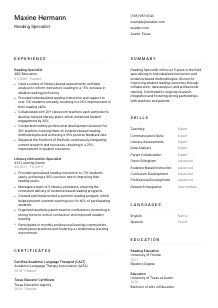
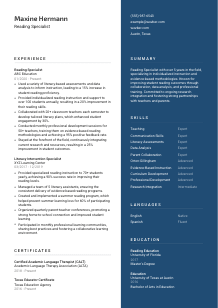
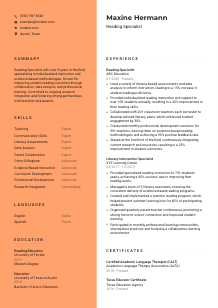
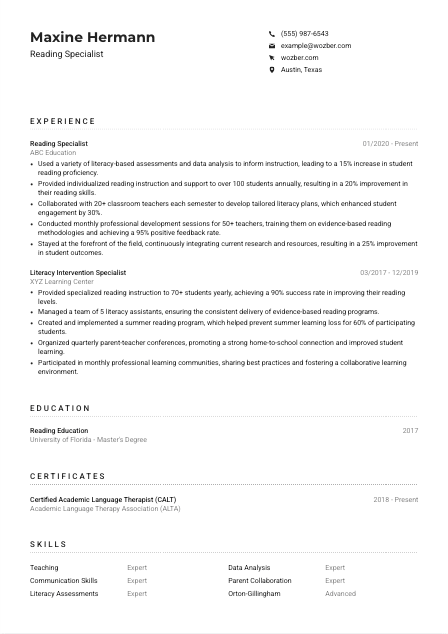
Working with dynamic curricula, but your CV doesn't turn the page? Check out this Reading Specialist CV example, created with Wozber free CV builder. It shows how to match your literary expertise with job specifics, ensuring your career narrative resonates as powerfully as a favorite story!
Reading Specialist work is measured in student growth, not broad claims about loving literacy. Schools want to see how you diagnose reading difficulties, choose interventions that match the learner, and move students forward through structured instruction, progress monitoring, and close coordination with classroom teachers. Your CV should make that instructional judgment visible from the start.
When that work is tailored clearly, a school can quickly tell whether your background is rooted in actual literacy intervention or general classroom teaching. Wozber's free CV builder helps shape an ATS-compliant CV around the language of the posting, so terms like reading assessments, intervention, and evidence-based methodology are easy to track back to real student outcomes and teacher support.
For school roles, the header is practical. It should tell a hiring team who you are, what role you do, and whether they can contact and place you without extra follow-up.
Use your full name in a larger, clean font so it is easy to spot at the top of the page. In education hiring, this section should look steady and professional, matching the tone of the rest of a CV that will likely be reviewed by principals, district staff, or instructional leaders.
Place "Reading Specialist" directly under your name when that is the role you are applying for. Matching the posted title helps frame the rest of your CV around literacy intervention, assessment, and teacher collaboration instead of leaving your background to be interpreted as general teaching support.
List a current phone number and a professional email address. Add a LinkedIn profile or professional website only if it supports your application with relevant teaching, literacy, or professional development credentials. Every contact detail should help a school reach you quickly, not add noise.
If the role requires local availability, state your city and state clearly. In the example, "Austin, Texas" addresses a stated requirement right away and removes an avoidable question about eligibility or commute. Treat that as a tailoring move for this opening, not a universal rule for every Reading Specialist CV.
Do not include age, marital status, gender, or other personal details that do not support your ability to run assessments, deliver targeted reading instruction, or work with families and staff. Keep the header focused on professional identity and logistics.
A clean header does its job fast. It confirms your role, your contact path, and any location requirement so the reader can move straight to your literacy experience.




This is the section that carries the most weight for a Reading Specialist. Schools want to see what kinds of learners you supported, how you assessed needs, which interventions you used, and what changed because of your instruction.
Before writing bullets, mark the responsibilities that define the role. Here, that includes individualized instruction, small-group support, literacy assessments, progress monitoring, intervention adjustments, collaboration with teachers and parents, and professional development for staff. Your experience section should respond to those areas directly.
Start with your most recent literacy or teaching role and work backward. Include your title, school or organisation name, and dates. This format makes it easier to see whether you meet expectations like 3+ years of teaching experience and whether your work has moved toward more specialised reading support.
Each bullet should connect what you did to how students, teachers, or programs improved. Focus on reading intervention work such as administering literacy assessments, building student-specific plans, delivering Orton-Gillingham-informed instruction, or coaching teachers on classroom strategies. In the example CV, bullets tie assessment use and collaborative literacy planning to measurable gains, which is exactly the kind of connection hiring teams want to see.
Use metrics that fit literacy work naturally. That can include student reading proficiency gains, number of students served, frequency of assessments, teacher training attendance, or improvement in engagement and intervention outcomes. The sample's "15% increase in student reading proficiency" and "50+ teachers trained" work well because they link your effort to student performance and staff impact.
If an accomplishment does not strengthen your case for assessment-driven reading support, small-group intervention, family communication, or instructional leadership, move it down or remove it. A Reading Specialist CV should emphasize targeted reading work over general classroom duties unless those duties directly explain your intervention background.
Your experience section should leave no doubt that you can identify reading needs, choose an intervention, and track progress over time. That is the standard schools are hiring for.
For Reading Specialist positions, education is usually a clear screening point. Advanced study in reading, literacy, or a related field often tells employers whether you have the theoretical grounding behind intervention decisions and assessment use.
If the posting asks for a master's degree in Reading Education, Literacy, or a related field, make sure that degree is easy to find. In the example, a Master's Degree in Reading Education should appear prominently because it matches the requirement directly and supports the candidate's specialization in literacy intervention.
List degree, field, school, and graduation year in the same order for each entry. This makes it easy for hiring teams to confirm your academic path, especially when they need to separate licensed specialists from candidates whose background is broader elementary or secondary teaching.
Use the formal wording of your degree when it aligns with the role. If your program was in Reading Education, Literacy, Curriculum and Instruction with a literacy emphasis, or a similar field, present it clearly rather than shortening it into something vague. Precision helps both ATS matching and human review.
If your graduate work included dyslexia intervention, reading diagnostics, structured literacy, language development, or assessment coursework, mention that when space allows. Those details are especially useful when the posting emphasizes evidence-based methodology or programs such as Orton-Gillingham.
Honors, thesis work, or literacy-focused projects can help if they reinforce your expertise in intervention, assessment, or teacher support. Keep them only when they add meaningful context. For an experienced candidate, the degree itself and related specialization usually matter more than older campus activities.
This section should quickly show that your literacy instruction is built on formal study, not only classroom experience. For many Reading Specialist openings, that distinction matters early.
Certifications can add real weight in literacy roles, especially when they point to structured reading instruction, language therapy, state licensure, or specialised intervention training.
Even when a school does not list certifications as a hard requirement, relevant ones can sharpen your case. For a Reading Specialist, credentials tied to dyslexia therapy, structured literacy, or state educator licensure can support your ability to deliver targeted intervention and work within school systems.
Lead with credentials that relate directly to literacy assessment or intervention. In the example, Certified Academic Language Therapist and a Texas Educator Certificate both add useful context because they support specialised reading work and local educational eligibility.
If a certificate is active, renewed, or time-bound, list the date range or "Present" status. That helps schools confirm that your training is current, especially for credentials linked to state requirements or evidence-based intervention programs.
Reading instruction changes with research, and districts often value specialists who keep developing. If you complete training in structured literacy, intervention frameworks, dyslexia support, or assessment administration, update your CV so your credentials reflect current practice rather than past coursework alone.
Relevant credentials tell a school that your literacy practice is backed by formal training and continued professional development, not just good intentions.
A skills section should give a quick read on the tools and capabilities behind your results. For this role, that means showing the mix of instructional, assessment, collaboration, and training skills that supports student reading progress.
Review the posting closely and note both explicit and implied skills. Here, the clearest priorities are literacy assessments, data analysis, evidence-based reading methodologies, individualized instruction, communication with teachers and parents, and professional development. Those are much more useful than broad labels like "team player" or "hardworking."
Include the methods, instructional strengths, and collaboration skills you can back up in your experience section. Terms such as "Literacy Assessments," "Data Analysis," "Orton-Gillingham," "Evidence-Based Instruction," and "Professional Development" work well when your bullets show how you used them with students or staff. The sample CV does this effectively by pairing these skills with measurable gains and teacher training outcomes.
Put the strongest reading-specialist skills first, especially the ones named in the posting. Wozber's free CV builder can help organise them in an ATS-friendly CV format so the most relevant terminology is easy to scan, both for software and for instructional leaders reviewing your application.
A focused skills section should reinforce your ability to assess, teach, collaborate, and improve reading outcomes. If a skill cannot be backed up elsewhere on the CV, it probably does not belong here.
Language ability matters differently in education than it does in many other fields. For a Reading Specialist, language listings should support instruction, family communication, and work with diverse student populations.
If the posting requires proficiency in English, list English first with an accurate level such as "Native" or "Fluent." This matters because the role depends on modeling language, teaching phonics and comprehension, interpreting assessment results, and communicating clearly with families and staff.
Additional languages can be valuable when they help you communicate with multilingual families or understand the language background of the students you serve. In the example, Spanish is a worthwhile addition because it may strengthen family engagement in many school communities, even though it is not required in every Reading Specialist opening.
Choose clear levels such as "Native," "Fluent," "Advanced," or "Intermediate." Schools need a realistic sense of how well you can communicate in meetings, parent conferences, and student-facing settings.
If you have used another language in family outreach, student support, or school communication, that can be worth including. Keep the emphasis on practical educational use rather than listing a language simply because you studied it years ago.
For Reading Specialists, language ability can strengthen trust with families, support culturally responsive communication, and reduce barriers around literacy planning. Include it when it adds real value to how you serve students and collaborate with the school community.
When listed well, languages add context to your ability to support students and families. Keep the section factual and tied to educational practice.
The summary should quickly define the kind of Reading Specialist you are. It works best when it combines years of experience, literacy focus, and one or two clear strengths that match the job.
Read the posting closely and identify the themes you want reflected in your first lines. For this role, that means individualized reading instruction, assessment-informed intervention, evidence-based methodology, collaboration, and teacher support. Build your summary around those ideas rather than generic passion statements.
Begin with your title and years of relevant experience, such as Reading Specialist with 5+ years in literacy intervention and remediation. That immediately positions you in the right lane and helps distinguish you from candidates whose background is limited to general classroom teaching.
Mention the capabilities that best support the posting, such as using literacy assessments to guide instruction, improving reading outcomes through small-group and one-on-one support, or training teachers in evidence-based reading practices. The sample summary works because it names individualized instruction, evidence-based methodology, collaboration, and data analysis without sounding inflated.
Aim for a few tight lines, not a full paragraph of educational philosophy. A hiring team should be able to understand your specialization, scope, and value quickly, then see the proof in your experience section.
A well-written summary tells the reader early that your background is built for targeted reading support, informed intervention, and collaboration across the school. That gives the rest of the CV a clear frame.
A Reading Specialist CV should show far more than classroom experience. It should connect assessment, intervention, student growth, and teacher collaboration in language that matches the job you want.
Use Wozber's free CV builder to shape that content into an ATS-friendly CV template, refine role-specific wording with AI support, and check alignment with an ATS CV scanner. The result should make it easy for a school to see that you can step into literacy intervention work and improve reading outcomes.




