



Use Wozber and land your dream job
Create CV
No registration required
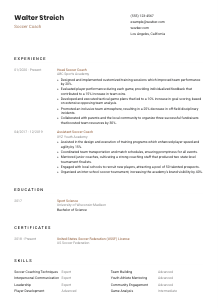
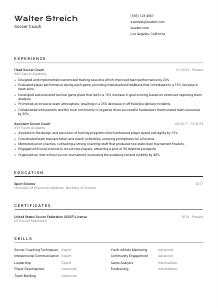
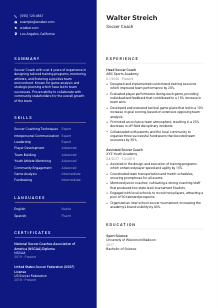
Refining game strategies, but your CV isn't scoring? Check out this Soccer Coach CV example, created with Wozber free CV builder. Learn how to show off your coaching skills to match job criteria, and propel your career to be as dynamic as a last-minute goal!
Soccer coaching CVs are strongest when they show how you develop players over time, not just that you ran practices or stood on the touchline. Hiring teams want to see the shape of your work: training design, match preparation, player feedback, team culture, and the results that followed across a season. If your CV only lists duties, it misses the part that matters most in coaching.
The first screen often comes down to whether your background clearly matches the level, credentials, and coaching language in the posting. Wozber's free CV builder helps you shape that into an ATS-compliant CV by aligning your wording with the role's requirements, so it is easier to recognize your experience in player development, tactical planning, and athlete mentorship right away.
For a coaching role, the personal details section should answer the practical questions immediately: who you are, what position you coach, and whether you meet the basic logistics for the job. Keep it clean and professional so the reader can move straight to your coaching background.
Your name should be the most visible text on the page. Use a clear format that feels professional and easy to scan, the same way a lineup sheet or match report needs to be readable at a glance. You want the hiring team to remember the coach, not struggle through formatting.
Place "Soccer Coach" directly under your name if that is the role you are targeting. Matching the title used in the posting helps frame the rest of your experience correctly, especially when you have worked as a head coach, assistant coach, academy coach, or youth development coach.
Include a phone number you answer regularly and a professional email address. Coaching searches move quickly around tryouts, preseason planning, and school or club calendars, so missed calls and typo-filled contact details can cost you an interview before your experience is even discussed.
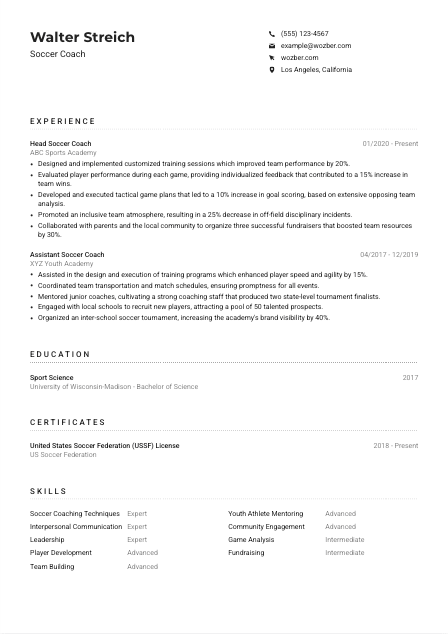
If a posting names a location requirement, include your city and state clearly. In this example, listing Los Angeles, California tells the employer you already meet an immediate practical condition and can move into training schedules, matches, and parent communication without relocation questions.
If you have a LinkedIn profile or coaching portfolio, include it only if it supports your CV with the same level of professionalism. A useful profile might reinforce coaching history, certifications, tournament results, community involvement, or player development philosophy. Keep the details consistent across both.
This section should remove basic friction. When your title, contact details, and location are clear, the reader can focus on your coaching record instead of logistics.




Experience carries the most weight on a soccer coach CV because it shows how you train, teach, adjust, and lead in real environments. The best bullets connect daily coaching work to measurable progress, whether that means stronger team performance, improved discipline, better match outcomes, or athlete development across a season.
Read the job description closely and build your bullets around the coaching work it emphasizes. For this role, that means training sessions, player evaluation, tactical game plans, mentorship, and collaboration with parents or support staff. If those responsibilities are already part of your background, use that same language naturally so the connection is immediate.
Lead with your most recent coaching position so the employer sees your current level first. That matters in coaching, where methods, age-group experience, and familiarity with modern training practices can change quickly. List each role with employer, title, and dates so your progression from assistant to lead responsibilities is easy to follow.
Avoid bullets that stop at "led practices" or "coached games." Show what changed because of your coaching. The sample CV does this well by linking training design to a 20% improvement in team performance and player feedback to a 15% increase in wins. That kind of phrasing makes your contribution concrete.
Numbers work especially well when they reflect team outcomes, player development, attendance, discipline, or community engagement. A 10% rise in goal scoring, a reduction in disciplinary incidents, or growth in player recruitment all tell the reader something practical about your coaching effectiveness. Choose measures that fit the environment you coached in rather than forcing generic business metrics.
Keep the focus on coaching environments that match the role's level and responsibilities. Since this posting asks for youth or high school coaching experience, roles with player development, match analysis, and family or school communication deserve the most space. Leave less relevant work in the background unless it directly supports your coaching profile.
Your experience section should show how you coach in practice and what that coaching produces. When your bullets connect training, tactics, and mentorship to visible outcomes, your value is much easier to judge.
Education matters most when it confirms that your coaching is grounded in sport science, physical education, athlete development, or a related discipline. For schools, academies, and structured youth programs, that academic background often supports credibility alongside field experience.
If the employer asks for a bachelor's degree in Sport Science, Physical Education, or a related field, make that easy to spot. In the example, a Bachelor of Science in Sport Science aligns directly with the requirement, so it should appear clearly without extra explanation.
List your degree, field of study, school, and graduation year in a straightforward format. This helps both human readers and ATS systems identify core qualifications quickly. There is no need to overdesign this section when the substance already works in your favor.
If your degree title or field is close to the employer's wording, reflect that phrasing faithfully. For example, "Sport Science" should appear exactly if that is your field. Accurate alignment helps the CV read clearly for screening without stretching your background beyond what you actually studied.
Early-career coaches can add coursework, honors, or campus roles tied to kinesiology, training methods, athlete psychology, or youth development. If you already have several years of coaching experience, keep the section shorter unless an academic distinction directly supports the position.
If you completed workshops or courses in conditioning, injury prevention, match analysis, or youth athlete development, mention them when they complement your degree and certifications. This is especially useful when you want to show that your coaching methods stay current with evolving training standards.
This section should confirm that your coaching is backed by relevant study, not distract from your field record. Keep it clear, accurate, and tied to the kind of athlete development work the role requires.
Soccer employers often look for formal coaching credentials early because certifications show recognized training in methodology, safety, and player development. When a posting names specific licenses, your CV should make those credentials easy to find.
List coaching certifications that directly support your work on the field, especially those named in the posting. Here, USSF and NSCAA credentials are especially relevant because they match the employer's stated preference and immediately reinforce professional legitimacy.
Prioritise licenses, diplomas, and coaching education tied to soccer instruction, tactical development, athlete management, or youth coaching. General certificates can stay off the page unless they add clear value to the role you are pursuing.
If a certification is current, show that with dates. Entries such as "2018 - Present" tell the reader your credential is active and not outdated. In coaching, where standards and methods evolve, current licensing carries weight.
Employers value coaches who keep refining their approach through clinics, federation courses, and advanced training. If you are working toward a higher license or recently completed development in areas like tactical analysis or youth coaching, include it to show progression in your coaching practice.
Relevant coaching certifications can clear an important hiring threshold quickly. Put them where they are easy to find and make sure they support the level and type of soccer program you want to coach.
A soccer coach skills section should read like a snapshot of how you run a team and develop players. That means combining technical coaching strengths with the communication and leadership skills needed to manage athletes, parents, staff, and match-day decisions.
Start with the capabilities the employer explicitly asks for. In this posting, that includes soccer coaching techniques, communication, mentoring, and tactical planning. If you have those strengths, name them clearly so your skills section reinforces the same themes already shown in your experience bullets.
A complete coaching profile includes both on-field and interpersonal skills. Technical strengths might include player development, game analysis, session planning, and team tactics. People-facing strengths can include leadership, athlete mentoring, communication with parents, and team culture building.
Lead with the skills most central to the role instead of listing everything you can do. In the sample CV, placing soccer coaching techniques, interpersonal communication, and leadership near the top creates a clear picture of coaching identity before moving into supporting strengths like community engagement or fundraising.
This section should support your experience, not repeat generic traits. When the skills listed reflect actual coaching work, the CV reads as grounded and credible.
Language ability can matter in soccer environments where coaches work with players, families, staff, and community partners from different backgrounds. Even when English is the only stated requirement, multilingual communication can strengthen your profile if it is genuinely relevant to your coaching setting.
If the job requires strong English communication, list English clearly with an honest proficiency level such as "Native" or "Fluent." This matters because coaching depends on giving instructions, delivering feedback, and communicating match expectations without confusion.
Include additional languages when they help you connect with athletes, parents, or local communities. Spanish, for example, can be valuable in many youth and school soccer programs because it supports clearer communication beyond the field.
Choose simple descriptors like Native, Fluent, Advanced, or Intermediate and keep them accurate. Overstating language ability becomes obvious quickly in a coaching interview or parent meeting, where real communication skills matter.
If a second language has helped you build trust with families, explain drills more clearly, or support recruitment and community outreach, that connection is worth noting. The value is not the language alone but how it improves coaching relationships and team operations.
Not every additional language belongs on every CV. Feature the ones most relevant to the athletes and families you are likely to serve. That keeps the section practical rather than decorative.
Language skills matter when they improve communication in training, matches, and family interactions. List them clearly and let them reinforce your ability to lead a diverse team environment.
The summary should quickly establish what kind of soccer coach you are, what level you have coached, and what results your work tends to produce. A vague opening wastes valuable space. A focused summary gives the reader a reason to view the rest of your CV through the right lens.
Before writing, identify the themes the employer cares about most. Here, that includes player development, training design, tactical planning, mentorship, and communication. Your summary should reflect those priorities in a few tight lines rather than trying to cover your whole career.
Lead with a direct statement about your background, such as years of experience and the level you coach. The example summary works because it immediately establishes more than 4 years of experience and connects that experience to training programs, mentoring, and team environment.
Choose two or three strengths that separate your profile, such as game analysis, youth athlete development, inclusive team leadership, or collaboration with parents and community stakeholders. Keep them rooted in real coaching work, not broad claims that could apply to any profession.
Aim for a short paragraph that sounds specific and controlled. A summary does not need every detail. It needs enough substance to show that your coaching background matches the role and that your results, methods, and communication style are worth a closer look.
A useful summary gives a clear read on your coaching level, your approach, and your track record. If those three points land quickly, the rest of the CV has a much stronger foundation.
A soccer coach CV should make your coaching methods, player development record, and team impact easy to follow from the first scan. When each section supports the role's actual demands, the document reads like a coach ready to lead training, guide athletes, and manage the wider team environment.
Use Wozber's free CV builder to shape that experience into an ATS-friendly CV format, and refine it with an ATS CV scanner so the language, structure, and priorities line up with the job you want. The finished CV should make one thing clear: you know how to build players, prepare teams, and lead a program with purpose.




