




Use Wozber and land your dream job
Create CV
No registration required
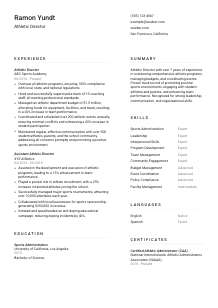
Driving sports strategy, but your CV is out of bounds? Tackle this Athletic Director CV example, created with Wozber free CV builder. Learn how to position your leadership game plan to match job expectations, propelling your career to the winner's circle!
Athletic Director hiring usually turns on one practical question fast: can you run a school sports program responsibly at scale? Schools look for leaders who can keep teams compliant, staff coaches well, manage facilities and budgets, and maintain a positive environment for student-athletes and families. Your CV needs to make that operational leadership visible, not just your enthusiasm for athletics.
When the CV is tailored well, reviewers can quickly separate candidates with real athletics administration scope from those whose experience is mostly coaching or event support. Wozber's free CV builder helps you align your wording with the posting, keep an ATS-compliant CV structure, and surface the details that matter most here, such as program oversight, budget ownership, and school-community communication.
This section is short, but it still carries screening value. For Athletic Director roles, hiring teams often confirm location, title alignment, and reliable contact information before they spend time on program leadership or compliance history.
Use your full name in a larger, clean font at the top of the page. Athletic Director CVs often move between administrators, principals, and HR staff, so instant recognition matters more than design flourishes.
Place "Athletic Director" below your name if that is the role you are pursuing. This immediately frames your background around athletics administration rather than coaching, physical education, or general school operations.
Include a working phone number and a professional email address, then check them carefully. If you also include a website or LinkedIn profile, make sure it supports your candidacy with relevant leadership experience, school athletics work, committee roles, or community-facing achievements.
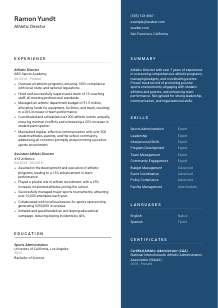
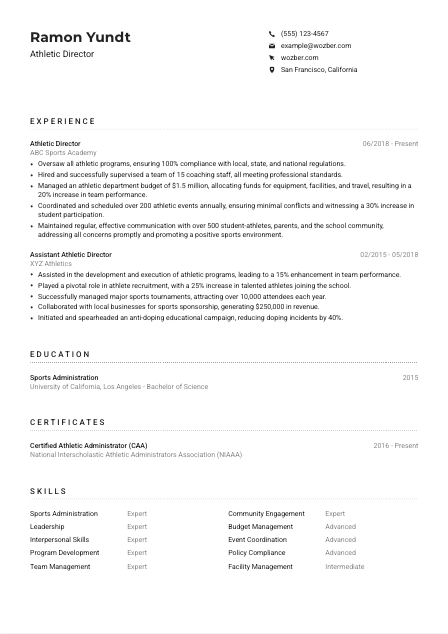
If a job requires a specific location, mirror that clearly. In the example, listing San Francisco, California directly answers a stated requirement and removes questions about relocation or availability.
A profile link is useful when it expands on athletics administration work, certifications, speaking engagements, or district involvement. Skip anything outdated or personal that does not reinforce your ability to lead programs, staff, budgets, and school relationships.
The header should confirm who you are, what role you want, and whether you meet practical requirements such as location. That lets the reader move straight into your athletics leadership record.




For Athletic Directors, experience is the section that carries the most weight. Schools want to see that you have already handled the moving parts of an athletics program, from compliance and scheduling to coach supervision, budgeting, and community communication.
Read the posting closely and underline the work you would actually own. Here, the core themes are program oversight, regulatory compliance, hiring and supervising coaches, budget management, event scheduling, and communication with families and the school community. Those themes should shape which bullets you keep and how you phrase them.
List your jobs in reverse chronological order, starting with positions closest to Athletic Director work. Titles such as Athletic Director, Assistant Athletic Director, athletics coordinator, or school sports administrator carry immediate relevance because they suggest experience with policy, staffing, and department-wide operations rather than team-level coaching alone.
Each bullet should connect your past work to the demands of running a school athletics program. Strong examples include maintaining compliance, supervising coaching staff, improving participation, managing tournaments, or building a positive environment for student-athletes. The sample CV does this well by showing full program oversight, staff management, and regular communication with more than 500 stakeholders.
Numbers help hiring teams understand the size of your operation. Useful metrics in this field include number of teams supported, coaches supervised, annual events scheduled, budget size, student participation rates, attendance, sponsorship revenue, or compliance outcomes. Managing a $1.5 million budget or coordinating 200 athletic events tells a much clearer story than saying you "handled department operations."
Prioritise experience tied to athletics administration, school policy, supervision, student engagement, and community relations. If a bullet does not help a reader picture you running programs, supporting coaches, or managing school athletics logistics, it can usually be replaced with something more relevant.
The best experience sections let a school imagine you stepping in and running seasons smoothly. Show the scale of your programs, the people you led, the budgets you managed, and the outcomes you improved.
Education matters here because many Athletic Director postings set a firm baseline in sports administration, education, or a related field. This section should confirm that requirement quickly and without clutter.
If you hold a bachelor's degree in Sports Administration, Education, or a related area, list it clearly. In the example, a Bachelor of Science in Sports Administration lines up directly with the posted requirement, so there is no reason to bury it.
Include degree, field of study, school name, and graduation year. Athletic Director hiring teams usually review this section for qualification alignment, not for decorative detail, so simple formatting works best.
When your major directly supports athletics leadership, include it in full. "Sports Administration" gives more hiring value than listing only "Bachelor of Science" because it connects your academic training to program management, policy, and sports operations.
Early-career candidates can include coursework, honors, or student leadership tied to athletics, education, compliance, or event management. If you are already well established in athletics administration, keep the section concise and let experience carry more of the argument.
Additional learning in areas such as sports law, risk management, student-athlete welfare, budgeting, or leadership can reinforce your readiness for broader department oversight. These details are especially helpful if they support responsibilities the target school emphasizes.
A clear degree match keeps the hiring team from wondering whether you meet the academic baseline. Once that is established, the rest of the CV can focus on how you have led athletic programs in practice.
Certifications can matter more in athletics administration than they do in many school roles because they point to current knowledge of governance, compliance, and professional standards. If a posting mentions recognized credentials, make them visible.
When a posting references credentials such as Certified Athletic Administrator or NIAAA certification, include them prominently if you have them. That immediately shows commitment to the professional standards used in interscholastic athletics administration.
Choose certifications that support department oversight, student safety, compliance, or administrative leadership. A short, relevant list carries more weight than a long list of unrelated courses.
List the credential name, issuing organisation, and date or active period. In the example, showing the CAA with NIAAA and an ongoing date range helps communicate that the certification is established and current.
Athletic Directors work in an environment shaped by changing regulations, eligibility rules, safety expectations, and school policies. Renewed certifications or recent professional development can reassure hiring teams that your administrative knowledge is up to date.
Relevant certifications strengthen your CV when they reflect the standards schools already use to evaluate athletic program leadership. Keep them current, clear, and closely tied to the work.
The skills section should read like the toolkit of someone who can run athletics across teams, seasons, and stakeholders. Hiring teams are looking for administrative judgment here, not a generic list of strengths.
Start with the capabilities named in the job description. For an Athletic Director, that often includes leadership, program development, budget management, event coordination, interpersonal communication, and policy compliance. These are the skills that connect directly to daily department work.
Using the same wording as the posting improves ATS optimisation and makes the match easier to read. If the school emphasizes "organizational" and "interpersonal" skills, use those terms if they genuinely describe your work supervising coaches, planning calendars, and handling family communication.
Focus on skills that show you can manage across multiple teams and constituencies. In the sample CV, sports administration, program development, team management, budget management, event coordination, and community engagement all support the picture of a department leader rather than a single-sport specialist.
A useful skills section helps a school picture how you will run programs, guide staff, and keep athletics organised. Keep the list tightly connected to administration, compliance, communication, and operational leadership.
Athletic Directors spend a lot of time communicating with students, parents, coaches, administrators, officials, and community partners. Language ability matters when it directly supports that work.
If the posting calls out English fluency, list it directly with an honest proficiency level such as "Native" or "Fluent." That is especially important in a role built around policy communication, parent outreach, staff supervision, and issue resolution.
Extra languages can be a real advantage in districts with diverse student and family populations. They are most valuable when they help you communicate with parents, build trust with student-athletes, or support community engagement.
Keep levels simple and credible, such as Native, Fluent, Intermediate, or Basic. Schools may rely on this information when considering your ability to communicate in meetings, event settings, and family-facing situations.
If you speak more than one language, treat it as a practical communication asset, not a decoration. In athletics administration, it can strengthen parent relations, improve outreach, and help make school sports more accessible across the community.
Only list languages you can genuinely use in a professional context. If your proficiency has improved through community work, school collaboration, or formal study, update the section so it reflects your present communication range.
For this role, language ability matters when it helps you lead, explain, and respond effectively across the school community. Keep the section honest and relevant to that day-to-day responsibility.
Your summary should establish, in a few lines, that you understand what athletic department leadership requires and that your background already reflects that scope. This is the place to connect your years of experience to the kind of program oversight the school needs.
Before writing, identify the few responsibilities that matter most in the posting. For Athletic Director roles, that usually means oversight of athletic programs, coach supervision, budget ownership, event coordination, and a positive sports environment. Build your summary around those ideas rather than broad leadership language.
Start with a direct identity statement such as "Athletic Director with 7+ years of experience" or a similar line grounded in your actual background. That gives the reader immediate context about your seniority in athletics administration.
Include the kinds of results that matter in school athletics, such as compliance performance, participation growth, budget management, staff leadership, or community engagement. The example summary works because it combines program oversight with budget management, event coordination, and positive communication with student-athletes and parents.
Aim for a short paragraph that a principal or hiring committee can absorb in seconds. Focus on the facts that best position you for this opening, and save the fuller detail for the experience section.
A well-written summary tells the reader early that you understand the realities of school athletics leadership. By the time they reach your experience section, they should already expect to see program oversight, staff management, and measurable department results.
An Athletic Director CV should leave little ambiguity about your ability to lead programs, supervise coaches, manage budgets, and communicate well with the school community. When each section reinforces those strengths, your application reads like a clear match for the work.
Use Wozber's free CV builder to organise that story in an ATS-friendly CV format, then refine it with targeted ATS optimisation so your terminology, structure, and achievements line up with the posting. The final result should make it easy for a hiring team to see you running an athletic department with confidence from day one.