



Use Wozber and land your dream job
Create CV
No registration required
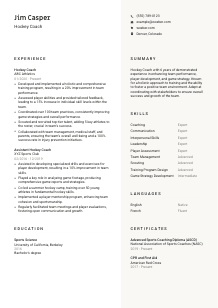
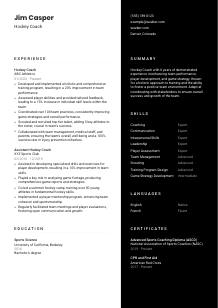
Crafting winning plays, but your CV seems stuck in the penalty box? Check out this Hockey Coach CV example, put together with Wozber free CV builder. Learn how to spotlight your coaching tactics to align with team owner strategies, so your career can score as much as your players do!
Hockey coaching CVs are strongest when they show how you improve performance over a season, not simply that you ran practices. Hiring teams want to see how you develop players, adjust systems, manage game preparation, and work with staff around player health and progression. Your CV should make that coaching impact visible in the same way you would evaluate a season plan or review game film.
A tailored hockey coach CV also helps separate broad sports leadership experience from actual bench-level coaching work. Using Wozber's free CV builder to align your language with the posting and keep an ATS-friendly CV format makes it easier to surface the right terms, from training programs and scouting to player assessment and game strategy, so the reader quickly sees where you can lead development and where you can influence results.
For a hockey coach, the top of the CV should read like a clear roster card. It needs to confirm who you are, how to reach you, and whether you meet practical filters before anyone gets to your practice plans, player development work, or recruiting record.
Use your full name in a larger, clean font so it anchors the page immediately. Coaching CVs often include a mix of leadership, development, and program-building experience, so the header should feel simple and professional rather than decorative.
Place "Hockey Coach" directly under your name if that is the role you are applying for. This removes ambiguity, especially if your background includes assistant coaching, camp instruction, player development, or athletic program work. A direct title match helps the hiring team and ATS connect your CV to the opening faster.
Include a reliable phone number and a professional email address. If you also have a coaching website, profile, or recruiting page with practice philosophy, season results, player highlights, or camp information, add it only if the content is current and supports your candidacy.
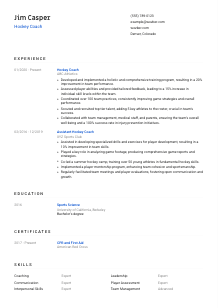
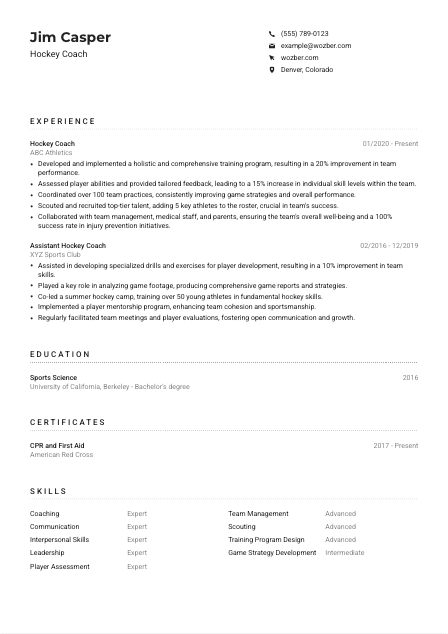
If a coaching role specifies a city or relocation requirement, include your location clearly. In the example CV, listing Denver, Colorado directly supports a stated job requirement. When relocation applies, note it plainly so your application is not filtered out over logistics before your coaching record is reviewed.
A digital link should add coaching context, not clutter. Prioritise pages that show program leadership, athlete development, clinic work, season schedules, or media coverage over generic social profiles. If it does not strengthen your credibility as a coach, leave it out.
Your personal details should answer the basic operational questions quickly: who you are, where you are, and how to contact you. Once that is clear, the rest of the CV can focus on what matters most in hockey coaching, how you develop players and improve team performance.




This is the section that carries the most weight for a hockey coach. Schools, clubs, and competitive programs want more than a list of duties. They want to see training outcomes, athlete development, game preparation, recruiting impact, and how you handled the daily demands of running a team environment.
Read the posting the way you would prepare for an opponent. Mark the repeated responsibilities and standards, then match them to your own record. Here, the emphasis falls on training programs, player assessment, practice coordination, game strategy, recruiting, and collaboration with staff and families. Those themes should shape which bullets you keep and which you cut.
List your most recent coaching position first, then work backward. Include job title, organisation, and dates for each role. That structure makes it easy to follow your progression from assistant coaching or development roles into broader team leadership, program oversight, or higher-level competition.
Each bullet should show what you planned, what you changed, and what improved. Strong hockey coaching bullets often reference skill development, system execution, roster building, player evaluations, special training blocks, game preparation, or collaboration with medical staff. In the example CV, "developed and implemented a holistic and comprehensive training program" works because it leads directly to a measurable improvement in team performance.
Quantify progress with metrics that make sense for coaching work. That might include win improvement, player advancement, roster growth, number of practices led, athletes recruited, injury reduction, camp participation, or skill gains measured through team evaluation. The sample CV does this well with figures like a 20% performance improvement, more than 100 practices coordinated, and 5 recruited athletes added to the roster.
Prioritise experience that matches the level of competition and responsibility in the posting. If the employer wants someone with high school, collegiate, or professional coaching exposure, make that visible early through your titles, team context, and bullet points. General sports supervision matters less here than direct experience with hockey instruction, tactical preparation, player feedback, and roster management.
Your experience section should show how you coach, how you improve athletes, and what changed under your direction. Presented well, it gives a hiring team a clear read on whether you can run practices, shape strategy, recruit talent, and support player well-being in a competitive hockey environment.
Education matters in hockey coaching when it strengthens your authority in training design, physical development, injury awareness, and athlete performance. If the posting asks for a degree in Sports Science, Kinesiology, or a related field, make that match easy to spot.
When a role names a specific academic background, place that qualification clearly in your education section. A bachelor's degree in Sports Science, Kinesiology, or a related area supports your work in training structure, conditioning, recovery awareness, and athlete development. In the example, the Sports Science degree is a direct match and should stay prominent.
List the degree, field of study, school, and graduation year in a consistent order. Hiring teams scanning coaching CVs do not need extra formatting here. They need to confirm quickly that your academic background aligns with the level of preparation expected for the role.
If your degree title is broad, clarify the field when possible so the connection to coaching is obvious. Sports Science, Kinesiology, Exercise Science, Physical Education, or similar fields all communicate something useful about your foundation in training and athlete performance.
Most experienced coaches can keep this section short, but relevant coursework can help earlier-career applicants or those shifting levels. Include subjects such as sports psychology, biomechanics, strength and conditioning, or motor learning only if they reinforce the coaching work shown elsewhere on the CV.
Athletic participation, team captaincy, coaching internships, or work with university programs can add value if they support your hockey background. Keep these details concise and relevant. The point is to reinforce your coaching development, not to turn the education section into a second experience section.
For this profession, education supports your coaching decisions rather than carrying the application on its own. Present it clearly, especially when the degree field is specifically requested, and let it reinforce your ability to design informed training and development plans.
Certifications are especially important in coaching roles that involve player safety, supervision, and program responsibility. The right credentials show that you can handle emergencies, stay current with coaching standards, and bring formal training into your daily work with athletes.
If the job asks for CPR and First Aid, list those credentials before optional coaching certifications. Player care is a core responsibility, and current safety training shows you can respond appropriately during practices, games, travel, and conditioning sessions.
Beyond mandatory credentials, include certifications that strengthen your case for athlete development, coaching methodology, or sport performance. Advanced coaching diplomas, player development credentials, or training-related certifications are useful when they connect directly to your responsibilities on the ice or in team preparation.
Coaching employers want to know whether a required certification is active. Show the issue date or active range clearly, especially for credentials like CPR and First Aid that expire and need renewal. In the example CV, the active date range helps show the certification is current rather than historical.
A current coaching credential tells a stronger story than an old one left unexplained. If you have recent education in coaching methods, player safety, sports performance, or leadership, include it to show that your approach is developing along with the game and the athletes you coach.
This section should confirm two things quickly: you meet safety requirements and you invest in coaching development. That combination matters in hockey, where player well-being, training quality, and informed decision-making all sit with the coaching staff.
A hockey coach skills section works best when it reflects the actual mix of instruction, leadership, tactical thinking, and operational coordination the job requires. It should support the experience section, not repeat broad claims without context.
Start with the language used in the job description. Here, that includes communication, leadership, interpersonal skills, coaching technology, player assessment, recruiting, and training program development. These are not filler terms. They point to how the program expects a coach to work day to day.
A hiring team needs to see both sides of the role. Include hard skills such as practice planning, game strategy, player evaluation, video analysis, scouting, or coaching software alongside soft skills like communication, leadership, and relationship management. The example CV handles this well by pairing player assessment and training design with interpersonal and leadership strengths.
Do not overload this section with every skill you have used in sports. Choose the ones most likely to matter for the target role and level of competition. If the posting specifically mentions coaching technology, include the relevant skill directly rather than leaving it implied. A focused list reads more credibly than a long inventory of generic strengths.
Your skills section should quickly confirm the blend of teaching, strategy, communication, and program management the role calls for. When the wording matches the job description and reflects your real coaching work, it strengthens both ATS alignment and the human read of your CV.
Language matters in coaching because instruction has to be clear under pressure. Practices move fast, game-day communication is immediate, and player feedback needs to be understood the first time. If the posting names a required language, your CV should confirm that plainly.
When English proficiency is listed as critical, include English and your level directly in this section. If it is your native language, say so. That gives the employer a clear answer on an explicit requirement without making them infer it from the rest of the CV.
Additional languages can be valuable when working with diverse rosters, families, camp participants, or international athletes. They are especially useful if they strengthen communication in recruiting, player support, or community-facing parts of the program.
Stick with standard levels such as Native, Fluent, Intermediate, or Basic. Those labels are easy to scan and easy to understand. In a coaching CV, clarity matters more than nuance-heavy descriptions of language ability.
If you speak a language that is relevant to the athlete population or families you work with, that can be worth noting. It is not a universal requirement, but in some programs it can improve trust, instruction, and coordination beyond the bench.
The value of listing languages is practical. It shows where you can teach, motivate, explain systems, and build rapport. Keep the section grounded in communication ability rather than broad statements about cultural awareness.
For a hockey coach, language skills are useful when they improve instruction, feedback, and coordination with the people around the team. List them clearly and let the employer see where your communication range adds real value.
The summary should give a quick, credible picture of the level you have coached at, the kind of teams or athletes you have supported, and the results you tend to deliver. In hockey coaching, a good summary usually combines years of experience with one or two specific strengths such as player development, training design, recruiting, or game preparation.
Start with a direct statement that places you in context. Mention your years of coaching experience and the levels you have worked at if they are relevant to the job. For this posting, experience at the high school, collegiate, or professional level matters, so that background should appear early when you have it.
Choose two or three strengths that reflect the role, such as building training programs, assessing players, coordinating practices, or improving team performance. In the example summary, player development, game strategy, and team performance are all relevant themes because they echo the responsibilities in the posting.
Aim for a short paragraph that gives substance without repeating your full experience section. Avoid generic leadership statements that could belong to any sport. Focus on what you coach, how you coach, and what kind of outcomes tend to follow.
Adjust the summary so the first few lines mirror the most important parts of the job description. If the employer is emphasizing comprehensive training programs, athlete assessment, recruiting, and collaboration with staff and parents, those ideas should show up in your summary when they reflect your actual background. This is one of the fastest ways to improve alignment for both the reader and the ATS.
Your summary should frame you as a hockey coach who can lead development, prepare a team, and work effectively across the program. When those points come through in clear language, the rest of the CV has a stronger foundation.
A hockey coach CV should now show more than enthusiasm for the sport. It should present a working record of player development, practice planning, tactical preparation, recruiting, and collaboration with the people who support the team.
Use Wozber's AI CV builder to sharpen wording, align key coaching terms with the posting, and keep everything in an ATS-compliant CV format. The result should make it easy to judge whether you can step into the bench role, lead athletes well, and improve team performance from day one.