



Use Wozber and land your dream job
Create CV
No registration required
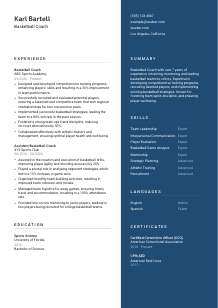
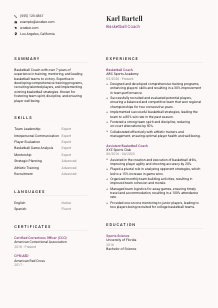
Scoring on the court but missing on your CV? Bounce into this Basketball Coach CV example, created with Wozber free CV builder. Learn how to lay up your coaching insights to match team and job needs, and slam dunk your career to the next league!
Basketball coaching gets judged in the margins. Plenty of candidates can say they ran practices or led teams, but hiring committees pay closer attention to how you improved execution, developed players over a season, adjusted strategy from scouting reports, and kept standards high across the roster. Your CV needs to show that coaching impact in concrete terms, not just enthusiasm for the game.
A tailored CV changes how quickly a hiring team can place you at the right level, whether that means player development, recruiting, game preparation, or full program leadership. Wozber's free CV builder helps you line up your wording with the job post while keeping an ATS-compliant CV easy to scan, so your experience reads clearly as basketball coaching experience rather than generic sports leadership. That distinction matters early.
This section is brief, but it still does real work. For coaching roles, it should immediately confirm who you are, what position you are targeting, and whether any practical requirements, such as location or contact access, are already covered.
Place your full name at the top, then use the exact role title you are pursuing when it matches the posting. If the opening is for a "Basketball Coach," use that wording directly under your name so both the hiring team and the ATS connect your CV to the role without guesswork.
Your phone number and email need to be accurate and professional. Coaching searches can move quickly between interviews, practice visits, and reference checks, so a mistyped number or informal email address creates avoidable friction right at the point where a program is trying to reach you.
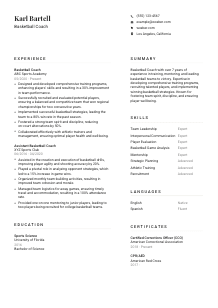
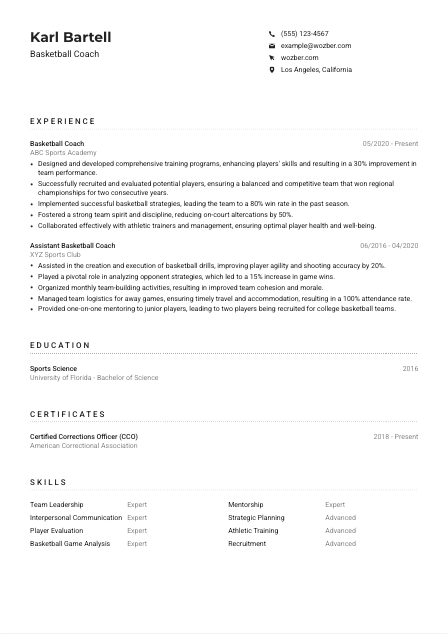
If the role has a location expectation, address it in this section. In the example, listing Los Angeles, California immediately supports a posting that prefers someone already based there or ready to relocate. That kind of detail belongs here because it answers a practical hiring question before it slows down your application.
Include a coaching website, LinkedIn profile, or similar professional page if it strengthens your case. For a Basketball Coach, that might mean a profile that reflects your coaching history, program results, player development work, clinics, or recruiting background. Only include links that are current and consistent with the CV.
Do not include age, marital status, headshot, or other details unrelated to coaching performance. Programs are hiring for leadership, player development, strategy, and communication. Keep the focus on information that helps them move you forward in the process.
This section should remove basic questions, not create new ones. When your title, contact information, and any location requirement are immediately clear, the hiring team can move straight to your coaching background.




For Basketball Coach roles, experience carries the most weight when it shows what changed under your direction. Hiring teams want to see how you ran training, improved team performance, evaluated talent, supported player welfare, and translated strategy into wins, development, or stronger discipline.
Start with the parts of your background that map most closely to the opening. Prioritise examples of designing training plans, running practices, preparing for games, recruiting players, mentoring athletes, and working with trainers or assistants. If you have experience across several sports or broader athletic operations, keep the basketball-specific coaching work in front.
For each position, include the organisation, your title, and dates in reverse chronological order. Choose titles that reflect your actual level of responsibility, such as Basketball Coach or Assistant Basketball Coach. The example does this well by making it easy to follow progression from assistant responsibilities into a lead coaching role with broader program impact.
Do not stop at "conducted practices" or "mentored players." Show what your coaching produced. Strong bullets describe improvements in shooting, defensive execution, team discipline, recruitment quality, or competitive results. In the sample, "30% improvement in team performance" and an "80% win rate" tell a far clearer story than a list of routine coaching tasks.
Quantify your work with metrics that fit basketball and program leadership. That can include win percentage, player progression, championship results, shooting or agility improvements, roster retention, successful recruits, reduced disciplinary issues, or attendance and availability outcomes. Numbers work best when they connect directly to your coaching decisions and not just team context.
Every bullet should support your case as a basketball coach. If older experience is only loosely related, trim it down or remove it to make room for stronger examples of strategy, player development, scouting, recruiting, or staff collaboration. The section should read like a record of coaching progression, not a full autobiography.
The best experience sections read like a season review with results attached. When your bullets show how you developed players, improved execution, and led a program day to day, hiring teams can picture you running their practices and games.
Education is usually not the headline in a coaching search, but it still matters when the posting specifies a degree. Present it cleanly and make it easy to see whether you meet the academic requirement without forcing the reader to hunt for it.
Check the posting for any degree requirement and place the closest match clearly in your education section. Here, a Bachelor of Science in Sports Science directly supports a job asking for a bachelor's degree in Sports Science, Physical Education, or a related field. That kind of alignment should be obvious at a glance.
List the degree, field of study, school, and graduation year. Coaching CVs do not need long education descriptions unless a specialised academic detail directly strengthens your fit, such as coursework in exercise physiology, motor learning, or athlete development.
If you hold multiple degrees, lead with the one most relevant to coaching and athlete performance. Sports Science, Physical Education, kinesiology, and related disciplines usually deserve the highest placement because they connect naturally to training design, player conditioning, and safe development.
Academic honors, coaching internships, or sports-related associations can be useful if they reinforce your credibility. Keep them selective. A short detail that shows deeper grounding in performance training or coaching development adds value. A long list of unrelated campus activities does not.
Once the degree requirement is clearly covered, your education section has done its job. Keep it polished, accurate, and relevant so the focus can return to your coaching record and program impact.
Certifications are especially useful in coaching when they connect to athlete safety, recognized coaching standards, or league and program requirements. This section should reassure the employer that you meet the practical credentials needed to step into the role.
If the job asks for CPR/AED, place that certification prominently and make sure the issuing organisation and active dates are visible. For a coach working daily with athletes in training and competition, this is not a minor add-on. It reflects readiness to operate responsibly in real practice and game environments.
List basketball and coaching credentials before unrelated certificates. The posting mentions the National Association of Basketball Coaches certification program, so that belongs high in this section if you have completed it. In the sample, CPR/AED fits the role, while an unrelated corrections certificate would weaken the focus and is better removed.
For certifications that expire or need renewal, include the date range or current status. Hiring managers want to know whether they are looking at an active CPR/AED credential or something that lapsed two years ago. That small detail can save time in later screening.
Coaching methods evolve through clinics, safety updates, player development education, and certification programs. If you have recent coursework or recognized basketball training credentials, include them to show that your approach is current and that you keep investing in your craft.
A short list of relevant, current certifications is stronger than a longer list with weak connections to basketball. Lead with credentials that support player safety, coaching standards, and immediate readiness for the bench.
The skills section should mirror the way basketball programs actually evaluate coaches. That means balancing leadership and communication with technical coaching strengths such as player evaluation, game analysis, training design, and recruiting.
Read the job description closely and note both explicit and implied skills. In this case, leadership, interpersonal communication, strategy development, player evaluation, mentoring, and collaboration with support staff all belong in the mix because they are central to the role, not filler keywords.
A Basketball Coach needs more than motivation skills. Show a combination of tactical and organizational ability. Skills like basketball game analysis, recruitment, training program development, team leadership, and mentorship present a fuller coaching profile than broad terms such as "hardworking" or "team player."
Choose skills you can support with experience. If you list player evaluation, there should be recruiting or roster-building evidence elsewhere in the CV. If you list strategic planning, your experience section should point to game results, system implementation, or measurable team improvement. The skills section works best when it reinforces the rest of the document.
This section should read like a compact version of your coaching toolkit. When the listed skills line up with your bullets on training, strategy, recruiting, and player mentorship, your CV feels consistent and credible.
Communication is central to coaching. Whether you are teaching defensive rotations, correcting footwork, running film sessions, or handling one-on-one mentoring, language ability matters when it affects how clearly you can lead players and work with staff.
If the posting specifies a language requirement, make that visible. Here, effective English communication is required, so listing English with an accurate proficiency level confirms that you can run practices, explain game plans, and communicate with staff and management without ambiguity.
Additional languages can strengthen a coaching CV when they reflect real communication value. Spanish, for example, may help you connect with players, families, or support staff in many programs. Include it if you can genuinely coach, mentor, or communicate comfortably in that language.
Use clear terms such as Native, Fluent, Professional, or Conversational. Avoid vague wording. A coach needs to communicate precisely, and your language section should do the same.
Language skill is useful because it affects relationships and teaching. In coaching, that can mean clearer feedback during drills, better rapport in individual development conversations, or smoother communication during high-pressure game situations. If a second language helps you do that, it is worth showing.
Not every basketball coaching role will value extra languages equally, but some programs with diverse rosters or international recruiting pipelines absolutely will. Include language skills that support the environments you want to coach in, rather than adding them as trivia.
For a coach, language ability is useful when it improves instruction, relationships, and team cohesion. Present it that way, and this section adds substance instead of decoration.
Your summary should give a hiring team a quick, accurate read on your coaching level. In a few lines, it needs to establish your experience, your core coaching strengths, and the kind of results or team environment you have produced.
Start with your title and years of relevant experience. For example, "Basketball Coach with over 7 years of experience" works because it immediately places you within the range expected for a role asking for 5+ years at a collegiate or professional level. Be direct and specific.
Use the next sentence to highlight the coaching capabilities most relevant to the opening. Training program design, player development, recruiting, game strategy, and team leadership are all stronger than generic self-description because they describe actual coaching responsibilities.
A summary becomes more convincing when it includes proof. That might be a strong win rate, championship success, measurable player improvement, or evidence of building team discipline and culture. The sample summary points in the right direction by emphasizing training, recruiting, and team spirit, and it would be even stronger with one specific result woven in.
Aim for a short paragraph that a hiring manager can absorb quickly before moving into your experience. Avoid motivational language, broad personality claims, or details better saved for later sections. The summary should frame your coaching value, not repeat the whole CV.
A well-written summary helps the reader understand your coaching range before they reach the first bullet point. Keep it focused on basketball leadership, player development, strategy, and results. Wozber's AI CV builder can help tighten that language and improve ATS optimisation so the summary reflects the same standard as the rest of your CV.
A Basketball Coach CV should show more than passion for the sport. It should make your training approach, player development record, recruiting judgment, communication style, and competitive results easy to follow from top to bottom.
Use Wozber's free CV builder to organise that story in an ATS-friendly CV format, then refine each section so the hiring team can quickly see where you have led, what improved under your coaching, and how closely your background matches the demands of the program. That is the standard your CV should meet before you send it out.