



Use Wozber and land your dream job
Create CV
No registration required
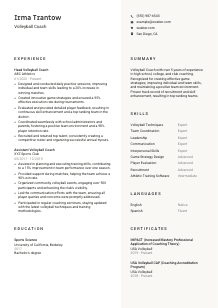
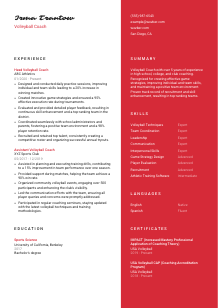
Spike your career, but your CV doesn't get set? Check out this Volleyball Coach CV example, created with Wozber free CV builder. Learn how to serve up your coaching chops to match the job requirements, smashing your way to the top of the candidate lineup!
Volleyball coaching CVs are often too vague about what actually wins trust. Hiring teams want to see how you run practices, develop players, adjust match strategy, and keep a roster engaged over a season. Your CV should make those coaching outcomes visible, not just state that you are passionate about the sport.
When the CV mirrors the language of the opening, it becomes much easier to surface the right coaching background in an ATS and in a first review. Wozber's free CV builder helps you align your wording with the role's priorities, from player evaluation to roster building, so the hiring team can quickly understand the level, scope, and results of your coaching work.
This section is simple, but it still carries hiring value. For coaching roles, clean contact details and a clear professional title remove friction and immediately show that you are aligned with the position being filled.
Use your full name in a clear, readable format at the top of the page. Keep the styling professional and easy to scan so the focus stays on your coaching background, not on design choices.
Place "Volleyball Coach" directly beneath your name if that is the role you are targeting. This helps your CV read as role-specific right away, especially when hiring teams are sorting through applicants with broader titles such as Coach, Athletics Instructor, or Program Director.
Include a working phone number and a professional email address. Coaching jobs often move through quick scheduling for interviews, tryouts, or follow-up calls, so accuracy matters more than presentation flourishes.
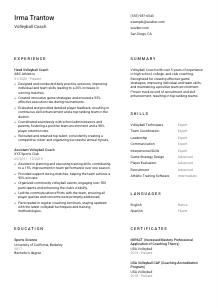
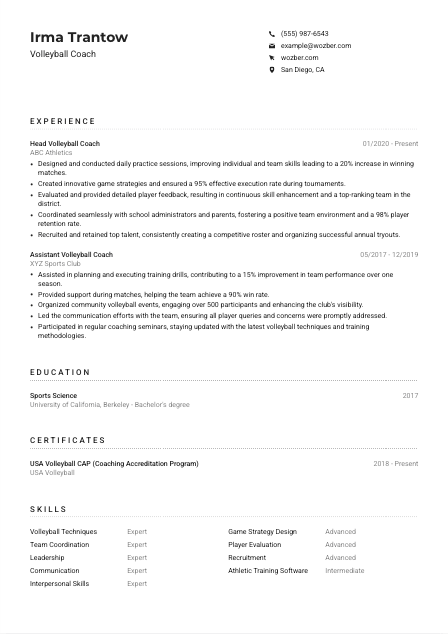
If the posting specifies a location requirement, reflect it clearly in this section. Here, listing "San Diego, CA" directly supports the employer's stated need for a local candidate or someone ready to relocate, which can remove an early screening obstacle.
If you have a LinkedIn profile, team bio, coaching portfolio, or athletics page, include it only if it strengthens your case. A useful link might show season records, program highlights, camp leadership, or player development work that supports the claims in your CV.
A volleyball coach does not need a flashy header. Clear identity, reliable contact details, and any location match the employer asked for are enough to move attention to your practice leadership, match preparation, and player development record.




This is the section most likely to decide whether your CV moves forward. Coaching experience needs to show more than where you worked. It should show the level you coached, how you trained athletes, how your teams performed, and how you handled the broader responsibilities around the program.
Start by marking the responsibilities and requirements that define the role. For a volleyball coach, that often means daily practice planning, match strategy, player evaluation, communication with parents or administrators, and roster recruitment. Those are the areas your experience bullets should cover first.
Lead with your most recent coaching work and include the organisation, title, and dates. Favor roles at the high school, college, or club level when they are available, since that is often the experience range employers want to compare directly.
Each bullet should show what you coached, what you changed, and what happened as a result. The sample CV does this well by tying practice design to a 20% increase in wins and linking game strategy to strong tournament execution. That kind of phrasing tells a hiring team how your coaching shows up on the court.
Volleyball programs are measured through results such as win rate, player retention, district ranking, tournament performance, tryout turnout, or improvement over a season. Metrics like a 95% execution rate during tournaments or a 98% player retention rate give real shape to your leadership and team management.
Keep the section focused on work that supports volleyball instruction, athlete development, strategy, recruiting, and team culture. If an older role does not add to that story, reduce it or leave it out so your most relevant coaching achievements stay prominent.
A hiring team should be able to see how you run practices, improve athletes, guide match decisions, and maintain a competitive roster just by scanning this section. When that is clear, your experience starts doing the selection work for you.
For coaching roles, education usually plays a supporting role, but it still matters when the job asks for a degree in a sports-related field. Present it clearly so the reader can confirm that your academic background matches the expected preparation.
If the opening asks for a bachelor's degree in Sports Science, Physical Education, or a related field, make that information easy to find. A degree in Sports Science, as shown in the example, lines up neatly with the requirement and reinforces your technical grounding in training and athletic development.
List the school, degree, field of study, and graduation year or date. This section does not need extra commentary unless your academic background adds something unusually relevant to volleyball coaching.
When your degree directly supports the role, put the field of study in plain view. For coaching jobs, coursework and academic preparation tied to kinesiology, exercise science, coaching theory, sports psychology, or pedagogy can strengthen your profile when they are relevant.
If you are early in your career, changing from another athletic role, or your degree title is broad, a few targeted academic details can help. Courses related to coaching methods, injury prevention, athlete assessment, or motor learning can clarify why your education fits the position.
Honors, team captaincy, research in sports performance, or leadership in university athletics can be worth mentioning if they reinforce discipline, leadership, or sport-specific commitment. Skip generic achievements that do not connect to your coaching work.
This section should make one thing easy to confirm: you have the formal background the role calls for. Once that box is checked, the spotlight can return to your training sessions, match results, and athlete development record.
Certifications matter in coaching because they show current standards, safety awareness, and sport-specific development. When a job posting names volleyball coaching credentials, your CV should make them visible without forcing the reader to hunt for them.
If the employer asks for USA Volleyball CAP or IMPACT certification, place those at the top of this section. They are directly tied to coaching legitimacy in volleyball and help show that your methods are grounded in recognized standards.
Order this section by hiring value, not by date alone. Volleyball-specific coaching credentials, safeguarding training, first aid, CPR, or athlete development certifications usually matter more here than broad professional development courses.
Add issue or active dates so the employer can see whether your certification is current. In coaching, recency often matters because rules, safety expectations, and training practices change over time.
A coach who keeps learning is easier to trust with athlete development. If you attend seminars, complete updated modules, or pursue advanced volleyball coaching education, include those selectively to show that your practice planning and technical instruction are current.
Relevant credentials tell a hiring team that your coaching is backed by recognized training, not just experience alone. For volleyball roles, that added credibility can matter quickly, especially when several candidates have similar years on the court.
A volleyball coach's skills section should read like the toolkit behind team performance. Generic soft-skill lists do not say much on their own. The strongest version combines sport-specific coaching ability with the communication and leadership skills needed to run a team well.
Scan the job description for explicit skills and for the work implied by the responsibilities. Here, that includes volleyball techniques, strategy, rules knowledge, communication, leadership, interpersonal skill, player evaluation, and recruitment. Those terms should shape the section.
Lead with the abilities most central to success in the role. For volleyball, that usually means technical instruction, practice planning, game strategy, team leadership, athlete feedback, and roster development before lower-priority tools or general traits.
Choose skills you can support elsewhere in the CV. The sample CV works because entries like "Volleyball Techniques," "Game Strategy Design," and "Player Evaluation" are reinforced by measurable coaching achievements in the experience section. That alignment gives the list substance.
A short, targeted skills section works best when every item connects to real coaching work already shown in your CV. That makes your technical knowledge, leadership, and match preparation easier to trust.
Language ability is rarely the headline of a coaching CV, but it can matter in programs with diverse athletes and frequent family communication. Present it clearly when it strengthens how you lead, instruct, and build relationships around the team.
If the posting says English proficiency is important, list English clearly with an accurate proficiency level. This is especially relevant in coaching roles that depend on live instruction, feedback during drills, and clear communication with athletes and parents.
Include additional languages if they are genuinely useful in your coaching environment. In some school, club, or community programs, Spanish or another widely spoken language can improve rapport with players and families and support smoother coordination off the court.
Extra languages can strengthen your profile when they help with recruiting, parent communication, camps, or a more inclusive team culture. If they are not relevant to the environments you coach in, keep this section brief.
Use straightforward levels such as Native, Fluent, Intermediate, or Basic. Coaching relies on real-time clarity during practices and matches, so overstating language ability can quickly create the wrong expectation.
Some volleyball roles involve community outreach, travel tournaments, or diverse athlete populations. In those settings, multilingual ability can be a practical advantage, though it should remain a supporting point rather than the centre of the CV.
If language skills help you teach more clearly, connect with families, or support a broader player base, include them. If not, keep the focus on the coaching competencies that drive performance and team development.
Your summary should quickly tell the reader what level you coach at, what you are known for, and what kind of results follow your work. This is one of the first places to establish whether you are a practice-floor leader, a match strategist, a player developer, or a coach who can do all three.
Build the summary around the work that defines successful volleyball coaching: structured practice sessions, technical development, match strategy, athlete feedback, and team culture. Keep it grounded in the responsibilities you can actually demonstrate elsewhere in the CV.
Start with your title and years of experience, then add the environments you have coached in if they strengthen your positioning. The example's mention of high school, college, and club coaching gives immediate context about range and level.
Choose achievements or specialties that match the target role. Strong options include improving win rates, building top-ranking teams, raising retention, recruiting competitive rosters, or designing effective match strategies. Those details tell the reader what kind of program you can lead.
Aim for a short paragraph that can be read in seconds. Skip broad statements about passion or dedication unless they are supported by concrete coaching outcomes. The summary works best when every line points back to player development, match performance, or program leadership.
By the end of this section, a hiring team should already understand your coaching level, your strongest contributions, and the kind of results your teams tend to produce. That is the right setup for the rest of the CV.
A volleyball coach CV should show how you train athletes, prepare teams for competition, and sustain a strong program over time. When each section is aligned to the opening, the full picture becomes much easier to read, from qualifications and certifications to match results and player development.
Use Wozber to shape that information into an ATS-compliant CV with language that reflects the role, the level of play, and the responsibilities named in the job description. The finished CV should make one thing clear fast: you can step in, lead practices, guide competition, and build a team that improves.