



Use Wozber and land your dream job
Create CV
No registration required
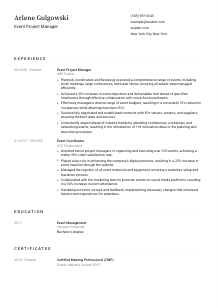
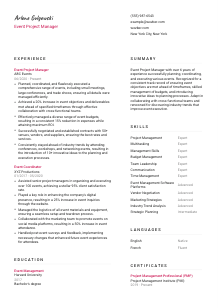
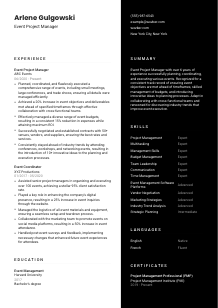
Juggling event projects, but your CV feels uncoordinated? Check out this Event Project Manager CV example, created with Wozber free CV builder. It shows how to showcase your event management skills in sync with job criteria, orchestrating your career to always take centre stage!
Event Project Managers are hired on proof that they can keep many moving parts under control without losing sight of budget, timeline, attendee experience, or business goals. A CV for this field needs to show more than enthusiasm for events. It should quickly establish the scale of events you have run, the vendors and teams you have coordinated, and the results you delivered when plans had to come together on schedule.
CV tailoring changes how fast a hiring team can place you in the right lane, whether that is corporate meetings, large conferences, or trade shows. Using Wozber's free CV builder helps you shape an ATS-compliant CV around the language and priorities in the posting, so your planning scope, budget ownership, and execution record are visible early instead of buried in generic project language.
For Event Project Manager roles, the header should remove basic friction immediately. Hiring teams need to know who you are, how to reach you, and whether you match any location or communication requirements before they spend time on your event portfolio or delivery history.
Use your full name as the most prominent text in the header. Keep it simple and easy to scan. In event management, where coordination and professionalism matter, an overdesigned header can work against you. A clean presentation already hints at the kind of organised communication expected from someone managing vendors, schedules, and stakeholders.
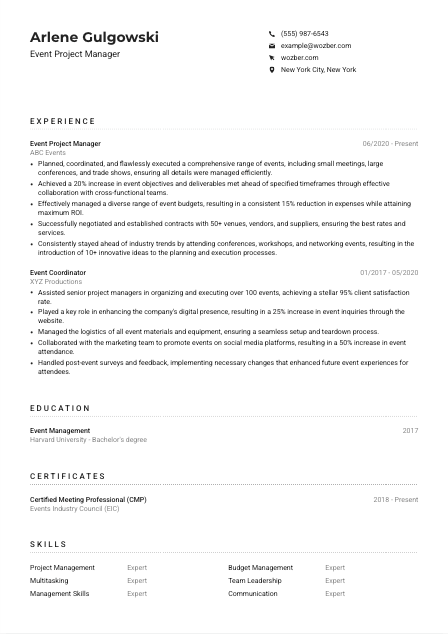
Place the target title directly under your name when it reflects the job you want. Using "Event Project Manager" makes your direction clear and helps position your experience around planning, logistics, budget control, and cross-functional execution. In the sample CV, that title creates immediate alignment with the posting instead of leaving the reader to infer whether the candidate is coming from events, operations, or general project work.
List one reliable phone number and a professional email address you check regularly. If recruiters need to schedule interviews around event cycles or peak planning periods, they should not have to guess how to reach you. Small details matter here. A typo in your phone number creates the same impression as a missed vendor confirmation.
If a role calls for candidates already based in a specific market, state your city and state clearly. For this opening, listing "New York City, New York" addresses a stated requirement and avoids unnecessary questions about relocation or travel logistics. Keep this kind of location matching specific to the posting rather than treating it as a rule for every Event Project Manager CV.
Include LinkedIn or a professional website if it expands on your event work with consistent information. This can be useful when your profile shows event types, industries served, portfolio highlights, or recommendations from clients and cross-functional partners. Make sure the titles, dates, and scope of work match your CV so the hiring team sees one coherent record.
Your personal details should confirm basic eligibility and professional polish in seconds. For an Event Project Manager, that means clear contact information, a role-aligned title, and any location detail the employer has asked to confirm before moving on to your execution record.




This is the section where hiring teams look for real operating range. They want to see what kinds of events you ran, how much ownership you held, what budgets or vendor relationships you managed, and whether your work improved timelines, attendance, cost control, or post-event outcomes.
Read the posting and mark the repeated responsibilities and constraints. For this role, the recurring themes are end-to-end event execution, cross-functional collaboration, budget and ROI management, vendor negotiation, and staying current with industry practices. Those are the themes your bullets should reflect, using your own experience rather than copying the employer's wording.
Start with your current or most recent position and work backward. For each role, include title, company, and dates, then make the scope easy to grasp through the bullets. This format helps hiring teams quickly track your progression from coordination support into full project ownership, as the sample CV does by moving from Event Coordinator into Event Project Manager.
Event hiring managers read past duty lists quickly. They pay attention when a bullet shows the kind of event environment you handled and what improved because of your work. Instead of saying you were responsible for logistics, say you planned and executed conferences, meetings, or trade shows, coordinated cross-functional teams, or managed vendor agreements that improved service delivery.
Metrics make event management experience concrete. Good examples include event volume, attendance growth, client satisfaction, budget savings, on-time delivery, vendor count, lead generation, or ROI-related improvements. The sample CV does this well with details such as reducing expenses by 15 percent, negotiating with 50+ venues and suppliers, and helping drive a 50 percent increase in attendance. Those numbers tell the reader what scale and business impact the candidate handled.
Prioritise experience that shows planning, execution, budgeting, vendor management, stakeholder communication, or post-event evaluation. Older bullets that focus on unrelated administrative tasks can dilute the message. If a past role is less directly relevant, keep only the achievements that translate to event delivery, operational coordination, or project control.
By the end of your experience section, a hiring manager should understand what events you can run, how you manage moving pieces under pressure, and what results follow from your planning and execution. Make that easy to see in every bullet.
Education usually is not the deciding factor for experienced Event Project Managers, but it still matters when the posting names a degree requirement. Present it clearly so the reader can confirm the academic baseline and move on to your event results, planning judgment, and operating range.
When the employer asks for a bachelor's degree in Event Management, Business, Marketing, or a related field, list the credential that fits that requirement most directly. In the sample CV, a Bachelor's degree in Event Management is an exact match, which helps remove uncertainty early in the review.
Include degree, field of study, school, and graduation year or date. That is usually enough. Event hiring teams are rarely looking for elaborate academic descriptions once you have several years of experience, so clarity matters more than detail here.
If your degree title closely matches the posting, keep that wording visible. For example, "Bachelor's degree in Event Management" aligns more directly than a shortened or vague version. If your degree is in a related discipline such as Marketing or Business, the field still works well when the rest of your CV supports event execution and project ownership.
Early-career candidates can include event planning projects, capstones, sponsorship work, or coursework in budgeting, marketing, hospitality, or operations. For someone with 4+ years in the field, those details usually matter only if they connect to a specialty such as trade shows, conference programming, or large-scale logistics.
Honors, leadership roles, or major student event work can be worth adding if they show planning responsibility or team coordination. As your professional track record grows, let those additions shrink. For an experienced Event Project Manager, the education section should confirm qualifications without competing with revenue impact, cost savings, or event execution outcomes from your work history.
This section should quickly confirm that you meet the stated degree requirement and have the right academic foundation for event, business, or marketing work. Then let your experience carry the heavier argument.
Certifications can strengthen an Event Project Manager CV when they point to formal training in project structure, meeting standards, or large-scale coordination. They are especially useful when the posting lists them as preferred credentials rather than mandatory screening items.
If the employer mentions PMP or CMP as a plus and you hold one of them, include it clearly. Both credentials map well to the role for different reasons. PMP supports planning discipline, timelines, and stakeholder management, while CMP speaks directly to the meetings and events field. The sample CV benefits from listing both because they reinforce both project rigor and event specialization.
List certifications that connect to event planning, project delivery, venue operations, hospitality, budgeting, or related platforms and methods. Skip certificates that sound impressive but do not add much to how you manage live events, conference logistics, or cross-functional delivery.
Show issue dates and, if relevant, active periods or renewal status. This is useful for credentials that require continuing education or recertification. It tells the reader that your training is current and that you stay engaged with evolving practices in event production and project management.
Event work changes with attendee expectations, hybrid formats, registration tools, sustainability standards, and vendor practices. A current certification record helps show that you are not relying only on older experience. It supports the claim that you bring updated methods and ideas into planning and execution.
Use certifications to reinforce areas where the role places extra value, especially structured project management and recognized event expertise. When they align with the posting, they make your profile easier to shortlist.
The skills section should mirror the operating tools and working habits behind successful events. For this profession, that means balancing logistics, negotiation, software fluency, timeline control, stakeholder communication, and budget judgment rather than listing broad strengths with no context.
Start with the language in the job description. Here, the employer emphasizes event management software, organizational strength, multitasking, time management, and project coordination. Those priorities tell you which skills belong near the top instead of being buried under more generic business terms.
Choose skills that support actual event delivery, such as budget management, vendor negotiation, cross-functional collaboration, team leadership, event logistics, post-event evaluation, and proficiency with event management platforms. The sample CV includes several of these, which helps connect the candidate's background to conference, meeting, and trade show execution rather than to general administration.
Do not overload this section with every capability you have developed. Pick the skills that matter most for the target role and that are backed up elsewhere in your CV. A concise list works better in ATS optimisation and gives hiring teams a quicker read on whether you can manage schedules, suppliers, budgets, and execution pressure.
Your skills list should make it obvious that you can run the planning mechanics behind a successful event and work effectively with the people involved. Keep it specific enough that the section supports your experience instead of repeating it in softer language.
Language ability matters in event management because so much of the work depends on precise communication. Briefing vendors, coordinating with internal teams, handling attendee needs, and resolving issues on-site all depend on clear language skills, especially when a posting explicitly names one as required.
This posting specifically asks for strong English ability, so English should appear first with your actual proficiency level. That makes the requirement easy to confirm and supports a role that depends on written updates, vendor communication, contracts, and live coordination.
List the language most relevant to the role first, then add any others that could support your work. Additional languages can be useful in event environments with international attendees, diverse vendor networks, or cross-border stakeholders, even when they are not listed as requirements.
Stick with recognizable terms such as Native, Fluent, Intermediate, or Basic. Event teams need a realistic sense of how confidently you can communicate in planning calls, email threads, registration support, or on-site issue resolution. Honest labels are more useful than inflated ones.
If you have worked on international conferences, multicultural attendee experiences, or vendor coordination across regions, language skills can reinforce that experience. They are especially worth highlighting when your events involve hospitality, sponsorship, or partner management across different audiences.
Even a basic level can be worth listing if it is real and usable. For example, a second language may help with guest interaction or vendor coordination in certain event settings. Just keep the proficiency accurate so the section remains credible.
For an Event Project Manager, the languages section should quickly confirm that you can communicate at the level the job requires and note any added language range that could help in attendee-facing or internationally connected event work.
The summary needs to establish your event-management identity fast. In a few lines, it should tell the reader what level of event work you handle, what outcomes you are known for, and which parts of planning and execution you can own without heavy supervision.
Before writing, identify the two or three themes the employer cares about most. For this role, that includes full event coordination, cross-functional execution, budget and ROI management, and current knowledge of event best practices. Your summary should foreground those themes rather than open with generic statements about being driven or detail-oriented.
Lead with a direct line that states who you are and how long you have worked in the field. A phrase like "Event Project Manager with 6+ years of experience" immediately sets context. The sample CV uses this approach effectively and then moves into planning and executing a range of events, which is exactly the kind of scope a hiring team wants to see early.
Choose strengths that the rest of the CV proves, such as budget control, delivering event objectives on schedule, vendor negotiation, or bringing in new ideas that improve execution. If you mention outcomes, make them native to the field. Reduced event costs, higher attendance, stronger satisfaction scores, or smoother delivery all work better than vague claims about impact.
Aim for three to five lines that a hiring manager can absorb quickly. Avoid stuffing the summary with every tool, credential, and soft skill. Save the detail for later sections. The summary should make one thing clear right away: you know how to run events from planning through post-event review, and you have the track record to prove it.
A good Event Project Manager summary gives the reader a fast, accurate read on your scope, strengths, and delivery record. When it is tailored well, the rest of the CV feels like proof rather than explanation.
An Event Project Manager CV works best when it shows operational control, budget judgment, vendor management, and execution results in plain language. Every section should help a hiring team understand what kinds of events you can run and how reliably you deliver under deadlines.
Wozber's free CV builder can help you turn that experience into an ATS-friendly CV format, refine role-specific wording with AI support, and check alignment with an ATS CV scanner before you apply. The final version should make one decision easier for the employer: whether you can step in and lead the event from planning through post-event review.