



Use Wozber and land your dream job
Create CV
No registration required
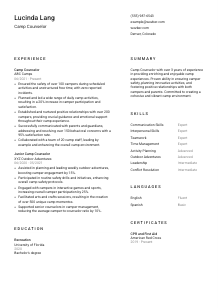
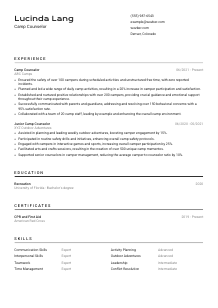
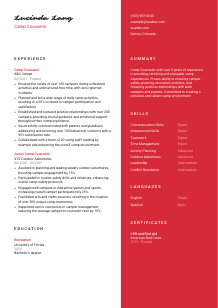
Guiding campfire tales, but your CV feels lost in the woods? Make your way through this Camp Counselor CV example, created with Wozber free CV builder. Learn how to match your outdoor leadership to the job's scouting needs, setting your career compass true north in the great employment frontier!
Camp Counselor hiring starts with trust. A camp is handing you responsibility for children's safety, energy, and day-to-day experience, often in fast-moving group settings where supervision, activity leadership, and judgment all matter at once. Your CV needs to show that you can keep campers safe, run engaging programs, and work calmly with families and staff.
A tailored CV quickly separates candidates who have actually led camper groups from those with more general childcare or recreation backgrounds. Using Wozber's free CV builder to shape an ATS-compliant CV around the posting helps surface the right terms, from camper safety to activity planning and parent communication, so hiring teams can immediately see how your experience translates to the camp floor.
For a Camp Counselor role, the personal details section should answer practical questions fast. Can the camp reach you easily, are you presenting yourself professionally, and do you already meet basic location or communication requirements called out in the posting?
Use your full name in a slightly larger font than the rest of the CV. Camp hiring can move quickly before a season starts, so your document should be easy to scan and easy to remember.
Place "Camp Counselor" directly under your name if that is the role you are targeting. It immediately frames your background around camper supervision, activity leadership, and daily camp operations rather than around a broader education or recreation label.
Include a phone number you answer reliably and a professional email address. Camps often need to schedule interviews, confirm availability, or follow up on certifications quickly, so accuracy matters here more than style.
If a posting requires you to be based in a specific area, include that city and state clearly. In this example, listing Denver, Colorado helps remove a basic screening concern right away.
A LinkedIn profile can help if it reflects the same camp, youth, recreation, or education experience listed on your CV. Keep dates, titles, and certifications consistent so parents-facing communication skills and child-focused work history do not look mismatched across platforms.
This section is simple, but it carries screening weight. Clear contact details, the right title, and any required location information help the reader move straight to your camp experience instead of stopping on avoidable questions.




Experience is where camps look for proof that you can manage real groups of children, not just assist occasionally. Focus on moments where you supervised campers, led activities, handled behaviour concerns, supported safety protocols, and worked as part of a camp or recreation team.
Read the posting line by line and mark the responsibilities that define daily success. For Camp Counselor roles, that usually includes constant supervision, activity planning, outdoor or recreation leadership, parent communication, and collaboration with other staff. Those themes should show up clearly in your bullet points.
List your most recent relevant work first so the reader sees your current level of responsibility right away. If you have camp, after-school, youth recreation, or outdoor education experience, keep the section ordered to show progression from support duties into fuller leadership or counselor responsibilities.
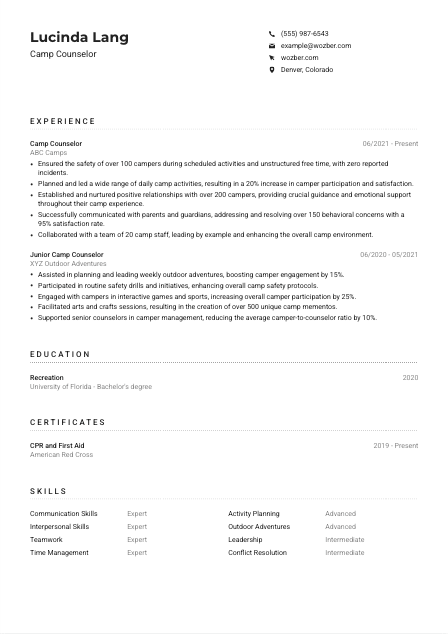
Each bullet should show what you were responsible for and what happened because of your work. Good Camp Counselor bullets often include supervising age groups, leading games or arts programming, supporting emotional well-being, resolving conflicts, or coordinating with families and staff. In the example CV, bullets such as ensuring camper safety and resolving parent concerns work well because they connect daily responsibilities to visible results.
Metrics make camp experience more credible when they reflect real scope. Use camper counts, activity participation rates, satisfaction scores, incident reduction, staff team size, or number of parent issues resolved. The sample CV does this effectively with details like supervising over 100 campers, improving participation, and maintaining zero reported incidents.
Prioritise experience that shows you can run a safe, engaging camp environment. If you also have unrelated jobs, keep them brief unless they add something directly useful such as leadership, conflict management, or group coordination. The reader should come away seeing you as someone ready to manage campers, not as someone hoping adjacent experience will do the work for you.
The best experience sections make camp work concrete. When your bullets show supervision, activity leadership, safety awareness, and communication with families and staff, the hiring team can picture you in the role without filling in the gaps themselves.
Many Camp Counselor openings ask for a degree in Recreation, Education, or a related field because it signals familiarity with youth development, program design, and structured learning environments. Your education section should make that connection easy to see.
If the role requires a bachelor's degree, list yours clearly with the degree type and field. When your background is in Recreation, Education, or another closely related area, that alignment should be obvious at first glance.
Include degree, field of study, school name, and graduation year or date. Keep the layout straightforward so the reader can confirm minimum qualifications quickly, especially during high-volume seasonal hiring.
When your degree matches the posting, let it do its job. In the provided example, a Bachelor's degree in Recreation lines up neatly with the requirement and reinforces the candidate's fit for activity-based youth programming.
If you are earlier in your career, relevant coursework or activities can help. Child development, outdoor leadership, recreation programming, education practicums, student mentoring, or club leadership can all support a Camp Counselor application when professional experience is still building.
You do not need to turn this into a long school profile, but worthwhile academic highlights can add context. Roles such as peer mentor, orientation leader, volunteer coordinator, or organizer of children's programs show initiative that translates well to camp settings.
This section should confirm the required academic background and, when relevant, reinforce your preparation for working with children in structured recreational settings. If the degree aligns cleanly, let that alignment be easy to spot.
Certifications carry real weight in camp hiring because they relate directly to child safety and emergency response. If a posting asks for current CPR and First Aid, treat those credentials as core qualifications, not side notes.
Start with the certifications named in the job description. For Camp Counselor positions, CPR and First Aid often move from preferred to essential because camps need staff who can respond appropriately during activities, free time, and outdoor incidents.
List the most role-relevant certificates before anything optional. Safety and youth-care certifications should appear ahead of general training because they speak directly to camper supervision and risk management.
Include dates or renewal ranges so the camp can see your credentials are active. The example CV handles this well by showing CPR and First Aid as current, which is exactly the kind of detail a hiring manager checks quickly.
If you have room, add other training that supports camp work, such as wilderness first aid, child protection training, water safety, behaviour management, or youth mental health support. Only include certificates that strengthen your ability to supervise, lead, or protect campers.
For this kind of role, certifications are operational qualifications. Current CPR and First Aid tell the camp that you can contribute to a safe environment from day one, which is exactly what this section should communicate.
A Camp Counselor skills section should read like the practical toolkit you use on the job. Prioritise skills tied to supervision, activity delivery, communication with children and parents, and working smoothly with a staff team through long, active days.
Start with the skills the posting emphasizes, then match them to your actual background. For this role, that includes interpersonal communication, activity planning, camper supervision, teamwork, and the ability to lead games, crafts, and outdoor activities safely.
Every skill listed should connect to a bullet in your experience, a certification, or your education. If you claim conflict resolution, parent communication, or outdoor leadership, the rest of the CV should show where you used those abilities with campers or staff.
Organise skills in a way that makes sense for camp hiring. You might group them into camper care, activity leadership, safety, and team collaboration, or simply lead with the most role-specific items. The sample CV works because it combines communication and teamwork with activity planning and outdoor adventures, which mirrors the job's day-to-day demands.
A focused skills section helps the reader connect your background to the realities of the role. When the list reflects supervision, safety, activity leadership, and communication, it supports the rest of your CV instead of repeating generic strengths.
Language ability matters in camp settings because counselors communicate constantly with children, parents, and coworkers. If the posting names a required language, make that easy to confirm, then treat any additional languages as added value for inclusive communication.
If fluent English is required, list it clearly and use an accurate proficiency label. For a Camp Counselor, this speaks directly to giving instructions, handling parent conversations, and responding clearly during safety situations.
After the required language, include others that may help you connect with campers or families from different backgrounds. Additional languages are a plus when they support rapport, inclusion, or clearer communication during activities and check-ins.
Use clear terms such as fluent, conversational, or basic rather than vague descriptions. Camp teams need to know whether you can manage real conversations with parents and campers, not just understand a few phrases.
Extra languages can strengthen your application when they help children feel welcomed and understood. This matters especially in camps serving diverse communities, though it should remain secondary to the required language and core counselor skills.
Do not overstate language ability or turn this into a cultural statement. The value is simple: if you can communicate clearly with more campers and families, that is useful in a camp environment. The example CV handles this well by listing fluent English first and Spanish as an additional skill.
For Camp Counselor roles, language skills are about trust, clarity, and inclusion. A concise language section helps the camp quickly confirm that you can communicate where it matters most, with children, parents, and staff.
The summary should give a hiring manager a quick read on your level of camp experience, your approach to camper care, and the kind of responsibilities you can handle. Keep it short, but make sure it covers the work that matters most in a camp setting.
Open with your title, years of experience, and the type of environment you know. If you have more than 2 years in camp or outdoor recreation, say so directly because that is often a screening threshold.
Include two or three core responsibilities that define your value, such as camper safety, activity planning, outdoor supervision, behaviour support, or parent communication. This gives the reader an immediate sense of your operating range.
A brief metric or result can strengthen the summary without turning it into a list. The example CV points to improving participation and supporting a positive camp environment, which works because those outcomes are native to the role.
Avoid generic enthusiasm and keep the focus on what you actually deliver in camp settings. A good summary sounds like someone trusted with children, group activities, and daily coordination, not like a general applicant trying to sound passionate.
When this section is done well, the rest of the CV reads through the right lens. The hiring team should immediately understand your experience level, your approach to camper safety and engagement, and why you belong in a counselor lineup.
A Camp Counselor CV works when it makes daily responsibility visible. Supervision, safety, activity leadership, parent communication, and teamwork should appear across the page in clear, specific language supported by numbers, certifications, and relevant education.
Use Wozber's free CV builder to organise your content in an ATS-friendly CV format, then refine the wording with its ATS CV scanner so the final version matches the posting naturally and stays easy to read. The result should make one thing clear right away: you are ready to lead a safe, engaging camp experience.




