



Use Wozber and land your dream job
Create CV
No registration required
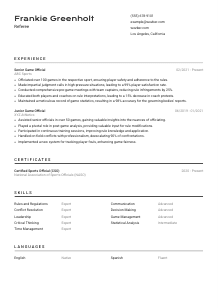
Playing defence on the pitch but feeling offensive on your CV? Check out this Referee CV example, created with Wozber free CV builder. It shows how to blow the whistle on your officiating skills to match any job's playing field, ensuring your career always stays fair and foul-proof!
Refereeing is public, fast, and unforgiving. Every call has to hold up under pressure, and your CV needs to show that you can manage a game with authority, protect player safety, and apply rules consistently when emotions run high.
A tailored CV helps separate general sports experience from actual officiating credibility. Using Wozber's free CV builder to create an ATS-compliant CV makes it easier to match the posting's language around rule enforcement, conflict resolution, incident reporting, and communication, so hiring teams can quickly see that you can control matches and document them properly.
Referee hiring starts with practical basics. If your contact details are incomplete, inconsistent, or missing a key requirement such as location, you create friction before anyone even gets to your officiating background.
Use your full name in a clear, readable format at the top of the page. For referees, credibility matters, and a clean header helps your CV feel organised and professional from the first glance.
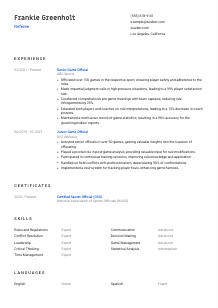
Place "Referee" or a more specific officiating title directly under your name if it reflects your actual background. If you have a higher level title such as "Senior Game Official," that can work well too, especially when the rest of the CV supports it with game volume, rule enforcement, and match control.
List a current phone number and a professional email address with no typos. Referees are trusted to communicate clearly before, during, and after games, so even this section should reflect reliability and attention to detail.
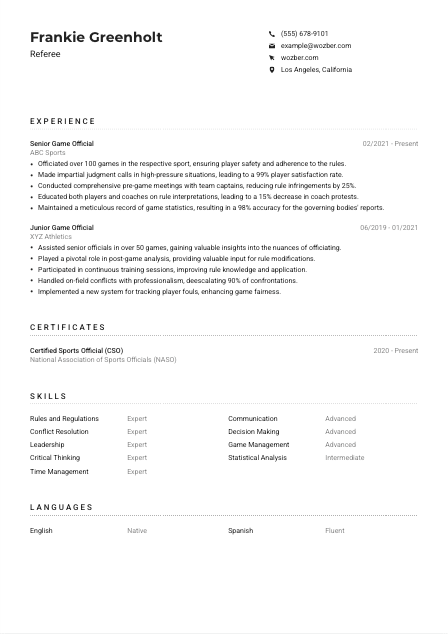
If a job requires you to be based in a certain area, show that requirement clearly in your header. In the example, listing Los Angeles, California directly supports the employer's stated location need and removes doubt about availability for local assignments.
Include LinkedIn or a professional profile only if it supports your CV with consistent titles, certifications, league history, or related sports leadership experience. Keep it aligned with your officiating record rather than using it as filler.
Your personal details should confirm that you are reachable, local if required, and professionally presented. That keeps the focus where it belongs, on your officiating experience and judgment.




This is the section that carries the most weight for a referee. Hiring teams want to see real officiating work, the level of competition you handled, how you applied rules, and how you managed pressure, disputes, and reporting responsibilities.
Before editing your experience section, pull out the exact responsibilities the employer emphasizes. For this role, that includes enforcing rules, making impartial judgment calls, leading pre-game meetings, educating players and coaches, and maintaining accurate records. Those points should shape which bullets you keep, cut, or rewrite.
List your officiating positions in reverse chronological order, including title, organisation, and dates. If you progressed from a junior role to a senior one, make that progression easy to see. The sample does this well by moving from "Junior Game Official" to "Senior Game Official," which immediately shows growth in trust and responsibility.
Your best bullets should show how you officiated, not just that you were present. Include work such as enforcing sport regulations, managing player conduct, handling protests, briefing captains, or reporting incidents. A bullet like "Officiated over 100 games, ensuring player safety and adherence to the rules" works because it ties volume to rule knowledge and on-field responsibility.
Numbers make this section more credible when they reflect the way officials are actually evaluated. Good examples include number of games worked, reduction in rule infringements, protest rates, reporting accuracy, or de-escalation outcomes. In the sample, reducing rule infringements by 25% and maintaining 98% report accuracy make the candidate's impact much easier to picture.
Do not crowd this section with generic sports involvement if it does not strengthen your officiating case. Prioritise bullets that show judgment, consistency, communication, conflict resolution, and recordkeeping. A hiring manager should be able to scan this section and quickly understand what level of match control you bring.
A referee's experience section should read like a record of sound judgment, clean rule enforcement, and reliable game administration. If those qualities are visible in your bullets, the section is doing its job.
Many referee roles lean more heavily on experience and certification than on formal education, but education can still support your profile. It helps when it adds relevant context, such as sports training, rules coursework, leadership development, or event-related study.
Start with the posting. If no degree is mentioned, keep this section straightforward and avoid overbuilding it. Use it to support your officiating profile, not to distract from experience and certification, which are often more important in sports official hiring.
List the school, degree or program, and graduation date if applicable. Clear formatting matters because hiring teams often review many CVs quickly, and this section should be easy to scan in a few seconds.
If you completed coursework in sports management, physical education, kinesiology, communications, or conflict management, include it when relevant. These subjects can reinforce your understanding of athletic environments, player interaction, and structured decision-making.
If you have workshops, clinics, or rule seminars that do not belong in the certificate section, this is a good place to mention them. Ongoing training helps show that your rule knowledge is current, especially in sports where interpretations and mechanics change over time.
Leadership in sports settings, team captaincy, event operations, or student athletics can help if you are earlier in your officiating career. Keep these details relevant and concise, especially if you already have more than 2 years of match experience.
For most referee CVs, education works best as background context. Let it reinforce your knowledge of the sporting environment while experience and certifications carry the main case.
Certification often matters more in officiating than in many other CV types because it signals formal rule knowledge, approved training, and eligibility to work certain matches or leagues. When a posting mentions certification, treat this section as essential.
Lead with credentials from recognized governing bodies or officiating associations. If you hold a sport-specific license or a certificate such as "Certified Sports Official," list it clearly with the issuing body so the reader can immediately understand its relevance.
Only include certificates that strengthen your case for officiating work. Prioritise credentials that show rules expertise, safety training, league approval, or officiating advancement over unrelated professional development.
Add the year earned and, when applicable, the active period. This helps employers see whether your credential is current. In officiating, recency matters because rule books, mechanics, and compliance standards can change from season to season.
If you renew credentials, complete advanced officiating clinics, or add higher-level certifications, update this section regularly. That tells employers you are keeping pace with rule changes and maintaining the standards required for competitive play.
When your credentials are current, specific, and easy to verify, they strengthen your authority as an official and support the experience claims elsewhere in the CV.
A referee's skills section should reflect what happens on the field, court, or match surface. That means rule interpretation, composure, communication, conflict management, and fast decision-making matter more than long lists of generic strengths.
Review the job description and note both technical and interpersonal requirements. Here, the clearest priorities are knowledge of rules and regulations, communication, conflict resolution, calm decision-making, and written English. These are also useful keywords for ATS optimisation when they accurately reflect your experience.
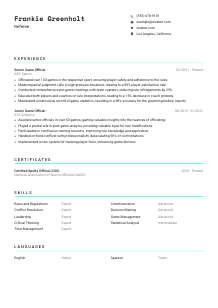
If the posting asks for "conflict resolution" and "quick decisions in high-pressure situations," use those terms instead of vague substitutes. The example CV does this well with skills such as Rules and Regulations, Conflict Resolution, Decision Making, and Game Management, which line up closely with the responsibilities of officiating matches.
Choose skills that support game administration and rule enforcement. Strong options include rule interpretation, communication, de-escalation, player management, incident reporting, leadership, positioning mechanics, and statistical recordkeeping if reporting is part of the role. Leave out broad traits that do not add specific value.
When the section reflects real officiating demands instead of generic strengths, it reinforces your fit for the assignment and improves ATS alignment at the same time.
Communication is central to officiating. Referees give instructions, explain rulings, manage tense exchanges, and file reports, so language skills matter most when they directly support game control and accurate communication.
If the posting asks for strong verbal and written English, show English clearly and state your level honestly. That requirement connects directly to pre-game briefings, in-game calls, coach interactions, and post-match incident documentation.
Extra language ability can be valuable in leagues with diverse players, coaches, and spectators. Spanish, for example, may be helpful in many sports communities, but treat it as a supporting strength rather than a substitute for officiating experience.
Use language levels that reflect what you can actually do under pressure. A referee who claims fluency should be able to explain decisions, manage disagreements, and understand fast exchanges in that language during a live match.
Multilingual communication can help reduce misunderstandings, defuse tension, and keep players focused on the game. That is especially useful when officiating youth, amateur, or community competitions where language backgrounds vary.
If you officiate in tournaments, regional circuits, or settings with international participants, language skills can become more important. Include them when they genuinely improve your ability to manage games and communicate rulings effectively.
For referees, language skills matter when they help you explain decisions clearly, manage people confidently, and produce accurate written reports.
Your summary should give a fast, credible picture of the level of officiating you bring. In a few lines, it should cover your experience, your command of the rules, and your ability to make sound calls in live competition.
Read the posting before writing the summary so you can prioritise the right points. For a referee position, that usually means years of officiating experience, sport-specific rule knowledge, calm judgment, communication, and any required certification.
Lead with a direct statement that gives the reader immediate context. The sample's opening, "Referee with over 4 years of experience officiating in the respective sport," works because it establishes tenure right away and clears the minimum experience threshold.
Mention abilities that reflect the actual work, such as making impartial judgment calls, conducting pre-game captain meetings, educating players and coaches on rule interpretations, or maintaining accurate game records. Choose points you can back up in the experience section.
Aim for a short paragraph that sounds grounded, not promotional. A referee summary should read with the same control the role requires: clear language, no inflated claims, and enough detail to show what level of games and responsibilities you can handle.
If your summary quickly communicates experience, composure, and rule authority, the rest of the CV starts from a much stronger position.
Your CV should make one thing easy to understand: you can apply the rules fairly, manage pressure, communicate decisions clearly, and document what happened after the game. That is the combination employers look for when hiring referees for real competition.
Use Wozber's free CV builder and ATS CV scanner to tighten your wording, align your background with the posting, and present it in an ATS-friendly CV format. The final result should give hiring teams a clear read on your officiating experience, certification status, and ability to control a match with confidence.