



Use Wozber and land your dream job
Create CV
No registration required
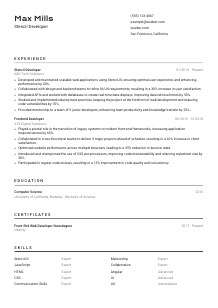
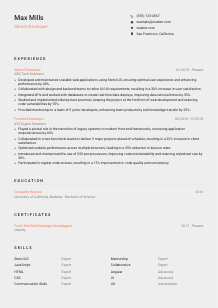
Spraying creativity, but your CV is fading into the background? Check out this Stencil Developer CV example, created with Wozber free CV builder. Learn how to stencil your design expertise to match job specifics, painting a career canvas that stands out in bold relief!
Stencil work sits at the intersection of component architecture, browser performance, and practical UI delivery. Hiring teams want to see more than general front-end experience. Your CV needs to show that you can build reusable web components, work comfortably with APIs, and ship interfaces that stay fast and maintainable as applications grow.
A tailored CV changes how quickly reviewers can place you in that delivery context. When StencilJS, responsive UI work, collaboration with design and backend teams, and measurable performance gains appear in the right sections, your experience reads as directly relevant instead of adjacent. Wozber's free CV builder helps structure that into an ATS-compliant CV, so both hiring teams and screening systems can quickly recognize where your front-end background matches the role.
This section does simple but important work. For a Stencil Developer opening, it should confirm basic eligibility, present a clear professional identity, and remove friction before anyone gets to your project history.
Put your name first and make it easy to scan. Right below it, use the role title you are pursuing, such as "Stencil Developer," when it accurately reflects your background. That small choice helps frame your experience around web components, UI engineering, and front-end application work from the first line.
Use a phone number you answer and an email address that looks professional in a technical hiring context. Keep it simple. If a recruiter wants to discuss framework experience, API integration work, or interview availability, your contact details should never create doubt about professionalism.
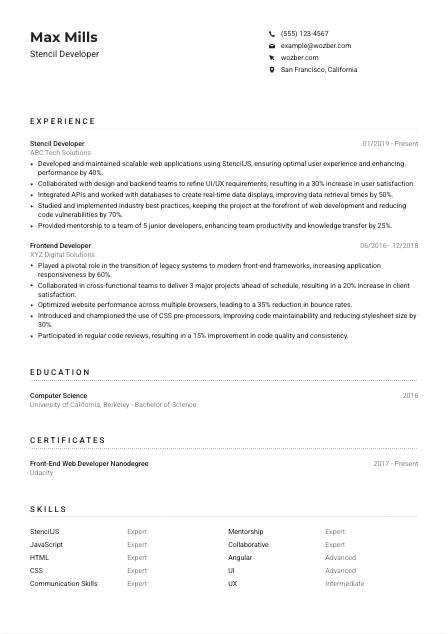
Some openings include a location requirement as a hard filter. Here, San Francisco, California is explicitly stated, so listing that location helps confirm eligibility immediately. Treat this as a tailoring move for this opening, not a rule for every Stencil Developer CV.
If you have a LinkedIn profile, portfolio, GitHub, or personal site, include the links that best show your component work, UI implementation, or shipped web applications. For this profession, a portfolio is especially useful when it includes responsive interfaces, reusable components, performance-minded code, or examples of framework-based front-end development.
You do not need to include extra demographic information, a full street address, or anything unrelated to the job. Keep this section focused on what helps a team contact you, confirm logistics, and connect you to the Stencil Developer role quickly.
By the time someone finishes your personal details, they should know who you are, how to reach you, and whether you meet any basic posting requirements such as location. That keeps attention where it belongs, on your front-end delivery record.




For Stencil Developers, experience is where the CV either becomes specific or stays generic. Bullet points should show the kind of interfaces you built, how you worked with product and engineering partners, and what changed because of your code, whether that was speed, maintainability, user satisfaction, or delivery quality.
Before rewriting bullets, mark the responsibilities and requirements that define the role. Here, the posting emphasizes StencilJS, scalable web applications, UI components, performance optimisation, API integration, database-related work, and collaboration across design and backend teams. Those are the themes your experience section should mirror in natural language.
List roles in reverse chronological order with title, company, and dates. Front-end hiring managers often scan quickly to understand your framework progression, team environment, and years of hands-on work. A clean timeline helps them see whether your path moved from broader front-end work into more component-focused engineering.
Each bullet should tie a concrete task to a result. Instead of saying you were responsible for front-end development, say what you built, improved, or integrated. The sample CV does this well by pairing StencilJS application work with a 40% performance improvement and API integration with 50% faster data retrieval. That structure tells a much clearer story than broad responsibility statements.
Quantify impact where you can with measures that make sense for the work. Good examples include page speed gains, reduced load times, improved responsiveness, lower bounce rates, fewer vulnerabilities, higher satisfaction scores, or delivery improvements tied to collaboration and code quality. Metrics are especially persuasive when they connect your component or UI work to actual product outcomes.
If a past role included work outside front-end engineering, keep the bullets that reinforce your target path. Prioritise component development, performance tuning, browser compatibility, responsive design, code review participation, framework migration, and mentoring if it shows technical leadership. The aim is not to document everything you have done, but to make your most relevant engineering work easy to recognize.
Your experience section should leave little doubt that you can build production UI with modern front-end tools, collaborate across functions, and improve the technical or business performance of the product. For a Stencil Developer, that is the proof that carries the most weight.
Education matters most when it answers a stated requirement or adds useful technical context. In front-end roles, it usually supports rather than leads, but when a posting asks for a bachelor's degree in Computer Science, Engineering, or a related field, this section should make that match obvious.
If you have the requested degree, list it clearly and use the official wording. This posting asks for a bachelor's degree in Computer Science, Engineering, or a related field, so a Bachelor of Science in Computer Science fits cleanly and should be easy to spot.
Present degree, field of study, school, and graduation date in a straightforward order. That keeps the section easy to parse in an ATS-friendly CV format and lets reviewers confirm academic background without searching through extra detail.
When your degree aligns with the role, make sure that connection is visible. A Computer Science background supports work in JavaScript, component architecture, browser behaviour, and data handling, all of which are relevant to Stencil-based front-end development.
If you are early in your career or your academic work directly supports the role, include selected coursework, capstone projects, or engineering labs. Focus on topics such as web development, UI engineering, software architecture, or database-backed applications. Skip this if your professional experience already carries the case.
Academic distinctions can be useful when they add technical credibility, especially for newer candidates. Honors, scholarships, research work, or leadership in computing clubs can strengthen the section if they point toward disciplined engineering work rather than just filling space.
This section does its job when a reviewer can confirm your degree requirement in seconds and see that your academic background supports front-end engineering work. If the role asks for formal education, make the match effortless to find.
Certifications are not always required for Stencil Developer roles, but they can strengthen your case when they show current front-end knowledge, structured learning, or continued development in tools and practices that matter to web application teams.
Prioritise certifications tied to front-end development, JavaScript ecosystems, web performance, UI engineering, or modern framework work. A credential such as a Front-End Web Developer Nanodegree fits because it supports the technical core of the role, even if the posting does not require a certificate by name.
A short, focused certification list is stronger than a long catalogue of loosely related courses. Keep the items that support your CV story. For this profession, that usually means training connected to component-based development, responsive design, testing, accessibility, or modern front-end workflows.
Front-end practices move quickly, and dates help reviewers understand whether your training is current. When you include issue or completion dates, certifications become more credible and more useful in showing that your knowledge has stayed active alongside your work experience.
New browser capabilities, framework patterns, performance techniques, and tooling practices keep changing the expectations for front-end developers. Ongoing study in areas such as design systems, accessibility, testing, web components, or performance optimisation can strengthen future applications and give you fresher language for your CV.
Certifications should back up your front-end trajectory, not compete with your experience section. When they are current and relevant, they show that your technical growth has continued beyond day-to-day project work.
The skills section works best when it reads like a realistic toolkit for the job, not a keyword dump. For a Stencil Developer, that means balancing core front-end technologies with the collaboration and technical judgment needed to ship usable, scalable interfaces.
Start with the hard and soft skills the employer actually names. Here, that includes StencilJS, JavaScript, HTML, CSS, responsive design, API integration, database work, communication, and cross-functional collaboration. Using the employer's language where it matches your real experience improves both ATS optimisation and human readability.
Lead with the tools and capabilities that define the work. For this role, StencilJS and core front-end technologies belong near the top, followed by related frameworks such as Angular if applicable, then collaboration strengths like communication or mentoring. This order helps reviewers understand your technical fit before they get to secondary strengths.
Avoid overloading the section with every library or soft skill you have ever used. Choose the technologies and working strengths that support component development, responsive UI delivery, API-backed features, and team collaboration. If the sample CV lists StencilJS, JavaScript, HTML, CSS, Angular, communication, and mentorship, that is a good illustration of a focused mix without turning the section into a giant inventory.
Your skills section should make the stack obvious. In a few seconds, a reviewer should understand that you have the front-end foundations, framework exposure, and collaboration habits needed to contribute to a Stencil-based product team.
Language fluency matters more in development roles than many candidates assume. Front-end work often involves requirement reviews, design discussions, code comments, pull requests, and documentation, so communication ability affects delivery quality as much as meetings.
If the posting specifies spoken and written English proficiency, include English clearly with an honest proficiency level. That matters for discussing UI behaviour, refining requirements with design partners, and communicating implementation details with backend or QA teams.
Additional languages can be worth listing when they reflect real proficiency. They may be useful in distributed teams, global product environments, or companies serving multilingual users. This is a useful bonus, even when the role itself does not require it.
Stick with familiar labels such as Native, Fluent, Professional, Intermediate, or Basic. Clear labels help hiring teams quickly understand whether a language supports everyday collaboration, documentation, or occasional conversation.
For developers, communication affects issue resolution, handoffs, and technical alignment. Listing relevant language ability can support your case when the role involves cross-functional teamwork, mentoring, or close interaction with non-engineering stakeholders.
If the employer works across regions, supports international users, or collaborates across time zones, extra language skills can add value. If not, keep the section brief and factual. The priority remains the language proficiency that directly supports the role's communication needs.
For a Stencil Developer, languages are most useful when they clarify how well you can collaborate, document, and communicate in real project settings. Lead with the required language, then add others only if they strengthen the picture.
Your summary should read like a quick technical introduction, not a collection of buzzwords. In a few lines, it needs to establish your level, your core front-end strengths, and the kind of results you have delivered in component-driven web application work.
Start from the actual demands of the position. For a Stencil Developer, that usually means front-end development, StencilJS or related framework experience, responsive UI work, and integration with APIs or data-driven features. Use that structure to decide what belongs in the opening lines.
Name your current professional profile and years of experience, then anchor it in the tools or work patterns most relevant to the role. The sample summary does this effectively by leading with Stencil Developer experience and then moving into front-end development, responsive design, and API integration.
Include the parts of the job you can already perform well, such as building scalable web applications, optimising performance, collaborating with design and backend teams, or mentoring junior developers. This gives the summary practical weight and helps distinguish you from candidates with only generic JavaScript experience.
Aim for three to five lines with direct language and specific strengths. Avoid soft claims like being passionate or results-driven unless they are tied to something tangible. A concise summary that names your framework background, front-end scope, and collaboration level gives hiring teams a cleaner starting point for the rest of the CV.
When this section is working, a reviewer immediately understands your front-end niche, your experience level, and why your background matches a Stencil-focused opening. That makes the rest of the CV easier to read in the right context.
A polished Stencil Developer CV should show clear component-focused front-end work, measurable performance or product improvements, and the ability to collaborate across design and engineering. When those points are easy to find, both recruiters and technical reviewers can quickly place your background in the kind of work the role actually requires.
Wozber's free CV builder can help you shape that into an ATS-friendly CV template, refine role-specific wording with AI support, and check alignment with an ATS CV scanner before you apply. The final result should make one thing easy to judge: you can step into a Stencil development environment and contribute with confidence.