



Use Wozber and land your dream job
Create CV
No registration required
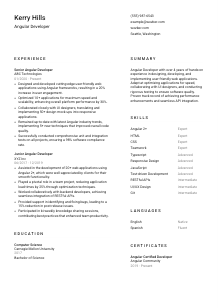
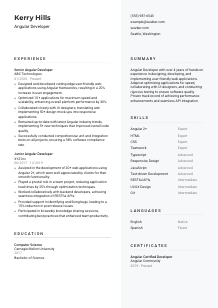
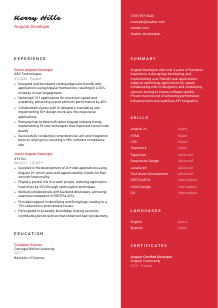
Navigating components and directives, but your CV seems unresponsive? Check out this Angular Developer CV example, created with Wozber free CV builder. Learn how to sync your front-end prowess with job requirements, building a career that's as dynamic as a single-page application!
Angular hiring moves quickly when a CV makes the right things obvious. Teams want to see more than familiarity with components and templates. They need proof that you can turn UI requirements into responsive, maintainable applications, work comfortably with backend integrations, and improve performance in ways users actually feel.
When that detail is tailored to the posting, your CV is easier to surface in ATS screening and easier for engineering managers to read as relevant from the first scan. Wozber's free CV builder helps you line up Angular, TypeScript, REST API, testing, and responsive design language with the role while keeping the document ATS-compliant. The result is a clearer picture of how you build, optimise, and ship front-end work.
This section does a quick but important job. For Angular roles, it should confirm who you are, how to reach you, and whether you meet any practical requirement such as location without adding distractions that have nothing to do with front-end delivery.
Put your name at the top in a clean, easy-to-read format, then place the role title directly beneath it. If you are applying for an Angular Developer job, use that exact title or a close match such as "Senior Angular Developer" only when it reflects your real level. This helps recruiters and hiring managers immediately place your background in the right front-end lane.
Use a current phone number and a professional email address you check regularly. One typo can cost you an interview, especially in fast-moving hiring cycles for web development roles. Keep the email simple, ideally based on your name, so the presentation feels as polished as your code.
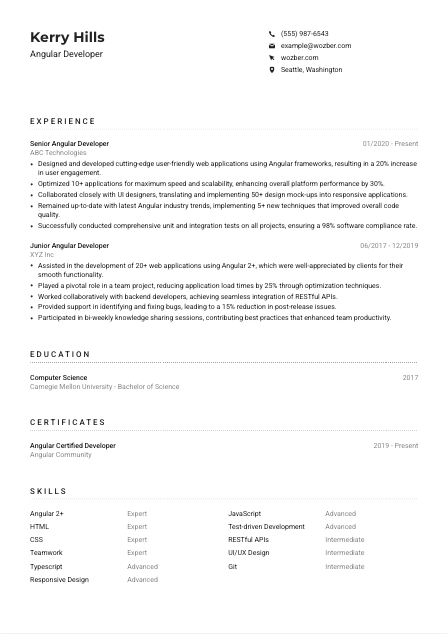
Some Angular openings are flexible. Others are tied to a specific office or hiring market. Here, the employer asks for Seattle, Washington, so listing Seattle, Washington in your contact block answers that requirement right away. Treat this as tailoring to the job at hand, not as a rule for every Angular application.
If you have a GitHub profile, portfolio, or personal site with Angular projects, include it. This is especially useful when the role involves translating mock-ups into responsive applications or integrating APIs, because reviewers can see component structure, UI decisions, and code quality beyond the CV bullets. Make sure those links are live and consistent with the experience you describe.
Age, marital status, and photos are usually unnecessary for software roles unless local norms explicitly require them. Keep the attention on Angular experience, TypeScript depth, testing habits, and application performance rather than personal information that does not help a team judge your technical contribution.
Your personal details should remove logistical questions in seconds. Once that is handled, the rest of the CV can stay focused on shipping Angular applications, collaborating across the stack, and improving user-facing performance.




Experience is where front-end hiring teams look for proof. They want to see what you built, how you built it, which tools and practices you used, and what changed because of your work. For Angular developers, that usually means application features, performance improvements, API integration, testing, and collaboration with design or backend teams.
Before editing your bullets, mark the terms that define the role. In this description, that includes Angular 2+, TypeScript, responsive design, RESTful APIs, testing, scalability, and collaboration with UI designers. Your experience section should mirror that language where it truthfully matches your work, so the CV reads as directly relevant instead of broadly front-end.
List your most recent position first with job title, company, and dates. That standard layout matters in engineering hiring because it lets reviewers quickly track your progression from junior implementation work to broader ownership, such as performance tuning, architectural input, or mentoring. Clear chronology also helps ATS tools parse your experience without confusion.
Replace generic duty statements with results tied to product behaviour, code quality, or delivery impact. The sample CV does this well by connecting Angular work to a 20% increase in user engagement, a 30% performance improvement, and a 98% software compliance rate through unit and integration testing. Metrics like load time reduction, defect reduction, feature throughput, or adoption improvements make front-end work much easier to evaluate.
Choose experience that supports the target role. For an Angular posting, prioritise component-based UI development, TypeScript, HTML, CSS, responsive behaviour, REST API consumption, testing frameworks, and Git-based team workflows. If you have broader JavaScript or full-stack history, include only the parts that strengthen your case for this opening.
Angular teams look for developers who can refine the product over time, not only implement assigned tickets. Include bullets about optimising rendering speed, reducing load times, handling scalable UI patterns, converting design mock-ups into usable interfaces, or introducing better testing practices. The example's mention of optimising more than 10 applications and implementing new Angular techniques is useful because it shows ongoing improvement, not static maintenance.
By the end of your experience section, a reviewer should understand the kind of Angular applications you have worked on, the level of ownership you held, and the technical outcomes you delivered. That is what moves your CV from familiar framework user to credible front-end contributor.
For Angular roles, education usually serves as a qualification check rather than the centre of the CV. It still matters when a posting asks for a specific degree, especially in software teams that use formal requirements to narrow an applicant pool.
This posting asks for a bachelor's degree in Computer Science, Information Systems, or a related field. If you have one, list the degree, field, school, and graduation year clearly. A Bachelor of Science in Computer Science, like the example, satisfies the requirement cleanly and should be easy to spot.
Avoid dense descriptions or decorative formatting here. Recruiters and hiring managers usually want a quick confirmation that your academic background aligns with the role. A straightforward entry is enough unless you are early in your career and need education to carry more weight.
If your degree directly supports software development, say so. "Computer Science" communicates more than a broad label because it reinforces your grounding in programming, systems thinking, and software engineering concepts that support Angular and web application work.
This is most helpful for junior candidates or recent graduates. Include coursework, capstones, or projects only if they strengthen your case for front-end development, such as web engineering, human-computer interaction, software testing, or API-driven application work. For more experienced Angular developers, your production experience should stay in the foreground.
Academic distinctions can add value, especially when you do not yet have extensive work history. Honors, scholarships, or technical project awards can signal discipline and technical potential, but keep them brief. They should support your software background, not compete with your professional accomplishments.
Your education section should quickly answer whether you meet the posting's academic requirement. Once that is clear, the rest of the CV can do the heavier work of showing Angular execution, collaboration, and front-end results.
Certifications are usually secondary to shipped work, but they can strengthen an Angular CV when they line up with the stack or the employer mentions them directly. They are most useful when they reinforce current framework knowledge or demonstrate continued investment in front-end practice.
If the posting mentions Angular certification as a plus, place any relevant credential here with the exact name. The example includes "Angular Certified Developer," which works because it directly supports the target framework rather than adding a generic tech badge.
Only include certifications that support the role you want. Front-end framework credentials, web performance training, testing-related certifications, or cloud certificates tied to your delivery environment can help. Unrelated credentials can dilute the message, especially when the job already has a clear Angular and TypeScript focus.
Frameworks evolve quickly, and dates help employers judge how current the credential is. Include the year earned and, if relevant, whether the certification remains active. This is particularly helpful in JavaScript ecosystems where versions, tooling, and best practices change fast.
If you regularly update your skills through Angular, RxJS, testing, or front-end architecture courses, this section can signal that you keep pace with the ecosystem. That matters for teams building modern applications where maintainability and current patterns have a real impact on codebase health.
Certificates will not replace strong project work, but they can sharpen your profile when they reinforce current Angular knowledge. Used selectively, they add another layer of confidence around your technical range and commitment to the stack.
This section should read like the toolset and working strengths behind your projects. For Angular positions, that means a tight mix of framework knowledge, front-end fundamentals, integration skills, testing habits, and the collaboration skills needed to work with designers, backend developers, and product teams.
Start with the skills the employer names directly, then add closely related ones you genuinely use. Here, Angular 2+, TypeScript, HTML, CSS, responsive design, RESTful APIs, communication, and teamwork belong near the top because they define the work. Matching this language helps both ATS screening and human review when the terms reflect real experience.
Order matters. Lead with Angular, TypeScript, HTML, CSS, responsive design, JavaScript, testing, and API integration before broader or secondary abilities. The sample CV does this fairly well by keeping Angular and core front-end skills prominent, then following with teamwork, testing, and Git. That ordering makes the candidate's working stack visible quickly.
Do not turn this section into an inventory of every tool you have touched. A shorter, better-prioritised list says more. For Angular jobs, include the technologies and working skills that affect delivery, such as component development, responsive UI implementation, REST integration, test-driven development, version control, and collaboration. Leave out tools that do not strengthen your case for this front-end opening.
A reviewer should be able to scan your skills and immediately recognize an Angular developer who can build interfaces, integrate services, test code, and work effectively inside a product team. Relevance matters more than volume.
Language skills matter most when the role depends on clear technical communication across teams, documentation, or client interaction. In software positions, this section is usually brief, but it can still answer an explicit requirement and remove uncertainty early.
This job specifically asks for strong English communication, so English should appear first with an accurate proficiency level. For Angular developers, strong English often affects more than conversation. It shapes code review discussions, ticket handoffs, written updates, and collaboration with designers or backend engineers.
List languages from strongest to weakest so the reader can interpret them quickly. Native or fluent languages should appear before conversational or basic ones. That simple structure avoids confusion and keeps the section easy to scan.
Terms such as native, fluent, advanced, intermediate, and basic are usually enough. Keep them honest. Overstating language ability can become obvious fast in interviews or day-to-day engineering collaboration, especially when the role involves explaining implementation choices or discussing defects and requirements.
Extra languages can help in global teams, international products, or multilingual client environments, but they do not need oversized attention on every Angular CV. Include them when they strengthen the application, then let your technical experience stay central.
If your language ability improves, update the rating. The same goes for any language you no longer use confidently. Accurate communication levels matter because software teams rely on clarity in standups, documentation, issue tracking, and cross-functional planning.
For this kind of role, the main purpose of the languages section is simple. It should confirm that you can communicate clearly in the environment the team works in, then stay out of the way of your Angular credentials.
Your summary sits at the top of the CV, so it needs to frame your background in practical terms. For Angular developers, that usually means years of experience, front-end focus, core technologies, and a short line on the results you tend to deliver.
Start with your role and years of experience in language that matches the jobs you are targeting. "Angular Developer with 4+ years of experience" works because it answers the first screening question immediately. Keep the title accurate to your actual background and avoid inflated labels that your experience section cannot support.
Use the next sentence to connect your technical strengths to business or product results. The example summary does this well by mentioning web application development, speed optimisation, collaboration with UI designers, testing, and API integration. Those are strong themes because they map directly to how Angular developers contribute on the job.
Aim for three to five lines. That is enough space to cover your Angular experience, core technologies, and one or two result areas such as performance, responsiveness, testing quality, or scalable implementation. Treat the summary as a high-value preview, not a full biography.
A brief line about your professional approach can help when it stays concrete. For example, mention that you focus on responsive UI delivery, clean integration with backend services, or maintaining code quality through unit and integration testing. That says more than a generic claim about passion or motivation.
Your summary should tell a hiring team, in a few lines, what kind of Angular developer you are and what kind of front-end results usually follow your work. When that message is clear, the rest of the CV has a strong frame to build on.
A solid Angular CV makes your front-end judgment visible. It shows that you can build responsive interfaces, work confidently with TypeScript and APIs, test what you ship, and improve performance in ways that matter to users and teams.
Use Wozber's free CV builder and ATS CV scanner to tighten the language, align your experience with the posting, and present everything in an ATS-friendly CV format. The finished CV should make it easy to see that you are ready to contribute to Angular development from day one.




