



Use Wozber and land your dream job
Create CV
No registration required
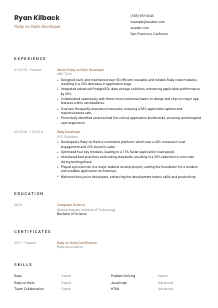
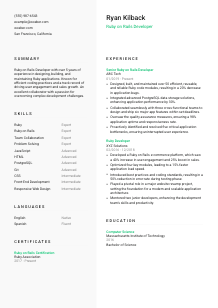
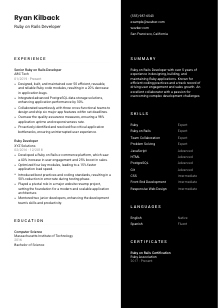
Crafting sleek code, but your CV feels dev-oid of luster? Check out this Ruby on Rails Developer CV example, made with Wozber free CV builder. It shows how to seamlessly match your Ruby gems to job specs, keeping your career track as dynamic as your web apps!
Rails teams look for developers who can ship features without leaving a trail of brittle code, slow queries, or avoidable bugs behind them. Your CV needs to make that visible fast through the kind of work you have handled, the applications you have supported, and the results you improved, whether that meant cleaner Ruby modules, faster page loads, steadier uptime, or smoother collaboration with product and QA.
When a Ruby on Rails CV is tailored well, the first pass becomes much more concrete. Wozber's free CV builder helps you align your wording with the job description and present it in an ATS-friendly CV format, so terms like Ruby on Rails, PostgreSQL, JavaScript, and feature delivery are easy to surface. That makes it easier for a hiring team to see whether you can contribute to a Rails codebase from day one.
This section handles the basics, but it still affects how smoothly your application moves forward. For a Ruby on Rails Developer, clean contact details, the right title, and any location requirement should be immediately clear, especially when the employer has practical filters before they even review your experience.
Use your full name as the main heading and make it the easiest text to scan at the top of the page. Keep the styling simple and readable. Rails hiring usually rewards clarity over flair, and that starts with a layout that feels as organised as the codebase you want to work in.
Place the target title directly under your name. If the posting says "Ruby on Rails Developer," use that wording unless your background is clearly more senior and the role supports it. Matching the title helps both ATS parsing and human reviewers connect your profile to the stack and responsibilities they are hiring for.
Include a reliable phone number, a professional email address, and a relevant link if you have one. For this profession, a GitHub profile, portfolio, or personal site can strengthen your application when it shows Rails projects, code samples, API work, or shipped products. Only include links you would be comfortable having reviewed in an interview.
Some Rails roles are flexible, others are not. Here, the employer specifically asks for someone located in San Francisco, California, so that belongs in your personal details if it applies to you. Stating the city and state clearly removes an avoidable screening issue before your technical background is even considered.
A website, GitHub account, or LinkedIn profile can help if it reinforces your backend and full-stack credibility. Prioritise links that show Ruby, Rails, database work, test coverage, or production-facing applications. Skip anything outdated or loosely related. Every item here should support the case that you are ready to work in a Rails environment.
Personal details do not need personality tricks. They need to remove friction, match the posting, and make it easy for the employer to contact someone who already looks viable for the Rails team.




For Ruby on Rails hiring, experience carries the most weight when it shows what you built, how you improved the application, and what technical problems you solved. Hiring managers want to see more than "worked on web apps." They want evidence of delivery in a Rails stack, collaboration across teams, and impact on performance, reliability, or product outcomes.
Start by identifying the work the employer actually needs done. In this case, that includes building and maintaining Ruby code, working with PostgreSQL or MySQL, shipping features with cross-functional teams, and resolving bottlenecks. Your bullets should echo those areas through real work you have already done, not generic engineering language.
List your most recent job first, then work backward with job title, company, and dates. That layout helps reviewers quickly understand how long you have worked with Rails and whether your experience has progressed from implementation into broader ownership such as architecture decisions, mentoring, or release coordination.
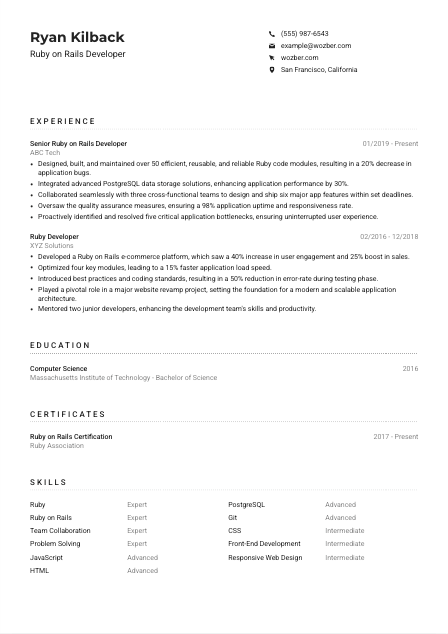
Each bullet should describe a concrete contribution. Good Rails bullets often cover feature development, code refactoring, API design, database integration, performance tuning, testing practices, or bug resolution. The sample CV does this well with bullets about building code modules, integrating PostgreSQL, and shipping major app features with cross-functional teams.
Numbers make technical contributions easier to judge. Use metrics that fit software work, such as defect reduction, load speed gains, uptime, feature volume, release cadence, or engagement outcomes tied to the product. In the example, a 20% decrease in bugs, 30% performance improvement, and 98% uptime tell a much clearer story than vague claims about quality.
You do not need to include every responsibility from every job. Prioritise experience that proves you can contribute to a Rails application today, especially work involving Ruby, Rails conventions, relational databases, front-end coordination, and team delivery. If you have older or adjacent experience, keep it brief unless it directly supports the role you are targeting.
Your experience section should leave no doubt about the kind of Rails work you can own. Focus on delivered features, database and application performance, code quality, and the business or user results your engineering work supported.
Education matters most here as a qualification check and a quick indicator of your technical foundation. For a Ruby on Rails Developer, this section should confirm that you meet the degree requirement while staying clean and brief unless early-career academic work is especially relevant to web development or software engineering.
If the posting asks for a Bachelor's degree in Computer Science, Engineering, or a related field, make sure your degree is listed in a way that clearly matches. A Computer Science degree is a straightforward fit for a Rails role because it supports the fundamentals behind web architecture, databases, algorithms, and software design.
List the degree, field of study, school name, and graduation year. That is usually enough. Keep the formatting easy to scan so the reviewer can confirm the credential without digging through extra text.
When your degree is closely related, do not bury it. "Bachelor of Science in Computer Science" immediately supports a backend or full-stack application. In the example, that degree aligns neatly with the employer's educational requirement and reinforces the candidate's technical base.
Additional learning can help, especially if it relates to web development, databases, software engineering, or application architecture. If you are early in your career, selective coursework, capstone projects, or bootcamp training may deserve a mention. If you already have several years of Rails experience, keep this section lean.
Academic distinctions are most useful when they add substance. A strong software project, open-source contribution, hackathon result, or honors distinction can help if it connects to backend systems, web applications, or collaborative development. Leave out filler that does not strengthen your profile for engineering work.
Education does not need to carry your application once you have real Rails experience, but it should still clearly support the role. Make the credential easy to find and keep the emphasis on technical relevance.
Certifications are rarely the main deciding factor for Rails hiring, but they can reinforce specialization and continued learning. Used well, they show that you stay current with frameworks, development practices, or adjacent tools that matter in modern web application work.
Choose certifications that strengthen your case for Ruby on Rails development, backend engineering, testing, cloud deployment, or database work. If a certificate has little connection to the role, it does not need space on the page.
One well-matched certificate is better than a long list of generic training badges. A Ruby on Rails certification, for example, can support your profile when it sits alongside real project work and professional Rails experience. The example CV uses that kind of credential effectively because it reinforces, rather than replaces, experience.
Certification dates help show whether the training is current, especially in a field where frameworks, tooling, and deployment practices evolve. If a certificate is active, renewed, or recently completed, note that clearly.
If you regularly complete courses or renew relevant credentials, keep this section current. Rails employers often value developers who continue sharpening their approach to testing, security, performance, and maintainable architecture, even when those improvements come through shorter learning programs rather than formal certifications.
Certificates work best when they back up the story already told by your experience. Keep the list relevant, current, and tied to the kind of Rails work you want to do next.
The skills section should give a hiring team a fast technical read on your stack. For a Ruby on Rails Developer, that means leading with the technologies and working strengths that shape day-to-day delivery, from Ruby and Rails to database work, front-end coordination, and collaboration inside a product team.
Mirror the required technologies you genuinely use. Here, that means Ruby, Ruby on Rails, JavaScript, HTML, CSS, and a database such as PostgreSQL or MySQL. When those terms appear naturally in your skills and experience, ATS systems and engineering reviewers can map your background to the role much faster.
Rails developers often work across controllers, models, views, APIs, and database layers while coordinating with designers, product managers, and QA. Include collaboration and communication if they are real strengths, but keep the technical core dominant. In the sample, Ruby, Rails, PostgreSQL, JavaScript, and Git create that backbone, while team collaboration supports it.
Do not turn this section into a master inventory of every tool you have touched. Prioritise the skills that directly support the target position and trim older, weaker, or unrelated items. A shorter list with strong alignment is more convincing than a long list with no clear technical focus.
A hiring team should be able to glance at this section and understand your Rails toolkit immediately. Lead with the technologies you can use in production and support them elsewhere in the CV with real outcomes.
Language skills matter when the role depends on clear communication across engineering, product, and support functions. For a Ruby on Rails Developer, that usually means showing you can communicate technical issues, feature tradeoffs, and delivery updates clearly, especially when the job description explicitly requires English.
When the posting says clear English communication is required, list English first and state your proficiency honestly. This matters in engineering roles because code reviews, standups, documentation, and cross-functional discussions all depend on precise communication.
Lead with the language the employer needs, then add others in descending order of proficiency or usefulness. That keeps the section aligned with the role while still showing broader communication range.
Extra languages can be useful in distributed teams, global products, or customer-facing technical environments. They are not usually the deciding factor for a Rails developer role, but they can add value when they reflect genuine fluency rather than casual familiarity.
Terms like "Native," "Fluent," or "Professional Working Proficiency" help set expectations quickly. The sample CV handles this cleanly with English listed as Native and Spanish as Fluent, which is enough detail without overexplaining.
Unless multilingual communication is central to the job, this section should stay short. Its purpose is to confirm communication readiness, not compete with your technical qualifications for attention.
For this kind of engineering role, language listings should quickly confirm that you can collaborate, document work, and discuss technical issues clearly. Lead with the required language and keep the rest concise.
Your summary should tell a Rails hiring manager what kind of developer you are before they reach the first bullet in your experience section. In a few lines, it should establish your level, your core stack, and the kind of application or engineering impact you are known for.
Start with a direct line that identifies you as a Ruby on Rails Developer and states your experience clearly, such as 3+ years or 5+ years depending on your background. This immediately places you within the experience range the employer is considering.
Mention the technical and working strengths that define your value. Good examples include building maintainable Rails applications, improving performance, working with PostgreSQL or MySQL, or collaborating across product and engineering teams to ship features. The sample summary uses efficient coding practices and measurable product impact effectively.
Aim for three to five lines. That is enough space to establish your stack, highlight one or two meaningful outcomes, and signal how you work. Avoid broad claims that could belong to any software engineer if they do not tell the reader something useful about your Rails background.
Adjust your summary for the specific opening by reflecting the employer's terminology where it matches your actual experience. If the role emphasizes reusable Ruby code, database integration, performance, and collaboration, those ideas should appear naturally in your opening paragraph. Wozber's AI CV builder can help surface missing role terms and tighten the phrasing so the summary aligns with both ATS screening and technical review.
A well-written summary gives immediate context for everything that follows. By the time a reviewer reaches your experience section, they should already understand your level, your stack, and the kind of engineering results you typically deliver.
Your Ruby on Rails Developer CV should now read like someone who has built real applications, worked comfortably with databases and front-end counterparts, and improved performance or reliability where it mattered. Keep the focus on shipped work, measurable outcomes, and the Rails stack you can support in production.
Before sending it out, run one last tailoring pass for the target posting. Wozber's free CV builder, ATS CV scanner, and ATS-friendly CV templates can help you tighten language, map requirements to the right sections, and produce an ATS-compliant CV that makes your Rails experience easy to evaluate. The final result should make one thing clear quickly: you can step into a Ruby on Rails codebase and contribute with confidence.