



Use Wozber and land your dream job
Create CV
No registration required
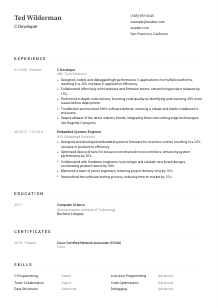
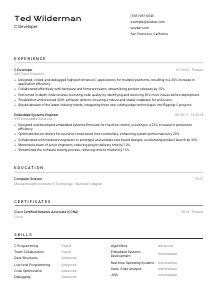
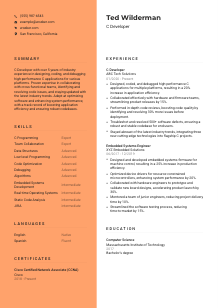
Crafting kernels, but your CV feels stuck in an infinite loop? Check out this C Developer CV example, created with Wozber free CV builder. Learn how to code your skills to match job criteria, so your career advancement isn't blocked by syntax errors!
C developers are often hired into codebases where stability, performance, and debugging discipline matter as much as feature delivery. A CV for this work needs to make your technical judgment visible. Hiring teams want to see how you handle low-level programming, how you improve reliability across platforms, and whether you can work through defects without losing sight of system behaviour.
When that experience is tailored well, the CV quickly separates general software development from hands-on C work in systems, embedded, or performance-sensitive environments. Wozber's free CV builder helps you align your wording with the posting and produce an ATS-compliant CV that surfaces the right terms early, so reviewers can immediately see your depth in C development and supporting areas like debugging, code review, or RTOS exposure.
The personal details section should remove uncertainty before anyone reaches your experience. For a C Developer application, that means making your identity, role target, contact information, and any location requirement easy to scan in seconds.
Use your full name in the most prominent text on the page. Keep it simple and professional. This section does not need design tricks. In technical hiring, clarity matters more than styling, and your name should be instantly visible when a recruiter or engineering manager opens the file.
Place the exact target title directly under your name when it reflects the position you want. If the posting says "C Developer," use that wording rather than a broader label like "Software Engineer." That small choice immediately tells the reviewer that your background is centered on C development rather than general application work.
Include a phone number and professional email address, then check them carefully. One typo can cost you an interview. If you also maintain a portfolio, GitHub, or technical website with embedded work, low-level projects, or code samples, include it only if it strengthens your case for this kind of engineering role.
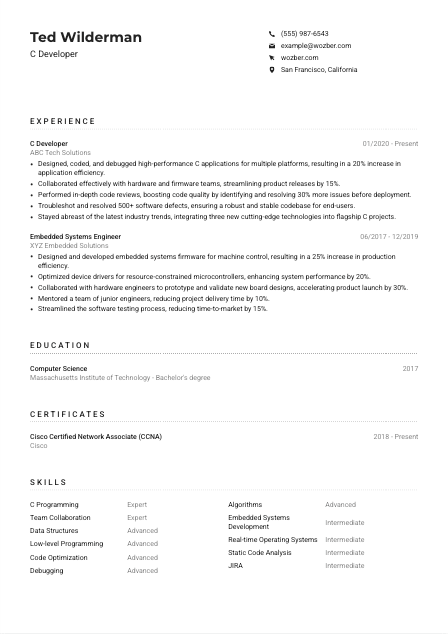
Some roles make location a firm filter. Here, the employer specifically asks for someone based in San Francisco, CA, so listing "San Francisco, California" in the example CV directly supports that requirement. Use this tactic whenever a job posting names a city or region, but do not treat location as a universal priority for every C Developer role.
A LinkedIn profile or personal site can reinforce your CV when it shows relevant engineering substance, such as firmware projects, systems programming work, or cross-platform development. Skip empty links. If you include one, make sure it supports the same professional story your CV is already telling.
This section is short, but it still shapes the first read. Give the employer a clear name, a precise role target, reliable contact information, and any required location detail so the CV can move quickly to what matters most in C development: code quality, technical scope, and delivery history.




For C Developer roles, experience is where employers look for real engineering range. They want to see what you built, how close you worked to the system, what kinds of defects you solved, and whether your work improved performance, reliability, or release speed.
Read the job description closely and mark the phrases that define the work: C development, data structures, algorithms, low-level programming, code reviews, defect resolution, and collaboration across teams. Then reflect those concepts in your own bullets where they are true. The example CV does this well with wording such as "designed, coded, and debugged high-performance C applications," which closely matches the employer's priorities without sounding copied.
Use reverse chronological order and include your job title, employer, and dates for every position. For engineering CVs, this structure helps reviewers quickly map your progression from junior implementation work to deeper ownership, such as platform development, embedded systems, or code quality responsibilities.
Do not stop at generic task statements like "worked on C applications" or "participated in debugging." Show what changed because of your work. Good bullets name the technical action, the environment, and the result. In the sample, "Troubleshot and resolved 500+ software defects" is stronger because it shows both the scale of the work and the contribution to codebase stability.
Quantified impact is especially persuasive in technical roles when the numbers reflect how the work is actually judged. Use improvements in efficiency, defect reduction, release speed, throughput, uptime, or test cycle time where appropriate. The sample's gains in application efficiency, release streamlining, and issue detection all give the reader a clearer view of engineering impact than vague claims about success.
Prioritise bullets that support this kind of role: C programming, low-level optimisation, debugging, embedded or RTOS exposure, code reviews, and work with hardware, firmware, or cross-functional product teams. The sample's earlier embedded systems role is useful because it reinforces resource-constrained development and collaboration with hardware engineers, both of which strengthen a C Developer profile.
A hiring team should be able to scan this section and understand where you have written C in production, how you handle debugging and code review, and what business or system results followed. When the bullets stay concrete, your experience reads like proven engineering work rather than a list of responsibilities.
Education tends to be straightforward for C Developer roles, but it still matters when the posting names a specific credential. Keep this section clean and factual so the required academic background is easy to confirm.
If the job asks for a Bachelor's degree in Computer Science, Engineering, or a related field, make sure that information appears clearly. In the example, "Bachelor's degree" in "Computer Science" from MIT directly checks that box. Use the exact field name you earned rather than a vague abbreviation.
List the degree, field of study, school, and graduation year or date in a standard format. This section should be easy to scan and should not compete visually with your experience. Technical recruiters usually want confirmation here, not a long academic narrative.
Where the employer names a field such as Computer Science or Engineering, mirror that language accurately if it matches your degree. This is useful both for human review and ATS matching. If your degree is in a related discipline, name it clearly and let your experience reinforce the technical fit.
Coursework can be worth including if you are early in your career or if it directly supports the role through operating systems, algorithms, computer architecture, embedded systems, or low-level programming. For experienced C developers, the degree itself is usually enough unless a course fills an obvious gap in your work history.
Honors, thesis work, capstone projects, or research can add value when they connect to systems programming, compiler work, embedded development, or performance-critical software. Keep these details selective. They should support your technical direction, not turn the section into a transcript.
This section only needs to answer the credential question cleanly. Once the degree is clear, your CV should return focus to the engineering work, problem-solving depth, and code-level contribution that matter most for a C Developer.
Certifications are optional in many C Developer searches, but they can still strengthen your profile when they add relevant technical depth. The key is relevance. List credentials that support systems work, embedded environments, tooling, or adjacent infrastructure knowledge.
Start with the job description. If no certification is required, treat this section as supporting material rather than a centerpiece. In this case, the employer does not ask for one, so any certificate you list should add context rather than distract from your C experience.
Choose certifications that connect naturally to the role. Embedded systems, networking, Linux administration, security, or systems architecture can all be relevant depending on the product environment. The sample includes a CCNA, which may help if the C work touches networked devices or infrastructure, though it is less central than core programming experience.
List the completion date and, if relevant, the validity period. This is especially useful for credentials that expire or require renewal. It shows that your knowledge is current and that you maintain professional discipline beyond day-to-day project work.
If you are aiming at embedded or real-time C roles, look for training that deepens your understanding of RTOS concepts, device communication, testing, or performance analysis. Certifications are most valuable when they sharpen the kind of engineering problems you actually want to solve.
Use this section to back up your technical direction with focused credentials. For C Developer roles, certificates work best when they add context around systems, devices, tooling, or adjacent infrastructure and leave no doubt about where your strengths are headed.
A C Developer skills section should do more than list buzzwords. It should show the technical toolkit behind your work: core language ability, systems knowledge, debugging strengths, and the collaboration skills needed to ship stable code with other engineers.
Pull required and preferred skills directly from the posting where they match your background. Here that includes C development, data structures, algorithms, low-level programming, embedded systems, real-time operating systems, collaboration, and English communication. This gives your skills section stronger ATS alignment and keeps it grounded in the role's actual demands.
Put C programming near the top, followed by the supporting areas that define your depth, such as debugging, code optimisation, data structures, algorithms, static analysis, embedded development, or RTOS experience. The sample skills list works because it leads with C and then expands into low-level and systems-adjacent strengths rather than burying them under generic software terms.
A shorter, well-prioritised list is stronger than a crowded one. Group or order skills so the reviewer quickly sees the core of your profile: language expertise, systems knowledge, and team-facing strengths like code reviews or cross-functional collaboration. Include tools such as JIRA only after the foundational engineering skills are already clear.
When this section is ordered well, a reviewer can see your command of C, your comfort with low-level and embedded concepts, and your ability to work effectively inside a delivery team. That combination is far more useful than a long inventory of disconnected terms.
Language skills matter in technical hiring when they affect documentation, code reviews, incident handling, or day-to-day collaboration. If the posting names a required language, make it easy to find.
This posting specifically requires strong English communication, so English should appear first in the section with an honest proficiency level such as Native or Fluent. That matters because C developers often need to explain defects, review code, document implementation details, and work through technical tradeoffs with teammates.
List the language most relevant to the role first, then add others that may support collaboration in broader teams or customer environments. In the example, English leads and Spanish follows, which keeps the section aligned with the job requirement while still showing additional communication range.
Extra languages are worth listing if they reflect your ability to work across distributed teams, support international products, or communicate in multilingual engineering environments. They are helpful supporting details, though they should not compete with your technical qualifications.
Use clear labels such as Native, Fluent, Advanced, or Intermediate. Avoid overstating your level. If you are likely to participate in technical discussions, code reviews, or documentation in that language, your stated proficiency should match that reality.
Some C Developer jobs are deeply local to one engineering team, while others involve firmware vendors, hardware partners, offshore QA, or globally distributed development. Include the languages that support that kind of collaboration when they are relevant to your actual work history.
For this kind of role, language ability matters most when it strengthens technical communication. If your CV makes English proficiency easy to see and adds any other useful languages honestly, this section does its job.
The summary is the fastest way to frame your technical identity. For a C Developer, it should tell the reader what kind of engineering work you do, how much experience you bring, and what areas of impact you repeatedly deliver.
Before writing, identify the two or three ideas the employer cares about most. In this posting, that includes professional C development, low-level programming strength, debugging, and collaboration. Use those priorities to decide what belongs in the opening lines instead of writing a generic software profile.
Lead with a direct statement of who you are professionally. A line like "C Developer with 5+ years of experience" works because it gives the reader immediate orientation. If your background leans embedded, systems, or performance optimisation, bring that in early as well.
Use the next lines to connect your core strengths to outcomes. The example summary does this effectively by combining high-performance C application work, cross-functional collaboration, issue resolution, and software optimisation. That combination is more convincing than broad claims about being passionate or results-driven.
Aim for a short paragraph that can be read quickly, usually three to five lines. Do not repeat every skill from the CV. Focus on the technical scope, the kind of systems you have worked on, and one or two meaningful contributions, such as improving efficiency, stabilizing code, or shipping across multiple platforms.
By the time someone finishes these opening lines, they should already understand your C background, your level of engineering maturity, and the kind of problems you solve well. That makes the rest of the CV easier to read in the right context.
A C Developer CV works when it shows where you have written production code, how you think at the systems level, and what results followed from your work. Keep the document grounded in technical scope, debugging depth, performance or reliability gains, and the collaboration required to ship stable software.
Use Wozber's free CV builder to organise that experience into an ATS-friendly CV format, align your language with the posting, and strengthen ATS optimisation with role-specific terminology. The final read should make it easy for hiring teams to see that you can contribute to real C development from day one.




