



Use Wozber and land your dream job
Create CV
No registration required
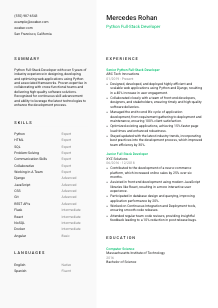
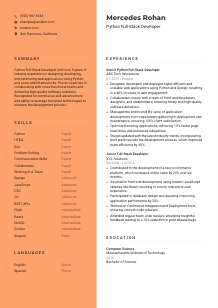
Juggling Python and stacks, but your CV feels like running into a syntax error? Check out this Python Full-Stack Developer CV example, built with Wozber free CV builder. Learn how to align your full-stack fluency with job specifics, scripting a career bound to execute to perfection!
Python Full-Stack Developer CVs get attention when they show how you build and maintain production web applications across the stack, not when they read like a generic list of languages. Hiring teams want to see where you owned backend logic, API design, front-end delivery, database work, and performance improvements, and how that work held up in a collaborative engineering environment.
A tailored CV helps separate candidates who know Python from candidates who have shipped with it in a full-stack setting. Using Wozber's free CV builder and an ATS-friendly CV format makes it easier to match the posting's language around Django, Flask, React, SQL, NoSQL, scalability, and deployment, so your CV surfaces the technical scope and delivery record the role calls for.
For engineering roles, the header does quiet but important work. It tells the reader whether they are looking at the right specialization, whether they can contact you fast, and whether basic logistics like location or portfolio access are already covered.
Keep your name prominent and clean at the top of the page. Use the version you use on LinkedIn, GitHub, and professional profiles so recruiters, engineering managers, and background checks do not run into mismatched records.
Place "Python Full-Stack Developer" directly under your name when that is the role you are applying for. This immediately positions you in the right lane, especially when the posting is looking for someone with several years of Python-based full-stack experience rather than a general software engineer.
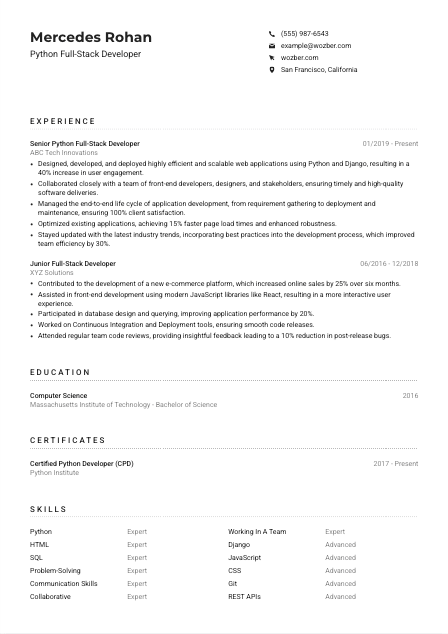
List a professional email address, a reliable phone number, and your city and state. In this example, San Francisco, California directly supports a posting that requires local candidates or relocation. If relocation applies to you, make that clear instead of leaving the employer to guess.
A GitHub profile, portfolio, personal site, or LinkedIn page can add useful context when it shows deployed applications, API work, React interfaces, database projects, or code samples. Only include links that are current and reinforce the stack you want to be hired for.
Skip details such as age, marital status, photo, or other non-job-related identifiers. Use the space for information that supports hiring decisions, such as location, web presence, or contact channels tied to your engineering work.
This section should answer three questions fast: who you are, what role you do, and how to reach you. For a Python Full-Stack Developer, that clean start helps the reader move quickly to the code, systems, and delivery history that matter most.




This is where hiring teams decide whether your background matches the level and scope of the role. For full-stack work, they are looking for shipped applications, framework depth, database experience, cross-functional collaboration, and the kind of results that come from improving performance, reliability, and delivery speed.
Mark the specific requirements before you rewrite any bullet points. Here, the key themes are Python expertise, Django or Flask, JavaScript frameworks, SQL and NoSQL, application life cycle ownership, scalability, and teamwork. Those should all show up in your recent experience if they reflect your actual work.
Use reverse chronological order so the reader sees your current technical level first. For engineering candidates, recent work carries the most weight because it shows the frameworks, deployment practices, and collaboration style you are using now.
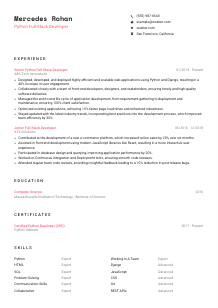
Write bullets around what you built, improved, or owned. "Designed and deployed Django web applications that increased user engagement by 40%" is much stronger than "Responsible for web development." The example CV does this well by tying Python and Django work to measurable product impact and end-to-end ownership.
Numbers give technical work context. Useful metrics for this role include page load improvements, release quality, uptime, user growth, conversion gains, bug reduction, and efficiency gains. A bullet about cutting page load times by 15% says far more than a vague claim about optimisation.
Trim experience that does not support your candidacy for this kind of role. Prioritise backend development, front-end implementation, REST APIs, database design, CI/CD, code review, cloud deployment, and team delivery. Even earlier roles can stay if you frame them around relevant stack exposure, as the sample does with React, database work, and release tooling in a junior position.
A Python Full-Stack Developer CV should show how you move from requirements to deployed software, not just what tasks were assigned to you. When your bullets connect frameworks, databases, collaboration, and results, the hiring team can picture you contributing to production systems quickly.
Education is usually not the deciding factor for experienced developers, but it still helps establish your grounding in software fundamentals. It becomes especially useful when your degree aligns with computer science, web systems, databases, or related engineering work.
If the job posting does not require a degree, you do not need to over-explain this section. Still, a degree in Computer Science, Software Engineering, or a related field adds context for your training in algorithms, data structures, databases, and application design.
List the institution, degree, field of study, and graduation year or date range. That is usually enough. For someone with 4+ years of experience, clarity matters more than detail here.
When your degree lines up with the role, let that connection be obvious. In the example, a Bachelor of Science in Computer Science supports the candidate's progression into full-stack development and reinforces the technical base behind Python, database, and web application work.
If you are early in your career or changing paths, selected coursework can help. Subjects like web development, database systems, software engineering, distributed systems, or human-computer interaction can support a full-stack application. If you already have strong experience, this detail is optional.
Capstone projects, research, hackathons, or engineering leadership activities are worth adding when they connect to application development, APIs, front-end systems, or scalable architecture. Keep the focus on work that resembles professional software delivery, not general campus involvement.
For an experienced Python Full-Stack Developer, education should reinforce your technical base and then get out of the way. Keep it concise, relevant, and aligned with the engineering work shown elsewhere.
Certifications are not mandatory for most full-stack developer roles, but they can strengthen your CV when they reflect current technical depth. They are most useful when they back up the stack, tools, or development practices the employer already values.
Lead with certificates tied to Python, web development, cloud deployment, security, or relevant framework ecosystems. In this case, a Python certification supports the posting's emphasis on deep Python experience, even though the role does not explicitly require credentials.
A short list of relevant credentials is more effective than a long catalogue of unrelated courses. Prioritise certifications that strengthen your story as someone who can build, deploy, and maintain web applications at production quality.
Dates help the reader judge recency, especially in a field where frameworks, tooling, and platform practices change quickly. If a certification is active or renewed, show that clearly, as in the example's continuing Python credential.
Ongoing upskilling matters in full-stack work because the stack rarely stands still. Whether you are adding cloud knowledge, sharpening API security practices, or updating front-end framework skills, recent learning supports the expectation that you can adapt in a modern engineering team.
Certifications should strengthen the technical profile already visible in your experience and skills. When they match the stack you want to work in, they add credibility without taking over the CV.
The skills section works best when it mirrors how full-stack development is hired. That means showing the backend framework, front-end technologies, database tools, and collaboration skills that let you contribute across the application, not just dropping a long list of keywords.
Start with the technologies and capabilities the posting names directly. For this role, that includes Python, Django or Flask, JavaScript, HTML, CSS, React or Angular, SQL, NoSQL, problem-solving, and communication. If you have them, include them using the same language the employer uses.
Put your most relevant skills first. For a Python Full-Stack Developer, backend languages and frameworks usually lead, followed by front-end technologies, databases, APIs, deployment tools, and collaboration strengths. That order helps both ATS parsing and human scanning.
Do not stop at languages and frameworks. This kind of role often involves requirement discussions, code reviews, debugging with other developers, and working with designers or stakeholders. A combination of Python, Django, SQL, REST APIs, React, problem-solving, and communication gives a much truer picture of how you operate on a team.
The best skills lists read like the stack behind your experience, not a keyword dump. When the technologies, tools, and team capabilities here line up with your project history, your CV becomes much easier to trust.
For software roles, spoken language requirements usually matter when teams collaborate across product, design, clients, or distributed engineering groups. If the posting asks for strong English communication, your language section should confirm that quickly and clearly.
List English prominently when the role requires strong written and spoken communication. For a full-stack developer, that matters in sprint planning, technical documentation, code reviews, and stakeholder discussions, not just in casual conversation.
Additional languages are a useful bonus when they reflect how you work with global teams, multilingual clients, or international user bases. They are secondary to the required language, but still worth listing when they are real strengths.
Choose clear labels such as Native, Fluent, Professional, Conversational, or Basic, and be consistent. If you say you are fluent, be prepared to discuss architecture decisions, debugging tradeoffs, or delivery updates in that language.
Communication affects how well you gather requirements, explain technical decisions, and resolve issues across teams. For this role, language skills support execution because full-stack developers often move between product conversations and implementation details in the same week.
List languages that add real context and leave out anything overstated or uncertain. The example handles this well by clearly showing English proficiency first and adding Spanish as an extra collaboration asset.
This section does not need much space, but it should remove doubt. When the posting requires strong English, make that easy to see so the reader can stay focused on your engineering background.
A summary should quickly establish your level, stack, and kind of contribution. For a Python Full-Stack Developer, that usually means years of experience, framework depth, full-stack range, and one or two concrete outcomes that show you have worked on live applications rather than only training projects.
Start with a direct statement of who you are professionally. Mention your years of experience and your core stack, such as Python full-stack development with Django, Flask, JavaScript frameworks, and database work, if that reflects your background.
Highlight the kind of work you are trusted with, such as building scalable web applications, owning features across backend and front-end layers, improving performance, or collaborating with cross-functional teams. The sample summary works because it combines technical breadth with delivery context.
Bring in the language that appears in the job description when it matches your experience. Terms like "scalable web applications," "full life cycle development," "Django," "React," "SQL and NoSQL," or "team-oriented environment" can help with ATS optimisation and make your positioning clearer to a human reader.
Aim for 3 to 5 lines. That is enough room to establish your profile without repeating the full CV. Focus on stack, scope, and outcomes, then let the experience section carry the detail.
When this section is written well, the reader understands your seniority, stack, and delivery style before they reach your experience bullets. That makes the rest of the CV easier to read through the lens you want.
Your CV should now present you as someone who can build, optimise, and maintain web applications with Python across the full stack, not simply as someone familiar with the tools. Keep the focus on shipped work, framework depth, database fluency, performance outcomes, and collaboration with product and engineering teams.
Use Wozber's free CV builder to turn that experience into an ATS-compliant CV, then refine it with the ATS CV scanner so the language matches the job's stack and delivery requirements. The finished CV should make one thing easy to judge: you can step into a Python Full-Stack Developer role and contribute to production software with confidence.