



Use Wozber and land your dream job
Create CV
No registration required
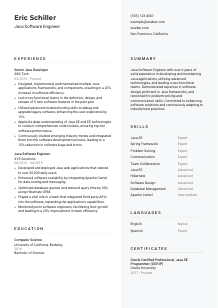
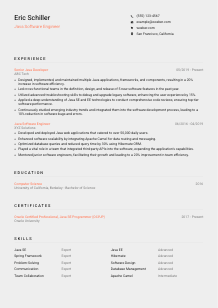
Weaving code like a master, but your CV seems stuck in an infinite loop? Check out this Java Software Engineer CV example, created with Wozber free CV builder. Learn how to align your software solutions with job requirements, programming an outstanding career at full speed with Java!
Java hiring usually turns on execution, not broad claims. Teams want to see where you designed and maintained production applications, improved performance, reviewed code, and worked with other engineers to ship features without creating reliability problems. Your CV should make that technical scope visible fast, especially around Java SE or Java EE work, framework depth, and the kind of systems or user load you have handled.
Screening gets easier when the CV reflects the language of the role instead of a generic software profile. Wozber's free CV builder helps you shape an ATS-compliant CV around the posting's terminology, from Spring and Hibernate to code review and debugging work, so the first read makes clear whether your background matches the Java stack and delivery expectations.
For software engineering roles, the header should remove friction immediately. Hiring teams should be able to see who you are, how to contact you, and whether you match any practical requirement in the posting, such as location or English fluency, without digging through the page.
Use your full name as the main heading, then place your target title directly beneath it. For a posting focused on Java development, writing "Java Software Engineer" or a closely aligned title helps frame the rest of the CV before the reviewer reaches your stack, projects, or delivery history.
If your recent title was "Senior Java Developer" or "Backend Engineer," you can still use the target title under your name when it truthfully reflects the position you are pursuing. That small adjustment helps align your CV with postings that search specifically for Java Software Engineer candidates.
Your phone number and email should be current, simple, and easy to scan. Engineering hiring often moves quickly once a candidate matches the stack, so avoid informal email handles or missing digits that create unnecessary delays.
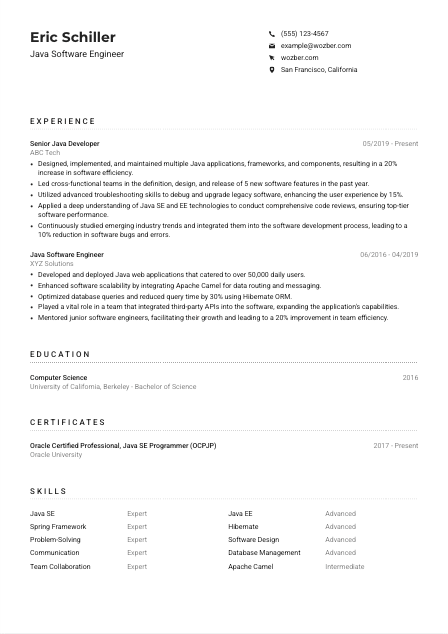
Some Java roles are flexible, others are tied to a team hub or relocation requirement. Here, listing San Francisco, California directly addresses the stated location preference and prevents questions about availability. For other jobs, mirror whatever level of location detail the employer requests.
Include LinkedIn, GitHub, or a portfolio only if they strengthen your application. For Java engineers, a GitHub profile with Spring services, integration work, test coverage, or API projects can reinforce the experience section. A bare or outdated profile does the opposite, so curate before linking.
This section should answer the basics in seconds: who you are, what role you are targeting, how to reach you, and whether any practical requirement such as location is already covered.




This is where Java CVs usually separate. Hiring managers look past general software claims and focus on what you built, how you built it, what frameworks or architecture patterns were involved, and whether your work improved performance, reliability, or delivery. Put the engineering work itself at the centre.
Before editing bullets, mark the terms that define the role: Java SE, Java EE, Spring, Hibernate, Apache Camel, code review, debugging, feature delivery, and cross-functional collaboration. Then reshape your experience so those themes appear where they genuinely match your work. In the example CV, the strongest bullets do this by tying Java technologies directly to shipped features, software efficiency, and reduced bugs.
List company, title, and dates in reverse chronological order. That structure lets reviewers trace your progression from implementation-heavy work to broader ownership, such as design, maintenance, code analysis, or mentoring. If your title differs slightly from the target role, the bullet points should close that gap through relevant Java responsibilities.
Each bullet should show what you worked on, what you did, and what changed because of it. For Java engineers, that may mean designing application components, integrating frameworks, improving query performance, debugging legacy services, or supporting a production release. "Developed Java web applications for 50,000 daily users" is far more useful than a generic line about participating in development.
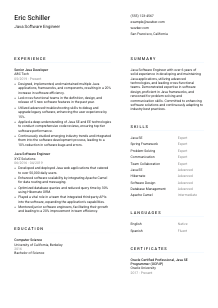
Numbers work best when they describe technical or business results tied to your contribution. Good examples include lower query time, fewer defects, faster software performance, user scale, delivery volume, or efficiency gains. The sample CV uses this well with a 30% query-time reduction through Hibernate optimisation and a 20% efficiency increase tied to Java application work.
If a past role included mixed technologies, keep the bullets that support the Java narrative and trim the rest. You do not need to document every task. Prioritise work involving Java applications, frameworks, debugging, code quality, APIs, performance tuning, and collaboration with product or QA. Focus beats completeness here.
A well-tailored experience section makes it easy to see your Java depth, framework usage, delivery record, and the quality improvements you drove in real software environments.
Education matters most here as a qualification check and a credibility marker. For Java software engineering roles, the degree line should confirm the required academic background quickly, then stay concise unless you are early in your career or have highly relevant academic work worth showing.
When a posting asks for a bachelor's degree in Computer Science, Engineering, or a related field, make that information easy to find. List the degree, field, school, and graduation year in a standard format. In the example, "Bachelor of Science in Computer Science" directly matches the requirement and needs no extra explanation.
School name, degree, field of study, and graduation date are usually enough. Clean formatting matters because this section is often scanned quickly after experience and skills. Save space for technical accomplishments unless your academic background is a major selling point.
If your degree is in Computer Science, Software Engineering, Computer Engineering, or a related discipline, use the formal program name. Exact wording can help with ATS matching and avoids ambiguity about your academic foundation in programming, systems, and software design.
Early-career candidates can include relevant coursework such as data structures, distributed systems, databases, operating systems, or software engineering. For experienced Java developers, this section is usually less important unless a course connects directly to backend architecture, database optimisation, or enterprise application development.
Include honors, research, or major projects only if they add technical substance. A capstone involving REST APIs, multithreaded Java applications, database design, or integration patterns can still be worth listing if it supports the role better than unrelated achievements.
For most Java engineers, this section should quickly confirm the degree requirement and then get out of the way of the experience and technical work that carry more hiring weight.
Certifications are not required for every Java role, but they can add useful credibility when they reinforce your technical depth or show continued learning in a mature enterprise stack. The key is relevance, not volume.
Some Java jobs explicitly ask for certifications, while others simply reward candidates who show ongoing technical development. This posting does not require one, so certificates should support the application rather than dominate it. A Java-focused credential helps most when it aligns with the technologies or level of the role.
Prioritise certificates that strengthen your case in Java development, enterprise frameworks, cloud deployment, or related backend engineering areas. The Oracle Certified Professional, Java SE Programmer works well here because it reinforces core Java proficiency already requested in the job description.
Certification dates help hiring teams gauge currency, especially in fast-moving technical areas. If a certificate remains active, note that clearly. If it is older but still respected, keep it if it supports your profile and the rest of the CV shows you are current with today's tools and practices.
Use this section to reflect a habit of staying current with frameworks, architecture patterns, or engineering practices. That is especially relevant in Java environments where teams value developers who keep up with ecosystem changes, testing approaches, and maintainability standards, not just syntax knowledge.
A focused certification section can strengthen your Java profile, especially when it supports the stack, seniority, or learning mindset already shown in your project and work history.
The skills section should read like a targeted technical snapshot, not a long inventory. For Java roles, reviewers usually scan this section to confirm stack alignment quickly before they return to your experience for proof.
Start with the technologies and working methods the employer actually named. Here that includes Java SE, Java EE, Spring, Hibernate, Apache Camel, code review, problem-solving, communication, and collaboration. Those are the terms most worth mirroring when they reflect your real background.
Lead with the technologies central to the position, then follow with adjacent capabilities. For example, Java SE, Spring Framework, Java EE, Hibernate, and Apache Camel should appear before broader items like communication or team collaboration. The sample CV gets this balance mostly right by placing core Java technologies near the top.
Group skills in a way that makes technical review easy. You can separate languages, frameworks, databases, and soft skills if your format allows it, or keep a compact list if space is tight. Only include skills you can support through bullets, projects, or interview discussion. A shorter, accurate list is stronger than an inflated one.
When this section is tailored well, a reviewer can immediately see that you cover the Java ecosystem, supporting frameworks, and collaboration skills the role depends on.
Language proficiency is usually a secondary section for software engineers, but it becomes important when the posting names a communication requirement. In cross-functional product teams, clear English matters for code reviews, standups, documentation, and feature discussions.
If the job explicitly asks for fluent English, list English first and state your level clearly. That handles a stated requirement without forcing the reader to infer it from the rest of the CV.
Choose familiar levels such as Native, Fluent, Professional Working Proficiency, or Conversational. Avoid vague labels that can be interpreted differently. In engineering hiring, clarity matters because language ability often affects collaboration across product, QA, and distributed teams.
Additional languages are worth listing when they reflect real proficiency. They can be useful in global engineering teams, customer-facing technical environments, or companies with multilingual collaboration, even when they are not formal requirements.
Do not overstate fluency. If you can handle technical discussions, documentation, and meetings in a language, say so honestly. If not, use a lower level. Interview loops reveal this quickly.
For most Java positions, this section stays brief. English may be essential, as it is here, while other languages are a useful extra rather than a hiring priority. One or two lines are often enough.
This section should quickly confirm any required language ability and then support the broader picture of how you work with engineers, product teams, and stakeholders.
The summary should quickly place you in the right lane. For a Java Software Engineer, that means naming your level, your core technical focus, and the kind of delivery or system work you handle well. Keep it compact and specific enough that the rest of the CV feels consistent with it.
Read the posting again before writing this section. If the role emphasizes Java development, frameworks, code quality, debugging, and collaboration, those should shape your opening lines. Avoid generic software-engineer language that could apply to any backend candidate.
Start with your title and years of experience, then add your strongest area of Java expertise. For example, a summary might mention 6+ years in Java application development, enterprise frameworks, or performance-focused backend work. The sample summary does this well by establishing experience and Java specialization immediately.
Choose two or three themes you can support later in the CV, such as designing Java applications, leading cross-functional feature delivery, improving performance, or reducing defects. Keep the claims grounded in work already shown in your bullets rather than broad descriptors alone.
Aim for a short paragraph that can be read in seconds. A concise summary with concrete Java focus, framework familiarity, and delivery context is more convincing than a long statement about passion or career goals. Save detail for the experience section where results carry more weight.
A good summary gives the reviewer an immediate sense of your Java scope, your level of ownership, and the kind of engineering outcomes they can expect to find in the sections below.
A tailored Java Software Engineer CV should now show the essentials clearly: relevant degree, Java stack alignment, framework depth, production-level accomplishments, and the collaboration needed to ship and maintain software. That is what helps a hiring team picture you in the codebase, not just on the candidate list.
Use Wozber's free CV builder to organise that experience into an ATS-friendly CV format, refine wording with role-specific terminology, and check alignment with an ATS CV scanner before you apply. The finished CV should make your Java capability, framework experience, and engineering impact easy to judge.