



Use Wozber and land your dream job
Create CV
No registration required
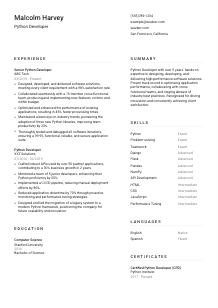
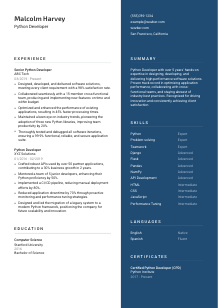
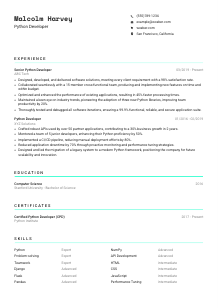
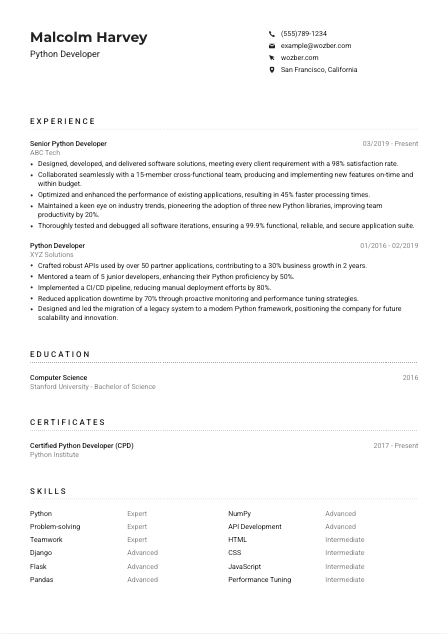
Crafting code, but your CV doesn't compile? Check out this Python Developer CV example, created with Wozber free CV builder. It shows how to script your software skills to match job demands, ensuring your career path is as smooth as a well-indented block!
Python developers are usually hired on proof of execution, not on broad claims about coding ability. A CV needs to show how you build and improve software in real environments, whether that means shipping features in Django or Flask, tuning application performance, writing APIs, debugging production issues, or working closely with product, QA, and other engineers. Hiring teams want to see practical Python work tied to reliability, scalability, and delivery.
When the CV reflects the language of the role, it becomes much easier to separate general software experience from hands-on Python development. Using Wozber's free CV builder and an ATS-friendly CV format helps you line up your frameworks, libraries, and project outcomes with the job description, so both recruiters and technical reviewers can quickly see where your Python background matches the work ahead.
For a Python Developer, the header should do more than identify you. It should immediately confirm the basics a hiring team scans for first: role alignment, reliable contact information, and any non-negotiable detail such as location. Keep this section clean, accurate, and easy to process.
Your name should be the most visible text in the header. Use a clear format that is easy to read on screen, since recruiters often review CVs quickly before moving into technical details like frameworks, APIs, or performance work.
Use a job title that reflects the role you are targeting. If the posting is for a "Python Developer," placing that title under your name creates immediate alignment. It also helps frame the rest of your CV around Python-specific work rather than broader software engineering experience.
List a phone number you answer and a professional email address. If you include a website, make it relevant, such as a GitHub profile, portfolio, or technical site that shows Python repositories, API projects, automation work, or contributions using tools named elsewhere in your CV.
If a posting includes a location requirement, state your city and state directly in this section. In the example, listing "San Francisco, California" addresses a stated requirement without taking up space elsewhere in the CV. For other Python roles, only include location when it helps remove a likely objection.
A GitHub or portfolio link can strengthen your application when it supports the rest of the CV. Prioritise repositories that reflect the kind of work employers hire Python developers for, such as web applications, data processing scripts, internal tools, test suites, or backend services with clear documentation.
This section should answer the first practical questions in seconds: who you are, what role you do, how to reach you, and whether any required location detail is already covered.




This is where a Python Developer CV earns credibility. Hiring teams look for shipped software, performance gains, debugging depth, framework usage, and collaboration with product or engineering partners. Write your experience so the reader can understand what you built, how you built it, and what changed because of your work.
Before editing bullets, identify the recurring themes in the job description. For this role, those include hands-on Python development, work with Django or Flask, familiarity with libraries such as Pandas or NumPy, collaboration across teams, and testing for reliability and security. Those themes should shape which accomplishments you keep and which you cut.
Use reverse chronological order and make sure your most recent roles emphasize Python-heavy work. For each position, include your title, company, dates, and bullets that show development scope. If you have mixed-language or broader engineering experience, give more space to the work that involved Python applications, backend systems, APIs, or automation.
Focus each bullet on a concrete contribution. Strong Python bullets often show that you designed software, built services, improved an application, resolved bottlenecks, or introduced tooling that changed team output. The example does this well with achievements such as delivering software that met client requirements and leading a migration to a modern Python framework.
Use numbers where they reflect actual engineering outcomes: faster processing time, lower downtime, better deployment speed, API usage, defect reduction, uptime, or customer impact. A bullet like "improved processing times by 45%" tells a much stronger story than "worked on performance optimisation" because it ties the technical work to a measurable result.
Review each accomplishment and ask whether it strengthens your case for this Python opening. Framework usage, performance tuning, CI/CD improvements, testing rigor, and cross-functional feature delivery belong near the top. General statements that do not show Python work, system impact, or team contribution can be cut to make room for stronger evidence.
Your experience section should make it easy to see that you can build Python solutions, improve existing systems, and contribute to a team that ships reliable software.
Education usually is not the most read section on a Python Developer CV, but it still matters when a degree is listed in the requirements. Keep it straightforward and make sure the academic background supports the technical baseline the role expects.
If the posting asks for a bachelor's degree in Computer Science, Information Systems, or a related field, make sure your degree is listed clearly. In the example, "Bachelor of Science in Computer Science" matches the requirement directly and removes any ambiguity.
Include the degree, field of study, school name, and graduation year. That is usually enough for an experienced Python developer. Keep the presentation simple so the reader can confirm the credential quickly and return to the sections that show your technical work.
If your degree is closely aligned with the role, write it exactly. A field such as Computer Science carries clear relevance for software design, algorithms, data structures, and systems thinking. If your degree is adjacent, use the precise field name rather than leaving the area of study vague.
Early-career candidates can include selected coursework if it strengthens the technical story. Subjects like software engineering, databases, operating systems, web development, or data analysis can support a Python CV, especially when professional experience is still limited.
If you built meaningful academic projects, include them only when they add something your experience section does not already show. Projects involving Python applications, REST APIs, data pipelines, testing, or performance work can help demonstrate practical development ability.
For most Python Developer applications, education needs to do one job well: confirm that you meet the stated academic requirement and support the technical foundation shown elsewhere in the CV.
Certifications are rarely the deciding factor for Python developers, but the right ones can reinforce technical depth or ongoing learning. They work best when they support the role's stack, methods, or domain rather than filling space with unrelated credentials.
This posting does not require a certification, so use this section selectively. A Python-focused credential can still help when it reinforces the role's emphasis on hands-on development, frameworks, or current technical knowledge.
List certificates that connect to the kind of work the job describes. Python, web development, cloud deployment, testing, security, or data tooling can all be relevant depending on the role. In the example, a "Certified Python Developer" credential supports the core language focus of the position.
Add the date earned or the active period so the reader can judge how current the credential is. In fast-moving engineering environments, recent learning around frameworks, libraries, or deployment practices can carry more weight than an undated certificate.
Use this section to reflect current learning habits, especially if you have recently completed training in areas like Django, Flask, testing, data libraries, cloud services, or CI/CD workflows. That matters because Python roles often evolve with changing tooling and architecture patterns.
Keep only the certificates that reinforce your Python development profile. A short, relevant list adds credibility. An unfocused list dilutes it.
The skills section should mirror the stack and working style the role calls for. For Python developers, that usually means a mix of language depth, framework familiarity, supporting web technologies, and the practical habits needed to build maintainable software with a team.
Start with the technologies and capabilities the employer names directly. Here that includes Python, Django or Flask, Pandas or NumPy, and familiarity with HTML, CSS, and JavaScript. Then add core engineering skills implied by the work, such as testing, debugging, scalability, API development, or performance tuning when they reflect your real experience.
Group skills in a way that makes sense to a technical reviewer. Core programming and framework skills should come first, followed by supporting areas like front-end basics, CI/CD, cloud tools, or collaboration strengths. The example balances Python, Django, Flask, API development, and performance tuning with teamwork and problem-solving.
Do not overload this section with every tool you have touched once. Prioritise skills you could discuss in an interview with specifics, such as what you built in Flask, how you used Pandas for processing, or where you improved performance in an existing application. Relevance and accuracy matter more than volume.
A hiring manager should be able to scan this section and quickly understand your Python stack, your supporting technologies, and the kind of engineering work you are equipped to handle.
Language skills matter more on technical CVs than many candidates realize, especially when engineers work across product, QA, client, or distributed teams. If a role explicitly asks for English fluency, make that easy to find and label it clearly.
When the posting states that strong English fluency is essential, include English in this section with a clear proficiency level. In collaborative development environments, language ability affects code reviews, documentation, tickets, standups, and cross-functional communication.
Order this section by relevance, not by personal preference. If English is required, list it first and use a direct label such as Native or Fluent so there is no uncertainty about your ability to work in an English-speaking engineering team.
Additional languages can still help, especially in globally distributed teams, customer-facing engineering work, or multicultural product environments. They are secondary to the required language, but they can still add useful context about communication range.
Use honest levels such as Native, Fluent, Intermediate, or Basic. Overstating proficiency creates problems quickly in interviews and on the job, particularly in roles where technical discussion, written updates, and issue tracking need clarity.
For Python developers, communication is rarely limited to writing code. You may need to explain implementation tradeoffs, review pull requests, clarify defects, or work through requirements with non-engineers. Language proficiency supports that day-to-day work, so include it when it genuinely strengthens your profile.
When language is a stated requirement, this section should remove doubt quickly and support the collaborative side of software development.
Your summary should work like a technical introduction, not a generic profile statement. In a few lines, it needs to establish your Python background, your level of experience, and the kind of software work you have handled, using language that matches the role you want next.
Read the job description for the themes that deserve space in the opening paragraph. For this role, that means hands-on Python development, framework familiarity, scalable application work, collaboration, and testing for functionality, reliability, and security.
Open with your professional identity and experience level. "Python Developer with 5+ years of experience" is far more useful than a vague label because it immediately places you in the right hiring lane and prepares the reader for the stack and outcomes that follow.
Use one or two sentences to highlight your strongest relevant capabilities. That could include building backend services, improving application performance, shipping features with cross-functional teams, or working with Django, Flask, Pandas, or APIs. The example summary succeeds because it ties Python expertise to performance improvements and collaborative delivery.
Aim for 3 to 5 sentences with concrete language. Avoid soft claims like "passionate developer" unless they are backed by something technical. A concise summary with role-specific tools, years of experience, and one or two clear outcomes gives the hiring team a sharper read on your value.
By the time someone finishes this section, they should already understand your Python focus, your level of experience, and the kind of engineering results you are likely to bring to the role.
A Python Developer CV works best when each section points to the same conclusion: you can write production-ready Python, collaborate with a team, and improve software in ways the business can measure. That means showing the right frameworks and libraries, keeping your project scope concrete, and matching the employer's language naturally instead of forcing keywords.
Wozber's free CV builder can help you organise that story in an ATS-compliant CV, and its ATS CV scanner can highlight missing requirements, keyword gaps, and section-level alignment before you apply. Use those tools to sharpen the connection between your real experience and the role's needs, then submit a CV that makes your Python development capability easy to recognize.