



Use Wozber and land your dream job
Create CV
No registration required
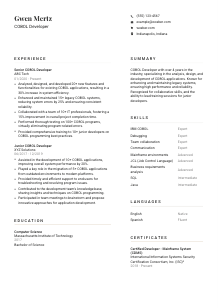
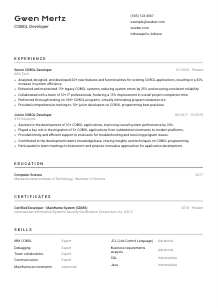
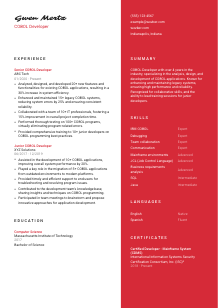
Cracking COBOL code, but your CV looks ancient? Check out this COBOL Developer CV example, created with Wozber free CV builder. It shows how to modernize your programming prowess to match job demands, ensuring your career stays as robust as your legacy systems!
COBOL hiring usually centers on one practical question: can you keep critical business systems stable while improving code that has often been running for years. Teams rely on COBOL developers to work carefully inside mainframe environments, trace defects through older logic, and ship enhancements without disrupting payroll, claims, billing, or other high-dependency processes. Your CV should make that operational trust visible, not just list programming languages.
When a COBOL CV is tailored well, reviewers can quickly separate general application developers from candidates who truly know IBM COBOL, JCL, production support, and legacy enhancement work. Wozber's free CV builder helps shape that experience into an ATS-compliant CV that mirrors the posting's terminology and surfaces the right mainframe keywords early, so the hiring team can quickly see whether you can maintain reliable COBOL applications in a team setting.
For COBOL roles, the top of the CV should do one simple job well: confirm who you are, how to reach you, and whether you meet any basic logistics the employer has stated. Keep this section clean and professional so nothing distracts from your mainframe experience later on.
Use your full name in a larger, clear font so it anchors the page immediately. On technical CVs, this matters more than design flair. Hiring teams often scan quickly from your name to title to recent experience, especially when sorting applicants for specialised legacy systems work.
Place "COBOL Developer" under your name if that is the role you are pursuing. That immediate alignment helps when a recruiter or hiring manager is reviewing several CVs for adjacent profiles like mainframe developer, application support analyst, or software engineer. If your current title is broader, your CV title can still reflect the role you are applying for.
Include a phone number and a professional email address, then double-check both. A missed digit creates the wrong kind of debugging task. If you include a website or LinkedIn profile, make sure it supports your application with consistent job titles, project history, or mainframe-related experience.
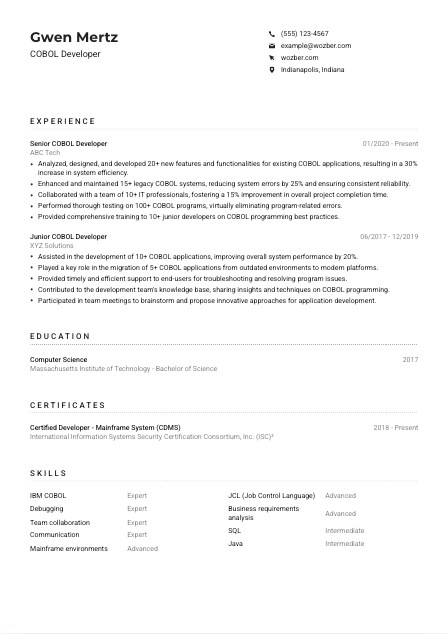
If the employer specifies a location, reflect that clearly in this section. In the example, listing Indianapolis, Indiana supports a stated requirement and removes a common screening question before anyone even reaches the experience section. If relocation is relevant, state it briefly and clearly rather than leaving the employer to guess.
A LinkedIn profile, portfolio, or personal site should add useful context such as project summaries, modernization work, documentation samples, or technical history across COBOL and mainframe tools. For COBOL developers, a sparse or outdated link can weaken the impression, so include it only if it reinforces your application.
This section should answer contact and logistics questions in seconds. Once that is settled, the reader can focus on what matters most for a COBOL developer: system reliability, enhancement work, and mainframe depth.




This is the section most likely to determine whether you move forward. COBOL hiring teams want to see how you handled existing applications, what you improved, how you tested changes, and whether your work held up in a production environment where errors can affect core business operations.
Before rewriting your bullets, mark the specific terms the employer uses. For this opening, that includes IBM COBOL, JCL, mainframe environments, debugging, enhancement work, testing, documentation, and collaboration. Those are not just keywords for ATS optimisation. They tell you what your experience bullets need to emphasize first.
List positions in reverse chronological order and make sure your strongest COBOL role appears first. If you have grown from junior support work into full development or enhancement responsibility, let that progression show. In the sample CV, the move from Junior COBOL Developer to Senior COBOL Developer creates a clear story of deeper ownership in legacy systems.
Replace generic statements like "worked on COBOL applications" with bullets that show scope, system impact, and outcomes. Strong bullets mention feature delivery, error reduction, testing volume, migration support, or reliability gains. The example bullet about developing 20+ new features and improving system efficiency by 30% works because it ties code changes to measurable operational value.
Numbers are especially useful in legacy environments where scale and stability matter. Include counts of programs tested, applications enhanced, defect reduction, batch job improvements, turnaround time, team size, or support volume when those metrics are real. The sample's reference to testing 100+ COBOL programs gives a hiring team a concrete sense of workload and rigor.
Each bullet should connect back to the kind of work described in the posting: maintaining legacy systems, building enhancements, troubleshooting errors, and partnering with business or technical teams. If a bullet cannot be linked to mainframe development, application reliability, or cross-functional delivery, cut it or rewrite it. Relevance is what makes specialised COBOL experience stand out.
A hiring manager should finish this section with a clear picture of the environments you worked in, the kinds of COBOL changes you shipped, and how reliably those changes performed. That is the experience story that moves a COBOL CV forward.
Education usually plays a supporting role in COBOL hiring once you have solid experience, but it still matters when the posting names a degree requirement. Present it clearly so the reviewer can confirm you meet the academic baseline without hunting for details.
If the posting asks for a Bachelor's degree in Computer Science or a related field, make that qualification easy to see. A Bachelor of Science in Computer Science matches the requirement directly, as it does in the example. When your degree is in a related discipline, use the full field name so the connection is obvious.
List degree, school, and graduation year in a straightforward format. Education should be easy to scan in a few seconds, especially on a CV where the heavier review will happen in the experience and skills sections.
For COBOL development, a computer science degree signals grounding in programming logic, data structures, systems thinking, and debugging discipline. You do not need to over-explain it. A concise entry is enough when the degree already lines up with the role.
If you are early in your career, selected coursework in programming, databases, operating systems, or enterprise systems can help. For experienced COBOL developers, coursework is usually less important than production work in IBM mainframe environments, so keep it brief unless it genuinely strengthens your case.
Honors, scholarships, or technical student projects can be useful if they relate to software development or analytical work. Once you have several years of professional COBOL experience, these details should stay secondary to your delivery record, testing work, and system maintenance experience.
Education should confirm that you meet the stated baseline and support your technical credibility. For most COBOL roles, once that box is checked, your CV needs to win on system work, reliability, and delivery history.
Certifications are rarely the deciding factor in COBOL hiring, but they can strengthen your profile when they reinforce mainframe knowledge, enterprise systems experience, or continued technical development. Use them to add depth, not to substitute for hands-on work.
Start with the job description. If no certification is required, include only those that genuinely support the role. For a COBOL developer, credentials tied to mainframe systems, enterprise development, or related infrastructure are far more useful than generic certificates.
Choose certifications that connect to COBOL, IBM environments, system operations, or adjacent enterprise technologies. In the example, a mainframe-oriented certification strengthens the CV because it supports the candidate's experience with legacy and production systems.
Show the year earned and, if relevant, whether the certification remains active. This helps reviewers understand recency and ongoing engagement with the field, especially if the technology area is specialised or regulated.
COBOL teams often value developers who keep current with the environments around the language, including job control, database interaction, migration work, testing practices, and platform changes. Relevant certifications can reinforce that you are keeping your enterprise skills current even while working in long-lived systems.
The best certification section supports your mainframe experience and shows steady professional development. It should add confidence in your technical depth, especially when paired with concrete COBOL accomplishments in production environments.
A COBOL skills section should feel practical, not padded. The right mix usually includes language and platform knowledge, debugging and maintenance strengths, and the collaboration skills needed to work with analysts, testers, and business stakeholders around legacy applications.
Read for explicit tools and implied working habits. Here, the technical side includes IBM COBOL, JCL, mainframe environments, testing, and debugging. The posting also points to collaboration and communication, which matter in COBOL work because requirements often come through business teams, support channels, and cross-functional delivery groups.
List the technologies and capabilities that show up in your work history, not every tool you have touched once. If your bullets mention enhancing legacy systems, testing large volumes of programs, or working with business requirements, your skills section should echo that with terms such as IBM COBOL, JCL, debugging, mainframe environments, and requirements analysis.
Put the strongest match first. For this kind of opening, core mainframe skills should appear before secondary languages or broader software knowledge. The sample does this well by leading with IBM COBOL, debugging, and mainframe-related strengths, while keeping SQL and Java in a supporting position.
A hiring team should be able to glance at this section and immediately recognize the stack and working style they need. For COBOL positions, that usually means mainframe fluency, debugging strength, and reliable collaboration across technical and business teams.
Language skills are usually a secondary section for COBOL developers, but they still matter when the posting names a required working language. In enterprise environments, clear communication affects requirements gathering, documentation, incident handling, and support handoffs.
If the role requires English proficiency, include it plainly and at the appropriate level. Since the posting lists English as a condition of employment, that should appear without ambiguity on the CV.
Additional languages can help if you work with distributed teams, multinational business units, or user support across regions. They are a bonus, not a replacement for the technical depth the role requires.
Choose labels that reflect how you actually communicate in meetings, documentation, email, and troubleshooting conversations. Overstating fluency can become obvious quickly in interview discussions or team-based exercises.
A second language can strengthen your profile when the company serves multilingual users or collaborates across offices, but keep it in proportion. For most COBOL roles, it should complement your system knowledge rather than compete with it for space.
Language ability is most useful when it supports day-to-day work such as writing documentation, explaining defects, training junior developers, or discussing business logic with non-technical stakeholders. That is the context where it matters on a COBOL CV.
This section does not need to be long. It should quickly confirm the required working language and, where relevant, show any added communication range that could support documentation, support, or cross-team work.
The summary sits at the top of the CV, so it needs to establish your technical identity quickly. For COBOL work, that usually means stating your years of experience, your core environment, and the kind of system work you handle well, such as enhancement, maintenance, debugging, testing, or support for legacy applications.
Start with a direct statement such as COBOL Developer with 4+ years of experience, then ground it in your environment or focus area. This helps distinguish you from broader software developers and immediately frames your background around enterprise and legacy system work.
Use the next sentence to reflect the priorities in the job description, such as IBM COBOL, mainframe development, feature enhancement, legacy maintenance, debugging, or collaboration with cross-functional teams. The example summary works because it stays close to the role's actual responsibilities instead of drifting into generic software language.
Aim for a compact paragraph that can be read quickly before the hiring manager moves to your recent experience. Two to four sentences is usually enough if each one carries concrete information about systems, outcomes, or working style.
Close on a clear professional value point, such as improving reliability, supporting critical legacy applications, reducing defects, or helping junior developers ramp up. In the sample, mentioning performance, reliability, and training gives the summary a practical finish tied to real team needs.
A strong summary makes your specialization immediately clear and prepares the reader to interpret the rest of the CV through the right lens. For a COBOL role, that means they should already expect solid legacy system work, careful debugging, and dependable production support.
A COBOL CV works best when it shows exactly where you have delivered value in mainframe environments: enhancing legacy applications, debugging production issues, testing carefully, and supporting reliable business operations. If those points are easy to find, both ATS filters and human reviewers can understand your background much faster.
Use Wozber's free CV builder to organise that experience into an ATS-friendly CV format, then refine the language with the ATS CV scanner so the posting's technical terms are reflected naturally across your summary, skills, and experience. The finished CV should make one thing clear at a glance: you can be trusted with production COBOL systems.