



Use Wozber and land your dream job
Create CV
No registration required
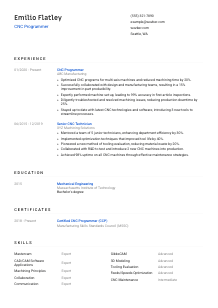
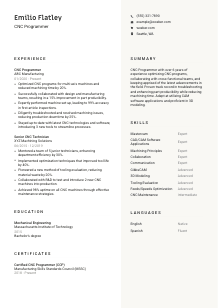
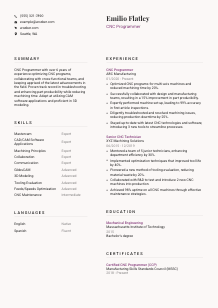
Cracking codes, but your CV seems to lock up? Check out this CNC Programmer CV example, created with Wozber free CV builder. It shows how to highlight your programming prowess to match job directives, carving out a career that's always on the cutting edge!
CNC programming work is judged in production, where a toolpath either holds tolerance, protects tool life, and keeps cycle time under control or it does not. That reality should shape the CV. Hiring teams want to see more than software familiarity. They want proof that you can turn drawings and 3D models into reliable programs, support setup and first article inspection, and solve machining issues before they become scrap, downtime, or missed output.
The first pass on a CNC Programmer CV often comes down to whether your background clearly connects CAM work to manufacturing outcomes. A tailored CV built in Wozber's free CV builder and refined for ATS optimisation helps surface the right language around multi-axis programming, CAD/CAM, tooling, and tolerance-driven problem solving so reviewers can quickly understand where you can contribute on the shop floor.
For CNC Programmer roles, the header should remove friction immediately. Keep it clean, accurate, and aligned with the opening so a hiring manager can confirm your identity, contact information, and any practical requirement such as location without hunting for it.
Use your full name in a clear, readable format at the top of the page. CNC hiring rarely rewards creative styling. A straightforward presentation signals professionalism and keeps the focus on your machining background, CAM experience, and production results.
Place "CNC Programmer" directly beneath your name when that is the role you are pursuing. This helps frame the rest of the CV around programming, toolpath optimisation, setup support, and machining improvement work instead of leaving the reader to infer whether you are applying from a machinist, technician, or manufacturing engineer track.
List a phone number you answer and a professional email address. Double-check every character. For roles that move quickly from CV review to technical screening, a typo in your contact details can cost you an interview before anyone gets to your Mastercam or GibbsCAM experience.
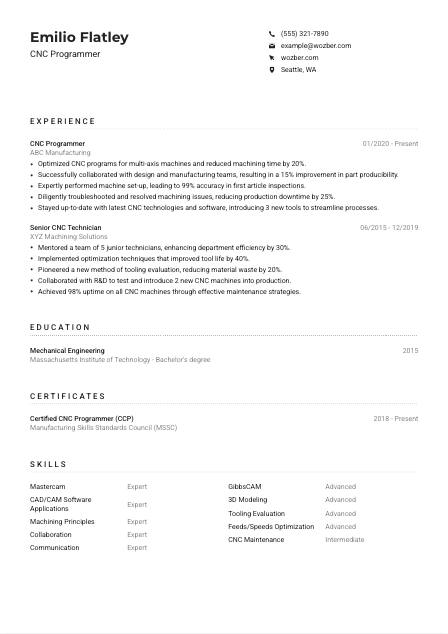
If the employer requires local presence or relocation, show that clearly in your header. In the example, listing Seattle, WA directly supports a stated job requirement. If you are relocating, note that plainly rather than leaving the employer to guess about your availability for onsite machine work and cross-functional collaboration.
A LinkedIn profile or professional website can be useful if it reinforces your CV with consistent dates, roles, and manufacturing experience. For CNC programmers, this only adds value if it stays current and supports the same story your CV tells about CAM software, machine scope, and measurable shop-floor outcomes.
Your personal details should answer the practical basics in seconds. When the header is accurate and aligned with the opening, the reader can move straight to your programming history, machining knowledge, and production impact.




This section carries the most weight for CNC Programmer hiring. Employers want to see where you programmed parts, what machine environment you supported, how you improved cycle time or uptime, and whether your work held up in setup, first article inspection, and day-to-day production.
Read the posting for the operating demands behind the title. Here, the role centers on multi-axis CNC programming, CAD/CAM proficiency, tooling and feeds and speeds optimisation, collaboration with design and manufacturing, and troubleshooting problems that affect output. Those are the themes your bullets should reflect, using your own experience rather than generic duty statements.
Lead with your most recent and relevant work, since CNC programming scope usually grows with machine complexity, autonomy, and process ownership. Include title, company, and dates for each role. If you advanced from technician or setup work into programming, that progression can work well as long as the bullets show increasing responsibility for toolpaths, process improvement, and production support.
Each bullet should connect your programming work to a result that matters on the floor. Good examples include reduced cycle time, better first-pass yield, improved part producibility, lower downtime, longer tool life, or less material waste. The sample CV does this well with points like reducing machining time by 20% and cutting production downtime by 25%, both of which tell the employer exactly how the programming work paid off.
Use metrics that belong naturally to CNC environments: setup accuracy, first article pass rate, uptime, scrap reduction, tool life, throughput, or tolerance consistency. Avoid vague claims such as "improved efficiency." A line like "performed machine setup and supported first article inspections with 99% accuracy" gives much clearer evidence of process control and production reliability.
Prioritise experience that strengthens your case for this opening. For a CNC Programmer role, that usually means CAM programming, multi-axis machining, tooling evaluation, cross-functional problem solving, and process optimisation. Older or less related work can stay brief unless it adds something useful, such as mentoring technicians, introducing new machines, or improving maintenance practices that supported uptime.
By the end of this section, the reader should understand the scale and quality of your programming work. Your bullets should make it easy to see what machines and processes you improved, how you worked with others, and what changed in production because of you.
Education matters differently in CNC programming depending on the employer and the seniority of the role. When a posting asks for a bachelor's degree in Mechanical Engineering, Computer Science, or a related field, your education section should confirm that requirement quickly and without clutter.
Check whether the job explicitly asks for a degree and mirror that wording where it accurately matches your background. In this opening, a bachelor's degree in Mechanical Engineering, Computer Science, or a related field is listed, so candidates with one of those degrees should make it easy to find.
List degree, field of study, school, and graduation year. That is enough for most experienced CNC programmers. Hiring managers reviewing production-focused roles are usually scanning first for whether the educational requirement is met, then returning to experience and technical accomplishments.
If your degree directly supports machining, manufacturing, programming, or engineering work, do not bury the field. In the example CV, "Bachelor's degree, Mechanical Engineering" aligns neatly with the employer's requirement and supports the candidate's credibility in tooling, geometry, and producibility discussions.
Early-career candidates can benefit from including relevant coursework, senior projects, or lab work tied to CAD/CAM, manufacturing processes, CNC systems, or 3D modeling. For experienced candidates, those details are usually optional unless they closely match a specialised shop environment or machine type.
Honors, technical competitions, or capstone work can help if they relate to manufacturing or process design, but keep this section disciplined. Once you have several years of shop-floor and programming experience, academic extras should support the story, not compete with more valuable production results.
Your education section should confirm the technical foundation the role asks for and then get out of the way. In CNC hiring, that foundation matters most when it supports the programming judgment and machining outcomes shown elsewhere on the page.
Certifications can strengthen a CNC Programmer CV when they point to real technical credibility, current knowledge, or continued development in programming and machining practice. They work best when they are relevant to the role rather than included as a long archive of unrelated training.
Prioritise certificates tied to CNC programming, machining standards, CAM software, or manufacturing process knowledge. A credential such as Certified CNC Programmer fits naturally because it supports the same capabilities employers are hiring for: program development, setup awareness, tooling decisions, and process control.
List the certifications that strengthen your candidacy for the target role, especially if they connect to multi-axis work, CAD/CAM, inspection, or process improvement. A shorter, relevant list is easier to trust than a crowded section full of training that has little bearing on production programming.
Include the date earned and, if applicable, the active period. CNC programming tools and manufacturing methods change over time, so recent certification or maintained status can signal that your knowledge is current. The example's active certification period helps show continued professional engagement rather than a one-time credential from years ago.
Employers value programmers who stay current with new CAM features, machine capabilities, tooling approaches, and machining strategies. If you regularly complete relevant training, this section can support the same message shown in experience bullets about introducing new tools or keeping processes up to date.
A well-chosen certification section adds technical credibility and shows that you keep pace with the field. For CNC Programmer roles, the best entries reinforce your ability to program accurately, optimise intelligently, and adapt as tools and methods evolve.
A CNC Programmer skills section should read like a practical snapshot of how you work. Focus on the software, machining knowledge, and collaboration strengths that the role actually uses, and keep the list close to the language of the job description where it reflects your real experience.
Start with the technical requirements the employer chose to name. For this role, that includes CAM software such as Mastercam or GibbsCAM, CAD/CAM applications, 3D modeling, machining principles, tooling, and feeds and speeds optimisation. If those are genuine strengths, place them prominently so both reviewers and ATS systems can find them quickly.
Be concrete. "CAM software" is useful, but "Mastercam," "GibbsCAM," "3D modeling," and "tooling evaluation" tell a much clearer story about your day-to-day capability. The sample CV works because it balances named software with broader manufacturing skills such as machining principles and collaboration.
Do not treat the skills section as a complete inventory. Lead with the abilities most likely to matter in CNC programming decisions, then include supporting strengths such as communication or cross-functional collaboration if the role emphasizes work with design, manufacturing, or inspection teams. A focused list makes your technical profile easier to read and easier to match in ATS scans.
Your skills section should reinforce what the experience section already proves. When the software, machining knowledge, and production-facing abilities line up across both sections, your CV reads like someone who can step into programming work quickly and effectively.
Language ability matters on a CNC Programmer CV when it affects communication in engineering reviews, setup discussions, troubleshooting, or documentation. Keep this section factual and concise, with the required language listed clearly if the posting specifies it.
If the role requires English, list it first with an honest proficiency level. In this opening, English is mandatory, so make that easy to confirm. For roles involving design collaboration, setup instructions, and issue resolution, language proficiency supports practical day-to-day communication, not just a box on the application.
Extra languages can be worth listing, especially in plants or supplier environments where teams may be multilingual. They are rarely the deciding factor for CNC programming roles, but they can support collaboration across operators, technicians, vendors, or broader manufacturing teams.
Choose labels that you can back up in conversation, whether that is "Native," "Fluent," or another accurate level. If you may need to explain machining issues, interpret instructions, or participate in technical meetings, overstating proficiency can become obvious quickly.
Some CNC Programmer positions are heavily production-facing, while others involve more design review, documentation, or coordination with engineers and quality teams. If the role includes cross-functional collaboration, language skills can strengthen your profile, but they should still stay secondary to programming and machining capability.
Even when you speak multiple languages, do not let this section overshadow the core of the CV. For CNC programming jobs, language ability is supportive. Multi-axis programming, CAM proficiency, tolerance control, and troubleshooting remain the main hiring criteria.
This section should answer one practical question: can you communicate effectively in the environment the role requires. Once that is clear, the CV should return attention to your machining knowledge, software skill, and production results.
The summary sits at the top of the CV, so it should establish your level, specialty, and the kind of machining results you deliver. For CNC Programmer roles, that usually means combining years of experience with specific strengths in programming, process improvement, and collaboration across manufacturing teams.
Before writing, identify the few themes that matter most in the opening. Here, the role emphasizes CNC programming experience, CAM software, CAD/CAM and 3D modeling, tooling and feeds and speeds knowledge, and collaboration with design and manufacturing teams. Your summary should combine only the themes you can support elsewhere in the CV.
Start plainly and professionally. A line such as "CNC Programmer with 6+ years of experience" gives immediate context and works well when followed by the kind of programming environment you know, such as multi-axis machining, process optimisation, or production troubleshooting.
Choose details that matter in hiring decisions for this field. Good options include reducing cycle time, improving part producibility, troubleshooting machining issues, supporting first article inspection, or working fluently in Mastercam and similar CAM environments. The sample summary succeeds because it connects optimisation, collaboration, troubleshooting, and CAM proficiency without drifting into vague claims.
Aim for a short paragraph that can be read in a few seconds. Avoid repeating every skill or every achievement. The summary should frame the rest of the CV, not duplicate it. A concise, technically grounded introduction works better than broad language about passion, hard work, or career goals.
A strong summary tells the reader what kind of CNC Programmer you are before they reach the first job entry. It should quickly connect your experience, software capability, and production-floor impact to the type of programming work the employer needs filled.
Your CNC Programmer CV should now show the full chain from CAD/CAM and multi-axis programming to setup support, troubleshooting, and measurable production results. That is what helps hiring teams distinguish a candidate who knows the software from one who can keep parts running accurately and efficiently.
Use Wozber to tighten that alignment with an ATS-compliant CV, apply role-specific language with its AI CV builder, and review missing requirements through the ATS CV scanner. The finished CV should make one thing easy to judge: you can program parts that run well in production.