




Use Wozber and land your dream job
Create CV
No registration required
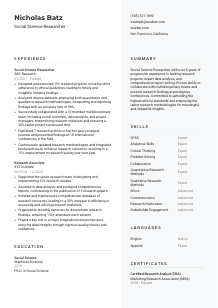
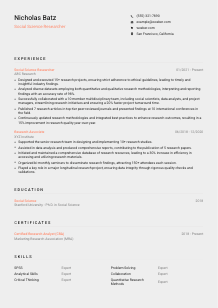
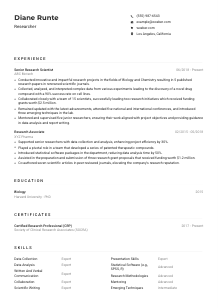
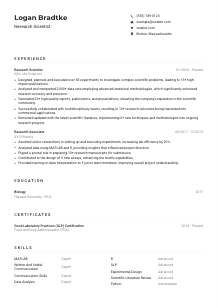
Parsing society's intricacies, but your CV appears vague? Check out this Social Science Researcher CV example, created with Wozber free CV builder. Learn how to spotlight your socially significant studies to match the job criteria, sketching your career blueprint as vividly as the landscapes you explore!

Social science research work is judged by how well you turn messy human data into defensible findings. Hiring teams want to see that same discipline on your CV. Instead of broad claims about being analytical, show the kinds of studies you have designed, the methods you have used, the standards you have followed, and the outputs you have produced, whether that means reports, publications, stakeholder briefings, or conference presentations.
A tailored CV changes how quickly your research background makes sense in screening. When your methods, software, publication record, and collaboration history match the language of the role, an ATS-compliant CV is far more likely to surface the right experience early. Wozber's free CV builder helps you organise those details clearly and strengthen ATS optimisation so reviewers can immediately see your research scope and methodological depth.
For a Social Science Researcher, the header should read like a clean author line on a paper. It needs to establish professional identity fast, remove any friction around contact details, and confirm practical requirements that matter for the role.
Use your full name in the most prominent text on the page so it is easy to spot in both human review and ATS parsing. Keep the styling simple and professional. In research hiring, clarity beats decoration every time.
Place
Give hiring teams the fastest route back to you. Use a reliable phone number and a professional email address, and check both for accuracy before sending the CV.
If the role has a location requirement, make that visible in your header. Here, San Francisco, California is a stated condition, so listing it removes an avoidable question in the first scan. For other applications, only include location when it helps clarify availability.
Include LinkedIn, a faculty or institutional profile, Google Scholar page, ResearchGate profile, or a personal site if it reinforces your publication history, project portfolio, or methodological expertise. Make sure the public content matches the experience and dates on your CV.
Do not add age, marital status, headshots, or other private details unless a region or employer explicitly requires them. Research hiring should stay focused on your methods, outputs, subject-matter expertise, and communication strengths.
This section should quickly answer who you are, what role you are targeting, how to reach you, and whether you meet any practical requirement such as location. Get that right, and the rest of the CV can stay focused on your research work.




This is the section where research employers look for proof of execution. They want to see whether you can design studies, handle data responsibly, interpret findings, work across disciplines, and turn analysis into outputs that other people can use.
Start by pulling out the recurring demands in the job description, such as research design, quantitative and qualitative analysis, report writing, ethical compliance, collaboration, and publication. Then choose bullets that show you have already done that work. In the example CV, projects, analysis, reporting, and peer-reviewed publication are all visible early, which makes the match easy to spot.
List positions in reverse chronological order and make each entry easy to read. Hiring teams need to understand where you worked, what level you operated at, and how your responsibilities progressed from one role to the next.
Your bullets should show what you designed, analysed, produced, improved, or published. Focus on outcomes that matter in this field, such as completed studies, quality of analysis, report accuracy, stakeholder adoption, publication record, or faster project delivery. The sample does this well by tying research design to completed projects and collaboration to a 20% faster turnaround.
Numbers help when they reflect real research performance. Good examples include number of studies led, datasets analysed, publications, conference presentations, survey sample sizes, coding reliability, turnaround time, report volume, or quality improvements. The example's
Prioritise experience that strengthens your case for this role. If you have unrelated jobs, either trim them back or leave them out unless they add something useful such as stakeholder communication, program evaluation, or data management. The strongest version of this section makes your research capability visible in the first few bullets.
A well-built experience section should make it easy to picture you running a study from design through analysis to reporting and dissemination. That is the level of clarity hiring teams need before they move you forward.
Advanced degrees matter in social science research because they signal training in theory, methodology, ethics, and academic writing. This section should confirm that your academic background supports the level of research design and analysis the role requires.
Read the posting closely and mirror the level of education it asks for. Here, a Master's or Ph.D. in Social Science, Sociology, Psychology, or a related field is required, so those credentials should be impossible to miss on the CV.
Use a consistent structure for every entry so both recruiters and ATS tools can read it cleanly. Degree, field, institution, and graduation date or completion year are usually enough.
If your degree title is broader than the posting language, use the field line to close the gap. The example CV does this effectively with a Ph.D. in Social Science and earlier degrees in Psychology and Sociology, which reinforces range across related disciplines without overexplaining.
Early-career candidates can use this space to show methods training, thesis work, lab research, survey design, ethnographic fieldwork, statistics, or mixed-methods analysis. That is especially useful if your professional record is still growing but your academic work already matches the role.
Relevant honors, fellowships, dissertation topics, teaching assistantships, or major research projects can add weight when they support the kind of work the employer needs. Keep them selective and tied to methodology, subject area, or publication potential.
This section should quickly show that you meet the academic threshold and have the training to handle rigorous study design, analysis, and scholarly communication.
Certificates are optional in many social science research roles, but the right one can strengthen your profile. They are most useful when they reinforce methodology, data analysis, ethics, evaluation, or a specialised research domain.
A certificate is most helpful when it adds a capability the degree section does not fully show. That might include advanced statistical analysis, qualitative coding, program evaluation, human subjects research, or survey methodology. If the posting does not require certifications, treat them as a targeted supplement, not filler.
List certificates that support the actual tasks of the role, such as analysis, reporting, research ethics, or applied evaluation. The example includes a research analyst certification, which works because it reinforces analytical credibility rather than adding something unrelated.
Show the year earned and, if relevant, whether the credential is current. This helps reviewers understand whether the training is recent enough to support current tools, standards, or compliance expectations.
Research methods evolve, and software workflows do too. If your work includes mixed methods, community-based research, behavioral data, or policy evaluation, current training can strengthen your profile and help you stay credible with hiring panels that care about up-to-date practice.
A short, relevant certifications section can reinforce your methodology toolkit or analytical depth. It works best when every credential clearly supports the research work described elsewhere on the CV.
The skills section should work like a quick index of your research toolkit. It needs to show your command of methods, software, analysis, and collaboration in language that matches the role without turning into a generic keyword dump.
Look beyond broad terms and identify the actual capabilities the employer needs. In this posting, that includes quantitative and qualitative methods, data analysis, report writing, collaboration, critical thinking, and software such as SPSS and NVivo. Those belong in your skills section if they reflect your real experience.
Include both hard skills and the professional capabilities that make research projects run well. For social science roles, that can mean statistical analysis, qualitative coding, survey design, interview protocols, literature review, data visualization, stakeholder communication, and cross-functional collaboration. The example handles this balance well by combining SPSS and NVivo with publication, communication, and stakeholder engagement.
Do not try to catalogue every method or platform you have ever touched. Prioritise the tools and capabilities most relevant to the target role, and group them in a way that is easy to scan. A tighter list usually performs better in both human review and ATS parsing than a long, unfocused inventory.
When someone scans this section, they should immediately understand the methods, software, and collaboration strengths you bring to a research team. Keep it precise enough that your experience bullets can back up every item.
Language ability matters in social science work when it affects data collection, participant communication, literature review, community engagement, or reporting. Even when only one language is required, listing it clearly can remove uncertainty in screening.
If the employer names a required language, list it clearly and use a realistic proficiency label. In this role, English fluency is a significant criterion, so it should appear first and at the appropriate level.
Order matters here. Lead with the language that directly satisfies the job requirement, then list additional languages that may support research interviews, community work, or international collaboration.
Additional languages can matter when your research involves multilingual communities, comparative studies, or broader dissemination. In the example, Spanish adds value because it can support participant interaction and cross-cultural research contexts, even though English is the stated requirement.
Choose standard terms that employers can understand quickly and compare across candidates.
Only include languages that are useful to the work or that you can genuinely use. For social science research, languages are most valuable when they improve access to populations, source material, or stakeholder communication.
This section should clarify whether you meet required communication standards and whether you bring any added range for fieldwork, participant engagement, or dissemination.
Your summary should quickly frame the level of researcher you are, the methods you use, and the outputs you have delivered. In a few lines, it should tell the reader whether your background fits the scale and rigor of the work ahead.
Use the job description to identify the essentials you need to reflect back: years of research experience, methodological strength, analysis, reporting, collaboration, and communication. That gives your summary a clear centre instead of a generic opening.
Start with your title or specialization plus your years of experience. For example,
Mention the research approaches and results that matter most for the target job. That could include mixed-methods analysis, SPSS, NVivo, peer-reviewed publications, conference presentations, evaluation reports, or stakeholder-facing briefs. The example summary works because it combines years of experience with collaboration, data analysis, reporting, and research dissemination.
Aim for a short paragraph that says something concrete in every sentence. Skip broad adjectives unless they are backed by substance. A hiring team should finish your summary with a clear picture of the studies you can run and the kind of findings you can deliver.
A strong summary should sound like the opening of a serious research profile, not a generic professional statement. Keep it concise, method-aware, and grounded in the outputs that define your work.
You now have a practical framework for shaping a Social Science Researcher CV that highlights methodology, analysis, reporting, collaboration, and research output. Wozber's free CV builder can help you turn that experience into an ATS-friendly CV template that stays clear, structured, and easy to tailor.
If you want to refine alignment further, use Wozber's ATS CV scanner to compare your CV against the posting, surface missing requirements, and strengthen the wording around methods, software, and outputs. The finished result should make one thing obvious fast: you can design sound research, analyse data rigorously, and communicate findings in ways other people can use.




