



Use Wozber and land your dream job
Create CV
No registration required
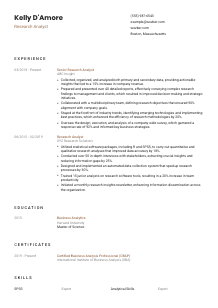
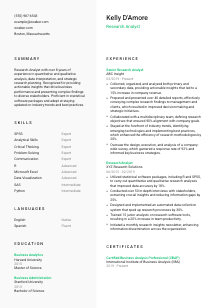
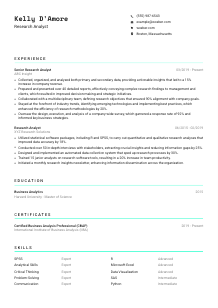
Working through data, but your CV isn't showing the insights you've uncovered? Unearth a clearer career trajectory with this Research Analyst CV example, created with Wozber free CV builder. Learn how to present your analytical acumen in line with job specifications, preparing your professional path for strong growth!
Research analyst hiring turns quickly on one question: can you take messy data, choose the right method, and turn findings into decisions people will actually use? A CV for this field needs to make that chain visible. Hiring teams want to see how you handle data collection, analysis, reporting, and cross-functional research work, not just that you are comfortable with numbers.
Screening gets much easier when your CV mirrors the language of the target role in a natural way, especially around research methods, statistical tools, and reporting outcomes. Wozber's free CV builder helps you shape that content into an ATS-compliant CV, so core terms like quantitative analysis, survey design, Excel, or stakeholder presentations are easy to parse and easy to connect to your actual work.
For a research analyst, the header should do one practical job well: confirm who you are, how to reach you, and whether you meet any basic screening requirements. Keep it clean, professional, and aligned with the posting before the reader reaches your analysis experience.
Use your full name as the most visible line in the header. Keep the formatting simple and readable. Research roles value clarity, and your CV should reflect that from the first line rather than relying on decorative styling.
Place the job title directly under your name when it matches the role you are applying for. If the opening is for a Research Analyst, say "Research Analyst." That immediate alignment helps frame the rest of your experience in the right context, especially if your recent titles vary across market research, business analysis, or insights work.
Your contact information should be accurate and professional so recruiters, hiring managers, or clients can reach you without friction.
Add your city and state when geography is part of the screening process. In the example job description, Boston, Massachusetts is a stated requirement, so listing "Boston, Massachusetts" in the header removes doubt early. For other research analyst roles, only include location details that are relevant to how the employer staffs the team.
Include LinkedIn or a professional website when it strengthens your application. For research analysts, that can be useful if your profile expands on projects, presentations, publications, dashboards, or research-focused credentials. Make sure titles, dates, and tools match your CV exactly.
Age, gender, marital status, and similar details do not help explain your research capability, software proficiency, or communication range. Unless a local application process explicitly asks for them, keep the header focused on professional information only.
Your header should answer the basic screening questions fast: who you are, what role you are targeting, how to contact you, and whether you meet any stated location requirement. That lets the reader move straight to your research credentials.




This section carries the most weight for a research analyst because it shows how you approach data, methods, reporting, and business decisions in real settings. The strongest entries do more than list duties. They show the scale of research work, the tools used, the audiences served, and the outcomes produced.
Start by marking the responsibilities that matter most in the target posting, then reflect those themes in your bullets. For research analyst roles, that usually means data collection, quantitative or qualitative analysis, survey or interview work, reporting, and collaboration with business teams. If the posting emphasizes actionable insights, your bullets should show how your findings influenced a decision, process, or result.
Lead with your most recent work and include the basics that let a hiring manager understand your progression quickly. Titles, employers, and dates matter because they establish your level of responsibility and the environments where you practiced research.
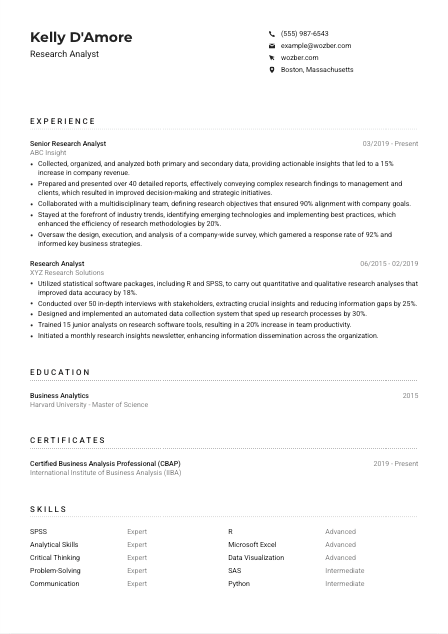
Move past task-only bullets such as "analysed data" or "prepared reports." Instead, describe what you analysed, who used the findings, and what changed because of the work. The example CV does this well by tying research output to revenue growth, decision-making, and company strategy. That is the level of specificity that gives research experience weight.
Research work is often evaluated through volume, accuracy, adoption, efficiency, and business impact. Use numbers where they are natural: number of reports delivered, response rates, interviews completed, data accuracy gains, process speed improvements, or revenue impact. Metrics like "prepared over 40 reports" or "improved data accuracy by 18%" tell the reader far more than a generic claim about strong analysis.
Choose accomplishments that reinforce your value as a research analyst. Strong bullets often mention methods, tool use, stakeholder collaboration, or reporting outcomes. If you automated data collection, trained analysts on SPSS or R, designed a survey, or translated findings for non-technical leadership, those details belong here. Remove achievements that do not strengthen the case for your analytical range.
After reading this section, a hiring manager should understand the kind of research you run, the tools and methods you use, and the decisions your work supports. That is what turns past jobs into a convincing case for your next one.
Education matters in research analyst hiring because it helps establish your grounding in business, economics, statistics, or another analytical field. Present it clearly, then use it to reinforce method training, quantitative coursework, or subject-area depth when it adds value to the role.
Read the education requirement closely and make sure your most relevant degree is easy to find. In the provided posting, a bachelor's degree in a related field such as Business, Economics, or Statistics is required. If your degree matches directly, make that connection obvious. If your field is adjacent, use the wording of your major and related coursework to show analytical relevance.
Keep each entry easy to scan so the reader can confirm your credentials without hunting for details. List the degree, field of study, school, and graduation date or expected graduation date in a consistent structure.
If you are earlier in your career or your degree title does not fully capture your analytical training, a short list of relevant coursework can help. Prioritise subjects such as statistics, econometrics, market research, data analysis, survey design, business analytics, or research methodology. Skip long course lists once your experience section carries the stronger proof.
Academic distinctions are useful when they show something specific about your analytical ability. A thesis using regression analysis, a capstone built on survey data, or honors tied to quantitative performance can add substance, especially if you do not yet have extensive professional research experience.
If you have continued your education through graduate study, specialised coursework, or training in analytics tools, include it when it sharpens your profile. In the example CV, a master's degree in Business Analytics adds extra weight because it supports the candidate's work with data interpretation and applied research methods.
Your education section should confirm that you have the academic base for structured research work and, when relevant, show extra training in analytics or methodology. Keep it factual, relevant, and easy to connect to the role.
Certifications are optional for many research analyst roles, but they can strengthen a CV when they add a tool, method, or business analysis credential that the rest of the application supports. The key is relevance. A shorter list of well-chosen certifications will help more than a long list of generic courses.
Prioritise credentials that connect to research execution, analytics, statistics, business analysis, data visualization, or survey methodology. If a certificate helps explain how you approach data, stakeholder requirements, or analytical problem-solving, it has a place on the CV.
If you hold several certifications, feature the ones that speak most directly to the target job. A business analysis credential, for example, can be useful when the role involves defining research objectives with cross-functional teams. That is why the CBAP on the example CV works as supporting context, even though it is not a universal requirement for every research analyst position.
Add the year earned and, if applicable, the validity period. This is especially helpful for certifications tied to current tools, analytical frameworks, or professional standards. Dates show whether your training is recent enough to reflect how research work is performed today.
Research methods, software ecosystems, and reporting expectations change over time. Updating your credentials in areas like statistical analysis, data storytelling, dashboarding, or research operations can make your CV more competitive, especially when a posting emphasizes emerging tools or evolving methodologies.
A certification section works best when each item adds something concrete to your profile, such as stronger analytical training, better tool coverage, or closer alignment with the job's research workflow.
The skills section should quickly confirm whether you can do the analytical work the role requires. For research analyst positions, that usually means a combination of technical tools, research methods, and communication strengths. Keep the list focused on skills you can support elsewhere in the CV.
Go beyond the exact bullet points in the posting. If the role asks for statistical software, data analysis, and presentations to non-technical stakeholders, the related skill set may include survey design, data cleaning, Excel modeling, data visualization, reporting, and stakeholder communication. Capture both the named tools and the practical capabilities behind them.
List the capabilities that matter most for the role first. In the provided job description, that would include software such as SPSS, R, SAS, and Microsoft Excel, along with analytical thinking, problem-solving, and presentation skills. The example CV strengthens this by pairing tool skills with communication and data visualization, which reflects how research findings are actually delivered.
Avoid turning this section into an inventory of every platform you have touched. Choose the tools, methods, and soft skills that the role is most likely to screen for, and make sure your experience bullets back them up. A concise list with SPSS, R, Excel, qualitative interviewing, quantitative analysis, and stakeholder presentation is much more convincing than a crowded list with weak relevance.
This section should make it easy to see that you have the technical toolkit and communication range to run research, interpret findings, and present usable recommendations. Relevance matters more than volume.
Language skills matter when the job posting asks for them or when the role involves interviews, client communication, or work across multiple markets. For research analysts, include languages in a straightforward way and connect them to the requirements of the role rather than treating them as filler.
If the posting names a language requirement, put it first. Here, English is mandatory, so it should appear clearly in the language section. That gives the employer a quick confirmation that you can handle reporting, presentations, and stakeholder communication in the required language.
List the language followed by a recognized proficiency level. If English is your native or fluent working language, say so plainly. Research roles often involve written summaries, interview guides, and presentations, so vague wording is less useful than a clear proficiency label.
Other languages can be valuable if the work involves multilingual respondents, international markets, or cross-border teams. The example CV includes Spanish, which could be relevant in customer research or stakeholder interviews, but only keep extra languages if they are accurate and potentially useful.
Stick to terms that are easy to understand across hiring teams and ATS systems.
Only give this section space when it adds something practical. For research analysts, that may mean broader interview coverage, easier communication with clients, or stronger access to multilingual source material. Keep the focus on usefulness, not decoration.
Language skills help when they support the way research is gathered, discussed, or delivered. Present them plainly and let the employer see where they would matter in the work.
Your summary should give a hiring manager a quick, accurate read on the kind of research analyst you are. Keep it short, but make it specific enough to show your level of experience, analytical range, and the types of outcomes your work supports.
Before writing, identify the few requirements that define the role. In this posting, those include quantitative and qualitative research, statistical software, actionable insights, and communication with technical and non-technical audiences. Those themes should shape the summary instead of generic claims about being results-driven or detail-oriented.
Start with your title, years of experience, and research focus. For example, a summary can establish experience across primary and secondary research, survey analysis, stakeholder interviews, or business decision support in one sentence. This gives the reader a fast sense of your scope.
Choose strengths you can support in your experience section, such as proficiency in SPSS, R, Excel, qualitative interviewing, reporting to leadership, or translating findings into strategy. The sample summary works because it combines years of experience with analytical capabilities and a clear business outcome: actionable insights that improve performance.
Aim for a compact paragraph, usually three to five lines. Skip broad personality language and concentrate on the work you do well, the tools you use, and the decisions your research informs. A concise summary should make the rest of the CV easier to understand, not repeat it.
A well-written summary should quickly position you as a research analyst who can gather data, interpret it with sound methods, and communicate findings in a way the business can act on. That is the standard to aim for.
A strong research analyst CV makes your process visible: how you gather information, what methods and tools you use, and what decisions your findings support. Wozber's free CV builder helps organise that experience into a clear, ATS-friendly CV that stays aligned with the language employers use in research and analytics hiring.
Start from an ATS-friendly CV template or revise an existing draft with Wozber's ATS CV scanner to check alignment by section, surface missing requirements, and sharpen wording around tools, methods, and outcomes. When the final version is tailored well, hiring teams can quickly see your analytical range, reporting strength, and readiness to contribute from day one.




