



Use Wozber and land your dream job
Create CV
No registration required
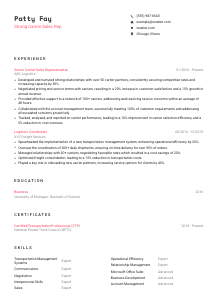
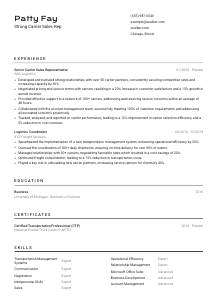
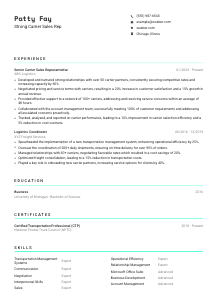
Bridging routes for success, but your CV seems off track? Check out this Strong Carrier Sales Rep CV example, created with Wozber free CV builder. Learn how to put your carrier expertise to work for the job, setting your career course for smooth sailing and hefty hauls!
Carrier sales CVs are read through the lens of margin, coverage, and execution. Hiring teams want to see whether you can build dependable carrier networks, negotiate rates without damaging service, and keep freight moving when capacity tightens or customer demands change. Your CV should make that operating reality visible, not bury it under generic sales language.
When the CV is tailored well, the first read quickly separates someone who only handled shipment coordination from someone who actively sourced capacity, managed carrier relationships, and improved cost or service performance. Wozber's free CV builder helps you shape that distinction into an ATS-compliant CV by aligning your wording with the job description and keeping the structure easy to scan. That makes it easier for the employer to recognize real carrier sales strength fast.
This section does quiet but important work in a carrier sales CV. It gives the employer the basics they need to contact you, and it can immediately remove friction around role title, professionalism, and location when a posting has a market-specific requirement.
Use your full name at the top in a clean, readable format. In transportation and logistics hiring, speed matters, and your header should be simple enough for both recruiters and ATS systems to pick up instantly.
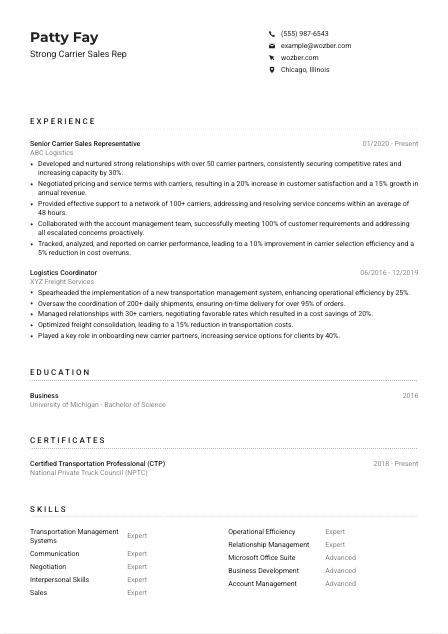
Place the role title directly under your name when it fits your background, such as "Strong Carrier Sales Rep." This helps position you for jobs centered on carrier sourcing, rate negotiation, and capacity management instead of broader logistics coordination work.
Include a reliable phone number and a professional email address. If a recruiter wants to discuss your carrier network experience, revenue results, or availability, they should never have to hunt for a way to reach you.
If a role specifies a market, include your city and state. Here, listing Chicago, Illinois directly supports a stated requirement and avoids unnecessary questions about relocation before anyone reaches your experience section.
Link to LinkedIn or a professional website if it supports your candidacy. Make sure it reflects the same transportation, sales, and operations background shown on your CV, especially if it expands on customer accounts, freight volume, or industry experience.
A strong header removes preventable doubt. For carrier sales roles, that means clear identity, clean contact information, and any location detail that helps the employer move straight to your transportation experience.




This is the section that usually decides whether a carrier sales candidate gets a closer look. Employers want proof that you can secure capacity, negotiate effectively, support carrier partners, and improve results through better pricing, service, or network performance.
Start by identifying the work that drives the role, then build bullets around that. For this position, that includes carrier relationship management, pricing negotiation, service issue resolution, cross-functional coordination, and performance reporting. If you have done those things under different job titles, make them visible in your wording.
List roles in reverse chronological order with job title, employer, and dates. That structure helps hiring teams quickly understand whether your background progressed from shipment coordination or logistics support into direct carrier sales responsibility.
Your bullets should show what changed because of your work. Strong examples include expanding carrier capacity, improving acceptance rates, negotiating better buy rates, resolving service failures faster, or helping account teams meet customer commitments. The sample CV does this well by linking relationship-building to a 30% capacity increase and negotiation work to revenue and satisfaction gains.
Numbers matter here because carrier sales is measured in results. Use metrics such as carrier count, shipment volume, margin improvement, cost savings, response time, on-time performance, or percentage of customer requirements met. Metrics like resolving carrier concerns within 48 hours or reducing cost overruns by 5% give hiring teams a much sharper picture than broad claims about communication or support.
Prioritise experience that supports transportation sales, carrier management, customer service coordination, and system-driven operations. Older or less relevant work can stay brief unless it explains a useful part of your progression into brokerage, freight operations, or transportation management.
Your experience section should show that you know how carrier sales affects both service and margin. If the bullets clearly connect your actions to capacity, cost control, carrier performance, and customer delivery, the value of your background becomes much easier to judge.
Education usually will not outweigh proven transportation results, but it still matters when a posting calls for a specific degree background. In carrier sales, a business or supply chain foundation supports the commercial and operational side of the work.
If the job asks for a bachelor's degree in Business, Supply Chain Management, or a related field, list that information clearly and without extra formatting clutter. A Bachelor of Science in Business, like the example CV uses, aligns well with this type of requirement.
Include degree, field of study, school name, and graduation year. That is usually enough for logistics and transportation roles, where employers are more focused on your carrier sales history than on long academic detail.
If your degree is in a related discipline, make the connection obvious. Studies in business, supply chain, logistics, operations, or transportation can all support work involving rate negotiation, network management, and freight coordination.
Early-career candidates can include a few relevant courses or projects, especially if they relate to transportation planning, supply chain operations, sales, or analytics. Once you have several years of carrier-facing experience, your job results should carry more weight than coursework.
Honors, scholarships, or relevant student leadership can help if they reinforce commercial initiative or logistics interest. Keep them brief and only include them if they still add something meaningful to your current profile.
For this kind of role, education should confirm that you meet the stated requirement and have a foundation relevant to freight and business operations. Keep it clean, accurate, and secondary to your transportation results.
Certifications are not always required for carrier sales, but they can strengthen your profile when they relate to transportation operations, freight, or professional development in the industry. They work best when they support the story already told by your experience.
Start with the job description. This one does not require a specific certification, so certificates are a supporting asset rather than a screening item. That means relevance matters more than quantity.
Prioritise credentials connected to transportation, logistics, operations, or sales effectiveness. A certification such as Certified Transportation Professional fits naturally because it reinforces industry knowledge behind carrier management and freight decisions.
List the issue date and, if applicable, an active period or renewal status. That gives hiring teams a quick sense of recency and helps show whether the credential reflects current knowledge.
Carrier sales changes with market cycles, shipper expectations, and transportation technology. Ongoing coursework or updated certifications can show that you stay current with the tools, terminology, and operating pressures shaping the field.
A certificate should reinforce your transportation credibility, not distract from it. Include the ones that strengthen your command of freight operations, carrier management, or commercial execution, and leave out anything generic.
The best skills sections for carrier sales roles are tightly aligned to how the job is actually done. Employers expect a mix of transportation systems knowledge, negotiation ability, relationship management, and the communication needed to work across carriers, customers, and internal teams.
Read the posting closely and pull out both technical and interpersonal requirements. Here, transportation management systems, Microsoft Office, negotiation, communication, and interpersonal skills are all directly stated, so they should appear if you genuinely use them in your work.
Lead with the capabilities that define strong carrier sales performance. TMS proficiency, carrier relationship management, pricing negotiation, sales, operational follow-through, and account coordination usually belong near the top because they map directly to day-to-day work.
Do not overload this section with every general skill you have ever used. A focused list is more convincing, especially when the same skills are backed up by measurable bullets in your experience section, like improved capacity, cost savings, or faster issue resolution.
Your skills section should read like the toolkit of someone who can source capacity, negotiate effectively, and work the operational side of freight without losing track of customer needs. Relevance and consistency matter more than length.
Language skills can matter in transportation, especially when carrier networks or customer relationships cross regions and markets. For this job, English fluency is a stated requirement, so your language section should make that easy to confirm right away.
List English prominently and describe your level accurately. If English fluency is specifically requested, this is not a minor detail. It is part of showing that you can negotiate, coordinate, and resolve service issues without communication gaps.
If you speak additional languages, include them when you can use them professionally. In freight and logistics, another language may help with carrier communication, customer service, or relationship-building in diverse markets.
Terms like "Native," "Fluent," "Intermediate," and "Basic" are usually enough. Keep the labels honest so they set the right expectation for calls, negotiations, and written communication.
Some carrier sales roles stay domestic, while others touch broader regional or international operations. If another language has helped you work with specific carrier bases or customer segments, it can be worth highlighting.
In this field, language ability matters when it helps move freight, resolve issues, or build trust faster. Present it in that practical spirit rather than as a generic extra.
For a carrier sales CV, languages should clarify communication capability. Meet the English requirement clearly, and include additional languages when they support the relationship-driven side of transportation work.
Your summary should quickly establish what kind of carrier sales professional you are. In a few lines, it needs to connect your tenure, commercial strengths, and transportation results so the rest of the CV reads in the right context.
Use the posting to identify the themes your opening should emphasize. For this role, that means carrier relationships, pricing negotiation, sales performance, operational support, and performance tracking rather than generic statements about being results-driven.
Open with your years of experience and the area you work in, such as carrier sales, freight brokerage, or transportation management. That immediately tells the reader whether your background matches a role centered on capacity procurement and carrier development.
Include measurable highlights that sound native to the job. The example summary works because it references more than 5 years of experience, strong carrier partnerships, and operational efficiency. You can strengthen that approach further with specific outcomes such as revenue growth, cost savings, improved carrier coverage, or service improvement.
Aim for a short paragraph, usually three to five lines. A summary that is concise and specific gives the recruiter a fast read on your market value without repeating every detail that appears later in the CV.
By the time someone finishes your summary, they should already understand your lane in transportation, the scale of your experience, and the kind of results you deliver with carriers and customers. That creates the right frame for everything that follows.
A strong Carrier Sales Rep CV should make your commercial judgment and operational follow-through easy to see. Focus each section on the work that matters most in freight brokerage and transportation teams: building carrier relationships, negotiating rates, protecting service, and improving measurable results.
Wozber's free CV builder can help you turn that experience into an ATS-friendly CV template with cleaner structure and sharper alignment to the posting. Use its ATS CV scanner and AI CV builder features to match role-specific terminology, strengthen weak phrasing, and present your background in an ATS-friendly CV format that keeps your carrier sales value clear from the first scan.
When your CV shows how you secure capacity, support carriers, and improve cost or service outcomes, hiring teams can quickly see you are ready for the seat.




