



Use Wozber and land your dream job
Create CV
No registration required
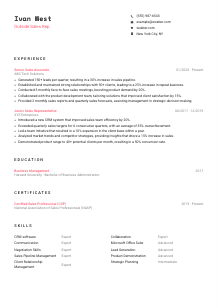
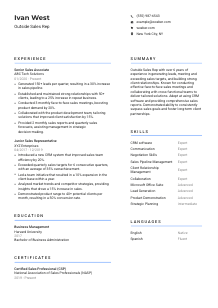
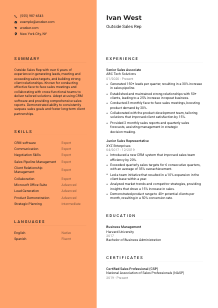
Knocking on doors, but your CV doesn't open opportunities? Check out this Outside Sales Rep CV example, built with Wozber free CV builder. Learn how to pitch your sales skills to match market demands, making sure your career trajectory is as impressive as your monthly quotas!
Outside sales hiring moves fast because the work is visible fast. Once you're in the field, you're expected to open doors, build trust in person, move prospects through the pipeline, and keep revenue moving against a quota. A CV for this kind of role needs to show commercial traction early, especially lead generation, face-to-face selling, relationship growth, and results tied to accounts or territory performance.
When those details are tailored to the posting, hiring teams can quickly tell whether your background is built around active prospecting and client-facing sales instead of broader customer support or inside sales work. Wozber's free CV builder helps shape that experience into an ATS-compliant CV by aligning your wording with the job description, so your pipeline ownership, target performance, and reporting discipline are easy to spot.
For an Outside Sales Rep, the contact section should do one practical thing right away: confirm that you are reachable, professionally presented, and available for the territory the employer is hiring in. Keep it clean, direct, and aligned with any location requirement in the posting.
Set your name at the top in a clear, readable format so it anchors the page immediately. Sales CVs often move through busy hiring pipelines, and a clean header helps keep your application easy to identify after recruiter review, manager handoff, or ATS parsing.
Place the job title you are pursuing under your name when it honestly reflects your background. Using "Outside Sales Rep" helps frame your experience around field selling, prospect meetings, demos, and quota-carrying work instead of leaving the reviewer to guess which side of sales you come from.
List a current phone number and a professional email address, then verify both. In outside sales, interview scheduling can happen quickly, especially when employers are hiring for active territories or growth markets, so missed calls and typo-filled emails create avoidable friction.
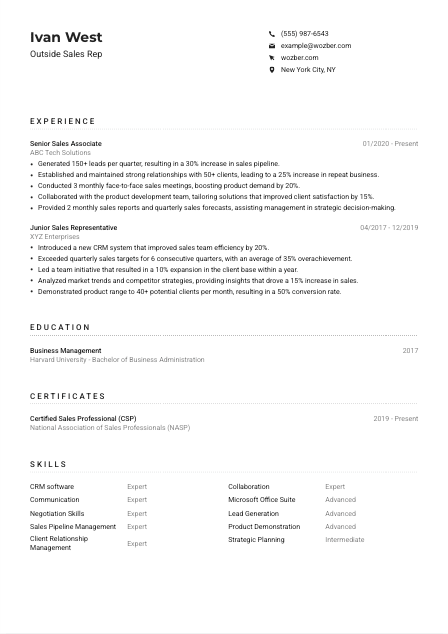
If the posting asks for local presence, reflect that clearly in your city and state. Here, "New York City, NY" matters because the employer specifically wants someone based there. You do not need a full street address. You do need to remove any doubt about territory availability.
Include LinkedIn or another relevant professional profile if it strengthens your case. For sales candidates, this can reinforce account-facing credibility, recommendations, industry network, and career progression. Skip anything that does not support your work in prospecting, relationship management, or revenue generation.
This section should confirm three things at a glance: who you are, what sales role you are targeting, and whether you are reachable for the territory. That is all the hiring team needs here.




This is the section that carries the most weight for an Outside Sales Rep. Hiring managers want to see what kind of pipeline you built, how you handled client meetings, whether you hit target, and what business moved because of your work. Generic responsibility lists will not do that. Your bullets need sales activity and commercial outcomes.
Start by identifying the few responsibilities that define the role. In this description, those are lead generation, pipeline building, client relationships, face-to-face meetings, collaboration on solutions, and regular reporting. Build your experience bullets around these same work patterns so the employer can map your background to the job quickly.
List your positions in reverse chronological order with title, company, and dates. For sales hiring, progression matters. Moving from a junior sales role into a senior account-facing position can show larger quotas, more complex deals, broader territory responsibility, or greater ownership of the sales cycle.
The best bullets connect action to result. Instead of saying you were responsible for lead generation, show volume and effect. The sample CV does this well with "Generated 150+ leads per quarter, resulting in a 30% increase in sales pipeline." That format works because it ties prospecting effort to pipeline growth, which is exactly how field sales performance is discussed.
Quantify what you can: leads per quarter, conversion rate, repeat business, target attainment, meeting volume, account count, client retention, territory growth, forecast accuracy, or average overachievement. Metrics such as "exceeded quarterly sales targets for 6 consecutive quarters" or "50% conversion rate" tell a hiring manager far more than broad claims about being results-driven.
Prioritise experience that shows you can prospect, present, negotiate, and manage accounts. Older or less relevant roles can be shortened if they do not strengthen that case. For this role, bullets about CRM adoption, product demos, client retention, and cross-functional solution building are much more useful than unrelated administrative detail.
A hiring team should be able to scan this section and understand your market impact fast: how you built pipeline, how you handled clients, and what numbers moved under your ownership.
Education usually will not outweigh sales performance, but it can still matter in screening, especially when a posting names a degree requirement. Keep this section straightforward and make the academic match easy to confirm.
If the employer asks for a bachelor's degree in Business, Marketing, or a related field, make that connection obvious. A degree such as Bachelor of Business Administration in Business Management fits the requirement well and should be listed clearly without extra wording around it.
Include degree, field of study, school, and graduation year or date. Outside sales hiring is usually driven more by track record than academic detail, so a concise format works best and keeps attention on your commercial experience.
Use the full, correct degree title rather than abbreviating it into something vague. If your degree is related rather than exact, the field name should still help the employer understand why it supports your background in sales, business development, marketing, or client management.
Relevant coursework can help if you are early in your career or if the classes clearly support the role, such as sales management, marketing, negotiation, or consumer behaviour. For experienced candidates, this is usually optional because quota history and account results will carry more weight.
Honors, awards, or notable projects are worth mentioning if they reinforce business acumen, presentation skills, market analysis, or leadership. Keep them brief. Education should support your candidacy, not compete with the experience section for space.
When the degree is listed clearly and aligns with the posting, the employer can check that box quickly and move back to the part they care about most, your sales record.
Certifications are not mandatory for most Outside Sales Rep roles, but the right one can reinforce your commercial discipline and commitment to the craft. Use this section to add relevant sales training, not to list every course you've ever taken.
Focus on credentials tied to prospecting, consultative selling, negotiation, account management, or sales methodology. A certification like "Certified Sales Professional (CSP)" works because it complements the client-facing, target-driven nature of outside sales.
A short list of relevant certifications is more convincing than a long list of loosely connected learning badges. Prioritise training that supports field meetings, relationship building, pipeline management, or solution selling, since those are common expectations in outside sales roles.
Show issue dates and renewal windows where applicable. Current credentials suggest recent engagement with sales practice, and that can matter if the certificate reflects updated techniques in prospecting, CRM use, or account development.
Sales environments change with new buying behaviour, tools, and reporting expectations. Ongoing certifications or recent training can show that you are keeping your approach current, whether that relates to negotiation, CRM workflows, or more structured sales processes.
A good certification section adds one more layer of credibility to your field sales profile. Keep it relevant, current, and clearly connected to the way you sell.
The skills section should reflect how you actually work in the field. For an Outside Sales Rep, that usually means a mix of prospecting, relationship management, negotiation, CRM discipline, presentation ability, and the practical tools used to track activity and forecast revenue.
Read the posting closely and mirror the skills that describe the work. Here, that includes interpersonal communication, negotiation, CRM software, Microsoft Office Suite, and the broader ability to generate leads and maintain client relationships. Matching that language improves both ATS alignment and reviewer recognition.
List the capabilities most tied to performance in outside sales. Sales pipeline management, lead generation, product demonstration, client relationship management, and negotiation all point directly to day-to-day execution. The sample CV also includes collaboration, which makes sense because solution-selling often requires coordination with product or internal teams.
Do not overload this section with generic traits. A shorter list of hard-working skills is stronger than a long catalogue of broad positives. Use terms that can be backed up elsewhere on the page through bullets, metrics, CRM use, meeting activity, or sales reporting.
Every skill here should connect to the way you prospect, present, negotiate, and manage accounts. If the employer can see those same abilities in your experience bullets, the section is doing its job.
Language ability matters most when it affects how you communicate with prospects and clients. In outside sales, that can influence meetings, presentations, follow-up, and relationship-building across a broader customer base.
If the posting states that English is required, list it clearly with an honest proficiency level such as "Native" or "Fluent." That removes uncertainty immediately and addresses a stated qualification without making the reader search for it.
Additional languages can be useful if the territory, customer base, or product environment includes multilingual clients. For example, Spanish may be a practical advantage in many markets because it can support rapport-building and more flexible client communication.
Choose standard levels such as Native, Fluent, Intermediate, or Basic. These are easy to understand and keep expectations realistic for sales calls, demos, negotiation, or account follow-up.
If your target roles involve diverse neighborhoods, regional territory coverage, or relationship-heavy selling, multilingual ability can become a differentiator. Mention it when it supports the commercial context rather than treating it as a decorative extra.
Language skills matter when they help you connect, explain value, and move conversations forward. Frame them as practical communication assets, especially for roles built on in-person meetings and ongoing client contact.
For sales roles, language skills are useful when they help you build trust and keep business moving. List them clearly and let the employer see where they add reach.
Your summary should read like the top line of your sales story. In a few sentences, it should establish experience level, selling strengths, and the kinds of outcomes you consistently drive. This is where you frame yourself before the hiring manager reaches the bullet points.
Pull the central themes from the job description and use them to shape the summary. For this posting, that means lead generation, sales target performance, client relationship management, face-to-face meetings, collaboration on solutions, and reporting. You do not need to list every requirement, but the summary should clearly belong to someone who has done that work.
Start with your years of experience and the kind of sales work you do best. A line like "Outside Sales Rep with over 6 years of experience in generating leads, meeting and exceeding sales targets, and building strong client relationships" works because it establishes tenure, sales motion, and measurable responsibility right away.
Use the next sentence to reinforce what you are known for, such as product demonstrations, account growth, cross-functional solution selling, or disciplined CRM reporting. Pull from the strongest parts of your background rather than speaking in vague terms about passion or motivation.
Aim for a short paragraph that a hiring manager can absorb in seconds. Outside sales leaders are usually looking for proof of pipeline ownership and target performance, so keep the language direct and make every sentence point back to selling results or client impact.
A good summary tells the reader what kind of seller you are before they reach your work history. Keep it specific enough that your experience section feels like proof, not explanation.
A polished Outside Sales Rep CV should make your pipeline generation, client-facing work, quota performance, and reporting discipline easy to follow from top to bottom. When those details are tailored to the posting, both recruiters and sales leaders can quickly see whether you have handled the kind of territory, account relationships, and revenue goals they need.
Use Wozber to turn that experience into an ATS-friendly CV format with sharper role wording, stronger ATS optimisation, and clearer section structure. The final result should make one thing obvious: you know how to win business in the field.