



Use Wozber and land your dream job
Create CV
No registration required
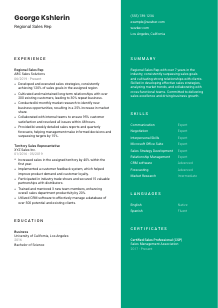
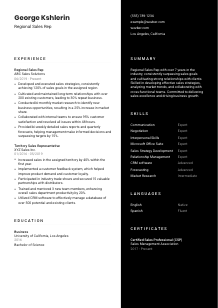
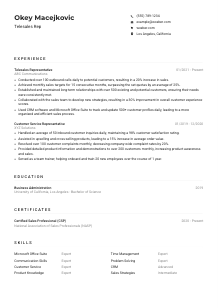
Crisscrossing territories, but your CV feels like it needs coordinates? Navigate this Regional Sales Rep CV example, created with Wozber free CV builder. Learn how to map your sales prowess to match regional requirements, setting your career trajectory for market-conquering success!

Regional sales work gets judged quickly on one thing: can you grow revenue across a territory without losing grip on relationships, follow-up, and market insight. Hiring teams want to see how you open accounts, retain customers, respond to regional demand shifts, and turn activity into quota performance. Your CV should make that commercial track record visible within a few lines.
A tailored CV also helps separate field-tested sales candidates from broader account management or customer service profiles. With Wozber's free CV builder, you can align your language with the posting, keep the document in an ATS-friendly CV format, and surface the sales metrics, CRM usage, and forecasting work that matter first for this kind of role.
For a Regional Sales Rep, the header needs to answer practical questions fast: who you are, how to reach you, and whether you meet basic logistical requirements for the territory. Keep it clean and businesslike so the reader can move straight to your sales record.
Use your full name as the most visible line on the page. Sales hiring moves fast, and a clean header makes your CV easier to reference after interviews, pipeline reviews, or internal forwarding between recruiters and regional leaders.
Place the job title you are pursuing directly under your name when it matches your background. Writing "Regional Sales Rep" helps frame your experience around territory management, client growth, and quota delivery instead of leaving the reader to interpret a broader sales label.
Include a reliable phone number and a professional email address you check often. If you also add a website or LinkedIn profile, make sure it supports your sales story with consistent titles, account growth examples, or industry experience rather than repeating incomplete information.
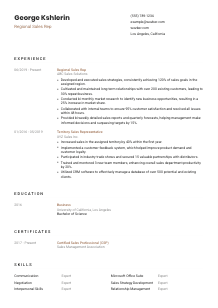
Regional sales roles often have location requirements because travel time, account coverage, and local market familiarity matter. If the posting specifies a city or region, include it in your header. Here, listing Los Angeles, California directly supports a stated requirement and removes an avoidable question.
A LinkedIn profile can strengthen your application if it reflects the same employers, titles, and results shown on your CV. For sales professionals, it can also reinforce industry focus, channel relationships, and business development credibility, but only when it is current and polished.
This section should confirm that you are reachable, professionally presented, and positioned for the territory. When those basics are clear, the reader can focus on quota history, customer growth, and regional sales execution.




The experience section carries the most weight for a Regional Sales Rep because it shows how you perform in the field. Hiring managers look for territory ownership, sales strategy, customer retention, pipeline management, market development, and reporting discipline, all backed by results.
Read the job description like a territory plan. Mark the responsibilities that define the role, such as developing regional sales strategies, building customer relationships, researching market opportunities, collaborating across teams, and delivering forecasts. Those priorities should shape which achievements you lead with in each job.
List your positions in reverse chronological order with company, title, and dates. For sales candidates, this helps employers quickly understand progression from territory support to full regional ownership, as well as how long you have carried a book of business, a region, or a quota.
Write bullet points around results, not duties alone. Useful proof includes quota attainment, revenue growth, account expansion, distributor development, repeat business, customer retention, and speed of issue resolution. The example CV does this well with lines like achieving 120% of sales goals and increasing market share through regular research.
Metrics make your impact concrete. Include figures such as percentage to quota, growth by region, number of active accounts, repeat purchase rate, forecast accuracy, partnership wins, or response times for customer issues. Details like managing 200 customers or lifting territory sales by 40% tell a much clearer story than "responsible for regional sales."
Every bullet should help the employer picture you handling the region they need covered. Prioritise work tied to revenue, relationships, market penetration, CRM usage, and cross-functional follow-through. Leave out generic tasks unless they show commercial impact or support a requirement from the posting.
Your work history should read like a record of territory performance. When each role shows customer growth, target attainment, and disciplined reporting, hiring teams can picture you stepping into a region and producing results.
Education usually plays a supporting role in sales hiring, but it still matters when a posting names a degree requirement. Present it clearly so recruiters can confirm eligibility without digging, then let your sales results carry the stronger part of the case.
If the employer asks for a bachelor's degree in Business, Marketing, or a related field, reflect that wording as closely as your background allows. A degree such as Bachelor of Science in Business aligns well here and clears a stated requirement immediately.
List your degree, field of study, school, and graduation year. This section does not need heavy detail for an experienced Regional Sales Rep unless your academic background is unusually relevant to the market, product category, or sales function.
When your degree connects naturally to the role, keep that link visible. Business, marketing, communications, or related fields can reinforce your understanding of market analysis, customer behaviour, and commercial planning, especially early in your career.
Most experienced sales professionals can skip course lists. Include them only if they add something specific, such as B2B marketing, consumer behaviour, analytics, or sales management, and only when that detail helps connect your education to the role you want.
Honors, leadership roles, or relevant student organizations can stay if they add substance and you are early in your career. If you already have several years of quota-carrying experience, keep the section lean and let the space go to account wins, growth metrics, and territory results.
For this role, education should confirm the baseline requirement and then get out of the way. A concise entry is enough when your experience already shows how you sell, forecast, and grow a region.
Sales certifications are rarely the deciding factor for a Regional Sales Rep, but the right one can support your profile. They work best when they add a credible layer to your experience in selling, negotiation, account management, or sales process discipline.
Start with the job ad. If no certification is required, treat this section as optional support rather than filler. A relevant credential such as Certified Sales Professional can still strengthen your profile by showing formal training in sales practice.
Prioritise credentials that connect to territory planning, consultative selling, negotiation, CRM process, channel sales, or customer relationship management. A certificate should reinforce how you operate in the field, not just show that you completed a course.
List the issue date and, if relevant, the active period. That helps employers see whether the credential is current, especially for certifications tied to continuing education or membership-based professional standards.
A short, relevant list works best. If you continue to train in areas like sales enablement, forecasting, account planning, or negotiation, keep the section updated so it reflects current practice and not a one-time credential from years ago.
Include credentials that sharpen your sales profile and leave out the rest. A focused certification section adds credibility when it matches the way the role is actually performed.
The skills section should mirror the tools and capabilities that drive regional sales performance. Hiring teams scan this area for a quick read on how you sell, manage accounts, use systems, and communicate across customers and internal teams.
Start with the posting's language. For this role, that includes communication, negotiation, interpersonal skills, CRM software, Microsoft Office, sales strategy, market research, and forecasting. These terms often appear in both recruiter searches and ATS screening, so they should be reflected naturally if they match your background.
List the capabilities that show up in your work history, not a wish list. If you claim forecasting, there should be bullets about sales reports or quarterly projections. If you list relationship management, show account retention, repeat business, or distributor growth. The sample CV handles this well by pairing CRM, forecasting, and market research with measurable outcomes.
Choose a tight set of role-relevant skills instead of an oversized inventory. For a Regional Sales Rep, that usually means a mix of selling skills, territory management strengths, and supporting tools. A concise section makes it easier to spot whether you can prospect, negotiate, manage a pipeline, and report accurately.
A hiring manager should be able to glance at this section and recognize a sales professional who can win business, manage customer relationships, and operate with the reporting discipline the region requires.
Language ability matters in sales when it affects customer communication, territory coverage, and relationship building. Keep this section accurate and practical, especially when the job posting names a required language for client or internal communication.
If the employer specifies English communication, make that visible first. For this posting, clear English expression is a stated requirement, so listing your English proficiency directly helps confirm eligibility.
Order languages by relevance to the role. If English is required, lead with it. Then add any additional language that could help with customer relationships, distributor communication, or regional market access.
Extra languages can strengthen a Regional Sales Rep profile when they expand your ability to build trust or work across diverse customer bases. For example, Spanish can be useful in many markets, but include it as added reach, not as a substitute for the role's core sales qualifications.
Label your proficiency clearly with terms such as Native, Fluent, Advanced, or Conversational. Sales roles rely on precision in meetings, negotiation, and follow-up, so overstating language ability can quickly become a problem.
If a second language has helped you manage accounts, support customer retention, or navigate a specific territory, the section becomes more meaningful. Keep the point grounded in relationship building and communication outcomes rather than listing languages as decoration.
Language skills are most persuasive when they clearly support customer communication and territory coverage. Presented honestly, they add useful depth to a sales CV.
Your summary should quickly tell the reader what kind of sales professional you are, how much experience you bring, and what commercial results you tend to produce. For a Regional Sales Rep, the strongest summaries balance territory scope, customer relationship strength, and quota performance in a few tight lines.
Before writing, identify the patterns in the posting. Here, the most important themes are regional strategy, customer relationship management, market research, cross-functional collaboration, and regular reporting. Those should shape the language in your opening lines.
Lead with your current professional level and years of relevant experience. A line such as "Regional Sales Rep with 7+ years in territory sales" gives immediate context and helps position you against the role's experience requirement.
Use the next sentence to highlight capabilities that matter in the field, such as exceeding sales goals, growing customer accounts, identifying new business opportunities, or producing reliable forecasts. In the sample, the summary works because it connects goal attainment, client relationships, market analysis, and cross-functional work in a compact way.
Aim for three to five lines. Skip soft claims that could apply to any job and use wording tied to sales execution, such as territory growth, account retention, pipeline development, or revenue performance. The summary should invite the reader into the evidence already waiting in your experience section.
A strong summary gives hiring teams an immediate picture of your market value. By the time they reach your first bullet point, they should already expect a candidate who can manage a region, grow revenue, and communicate clearly with customers and leadership.
A Regional Sales Rep CV should make three things easy to see: you can hit targets, grow relationships across a territory, and report the business with discipline. When your sections are tailored around those points, the document reads less like a generic sales profile and more like a candidate ready to own a region.
Use Wozber's free CV builder to shape your content into an ATS-compliant CV, strengthen wording with role-specific terms, and keep everything in an ATS-friendly CV template. That gives hiring teams a clearer view of your quota history, customer portfolio, and regional sales judgment from the first scan.