



Use Wozber and land your dream job
Create CV
No registration required
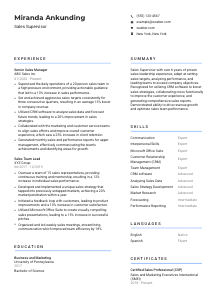
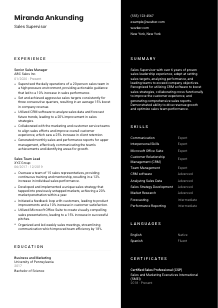
Steering sales, but your CV isn't navigating it right? Check out this Sales Supervisor CV example, created with Wozber free CV builder. Learn how to map out your leadership and revenue skills to match job criteria, guiding your career trajectory toward peak performance and growth!
Sales Supervisor hiring usually turns on one question fast: can you lead a team to quota while keeping daily sales execution disciplined. A CV for this role needs to show more than personal selling ability. It should make your coaching, target-setting, pipeline oversight, reporting cadence, and cross-functional coordination easy to see.
When that leadership work is tailored to the posting, the CV is easier to rank in both human review and ATS screening. Wozber's free CV builder helps you align your language with the job description, keep an ATS-friendly CV format, and surface terms such as CRM reporting, sales targets, and performance analysis so a hiring team can quickly understand your supervisory scope.
This section is simple, but it still does real work. For a Sales Supervisor, it should immediately confirm who you are, the role you are targeting, and whether any practical requirement, such as location, is already covered.
Use your full name in a larger, easy-to-read font so it anchors the page. This is basic formatting, but it matters when your CV is moving quickly between recruiters, sales leadership, and HR.
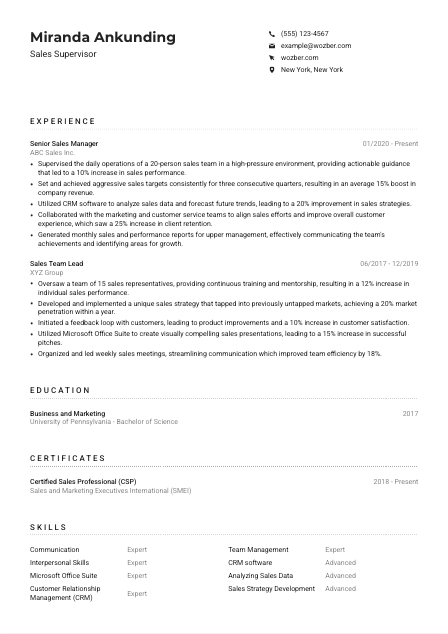
Place "Sales Supervisor" under your name when that is the role you are applying for. Matching the posted title helps frame the rest of the CV around team leadership, sales performance management, and reporting responsibility instead of a general sales profile.
Include a phone number you answer and a professional email address. Sales roles depend on responsiveness, so even this section should feel polished and reliable. If you have a LinkedIn profile or professional website, include it only if the information supports the CV and reflects your current experience.
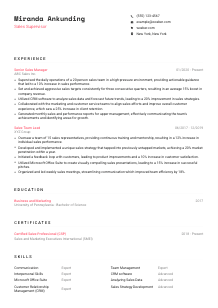
If the employer requires someone to be based in a specific city or willing to relocate, show that clearly here. In the example, listing "New York, New York" answers the location requirement right away and removes unnecessary uncertainty from the first review.
A LinkedIn page, portfolio, or company bio can help if it reinforces your sales results, leadership history, or industry background. Make sure titles, dates, and achievements match your CV. Any mismatch around territory size, team headcount, or revenue wins can weaken credibility fast.
Keep this section concise and accurate. For a Sales Supervisor application, it should confirm your identity, target role, and practical availability without distracting from the sales leadership story that follows.




This is the section sales leaders read most closely. They want to see how you managed day-to-day team activity, where you influenced revenue, what tools you used to track performance, and how your decisions improved results.
Before rewriting bullets, mark the duties that define the job. For this opening, that includes supervising daily sales operations, setting targets, analysing sales data, forecasting, collaborating across departments, and reporting results to management. Those are the themes your experience bullets should cover in plain language.
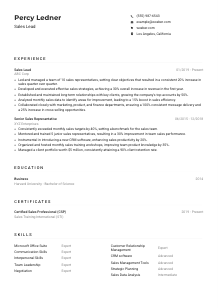
List jobs in reverse chronological order and make sure the path toward supervision is visible. Titles such as Sales Team Lead, Senior Sales Manager, or Account Executive with coaching responsibilities help show progression. Include company name and dates so employers can quickly read your tenure and leadership growth.
Each bullet should show what you led, what you changed, and what happened next. In this field, strong bullets often include team size, quota attainment, revenue growth, retention gains, forecast accuracy, or process improvements. The example does this well by tying supervision of a 20-person team to a 10% lift in sales performance and linking cross-functional work to a 25% increase in client retention.
Numbers matter here because sales performance is measured constantly. Use percentages, revenue growth, target attainment, conversion improvement, retention rate, market expansion, or reporting frequency where they are accurate. A bullet about generating monthly performance reports or increasing revenue over three consecutive quarters says far more than a vague claim about "driving results."
Prioritise experience that shows leadership, coaching, planning, analysis, and operational control. If a bullet only describes generic selling activity, rewrite it so the management angle is clear, or remove it. The hiring team is trying to picture you running meetings, guiding reps, reading CRM data, and adjusting strategy when numbers slip.
Your experience section should read like a record of sales management in action. If the hiring manager can quickly see team oversight, target ownership, data use, and business results, you are giving them the right reason to move you forward.
Education is rarely the deciding section for an experienced Sales Supervisor, but it still matters when the posting asks for a specific degree background. Present it cleanly so the employer can confirm the requirement in seconds.
If the posting asks for a bachelor's degree in Business, Marketing, or a related field, make that connection obvious. In the example, "Bachelor of Science in Business and Marketing" aligns neatly with the requirement and needs no extra explanation.
List degree, field of study, school, and graduation year in a consistent order. This makes it easier for recruiters and ATS systems to parse your academic record, especially when they are checking for a minimum qualification rather than reading for detail.
Write the exact degree name instead of shortening it too much. If your program included business, marketing, management, or sales-focused study, that context helps position you for team leadership and commercial planning responsibilities.
If you are earlier in your career or your work history is lighter on supervisory scope, selected coursework in sales management, consumer behaviour, market analysis, or business communication can help. For a more experienced candidate, this is usually optional unless the coursework is especially relevant to the role or industry.
Workshops, executive education, or employer-sponsored training in sales leadership, forecasting, CRM usage, or performance coaching can be useful additions if they are recent and relevant. This is a good way to show continued development without overloading the section.
Education should support the application without competing with your experience. For this role, the main job is to show that you meet the degree requirement and have a business foundation that fits sales supervision.
Certifications are not always mandatory for Sales Supervisor roles, but the right one can reinforce credibility in sales practice, coaching, or leadership development. Use this section selectively and keep it relevant to the work.
Start with the posting. If no certificate is required, do not pad the section with unrelated courses. Instead, choose certifications that support sales performance, leadership, customer management, or reporting discipline.
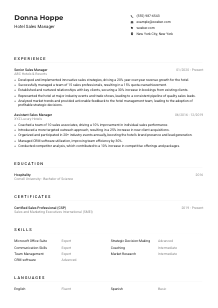
Choose certifications that connect to how Sales Supervisors are evaluated. A credential such as Certified Sales Professional can support your case because it relates directly to selling standards and commercial execution. Leadership or coaching certificates can also help when the role emphasizes team supervision.
Include when the certification was earned and whether it is current. Dates matter because they show whether the credential reflects recent practice or outdated training. In a role that depends on current selling methods and CRM-based processes, recency adds context.
Sales environments shift with product strategy, buyer behaviour, and reporting expectations. Ongoing certification work can show that you keep building skills in areas such as negotiation, pipeline management, analytics, or frontline leadership.
A focused certifications section can reinforce your profile, especially when it supports team leadership or sales execution. Keep the emphasis on credentials that add something your experience alone may not fully show.
This section should reflect how the role actually operates. Sales Supervisors are expected to balance people leadership with data-driven management, so your skills list should show both the human side of supervision and the tools used to run performance.
Start with the language in the posting. Here, the employer asks for leadership, communication, interpersonal skills, CRM proficiency, Microsoft Office, sales data analysis, forecasting, and reporting. Those terms should appear if they match your background, because they connect your CV to both ATS filtering and the hiring manager's checklist.
Do not list only soft skills. A Sales Supervisor is expected to coach people and read numbers. Combine leadership, team management, and communication with practical capabilities such as CRM software, pipeline tracking, forecasting, reporting, Excel, or presentation tools. The example's mix of team management, CRM, analysing sales data, and sales strategy development is a solid model.
Select skills that support the actual work of setting targets, monitoring activity, improving customer experience, and reporting results. Trim generic items that do not help explain how you supervise a sales team. If you use proficiency labels, keep them honest and consistent across the section.
A useful skills section makes your operating style easy to understand. For this role, that means showing you can guide people, work comfortably in CRM and reporting tools, and turn sales data into action.
Language ability matters more in sales than many candidates realize because supervisors spend so much time coaching reps, handling escalations, and presenting results. List languages in a way that supports the communication demands of the role.
If the job requires English fluency, list English prominently and label your proficiency clearly. That is a direct qualification check, so do not leave it implied.
Additional languages can be valuable when a team serves diverse customers or works across regions. In the example, Spanish adds useful range, though it is an advantage rather than a stated requirement for this particular opening.
Terms such as Native, Fluent, Intermediate, or Basic are usually enough. Hiring teams want a realistic sense of how well you can communicate in meetings, coaching conversations, and customer-facing situations.
If the role involves multilingual markets, regional accounts, or cross-border coordination, language ability can carry more weight and may deserve a stronger place elsewhere in the CV. If not, keep the section concise and factual.
Only include languages you can use credibly in a professional setting. For sales supervision, that means being able to coach, negotiate, explain product value, or resolve issues with confidence, not just hold casual conversation.
For a Sales Supervisor, language skills are useful when they support coaching, client communication, or team coordination. Lead with the required language, then add others that genuinely expand your value.
Your summary should sound like a sales leader, not a generalist. In a few lines, it needs to establish your level, your supervisory scope, and the business results you are known for delivering.
Read the job description closely and identify the handful of themes that define success in the role. For this opening, those themes are sales leadership, target-setting, performance analysis, CRM proficiency, reporting, and cross-functional collaboration. Build your summary around the parts you can prove.
Lead with a direct statement of who you are professionally. For example, a summary that starts with "Sales Supervisor with 6+ years of sales leadership experience" immediately positions you at the right level and gives context for the achievements that follow.
Choose strengths that match the work, then anchor them in results or operating responsibilities. The example summary works because it mentions setting sales targets, using CRM software to improve strategy, collaborating to improve customer experience, and driving revenue growth. Those are concrete supervisory themes, not broad claims.
Aim for three to five lines. Every phrase should help explain why you can run a sales team, interpret performance data, and support company objectives. If a line could describe almost any business professional, rewrite it until it sounds specific to sales supervision.
A focused summary helps the reader understand your leadership profile before they reach the detail below. For a Sales Supervisor application, it should quickly connect your experience, tools, and results to the demands of team performance management.
A Sales Supervisor CV works when each section supports the same picture: you can lead reps day to day, set direction, read the numbers, and report on performance with confidence. That means aligning titles, achievements, skills, and summary language around quota ownership, team guidance, CRM use, and measurable sales outcomes.
Use Wozber's free CV builder and ATS CV scanner to tailor that story to each opening, strengthen ATS optimisation, and keep the final document clean and job-aligned. When the CV is done well, a hiring manager can quickly see that you are ready to supervise sales execution, not just contribute as an individual seller.