



Use Wozber and land your dream job
Create CV
No registration required
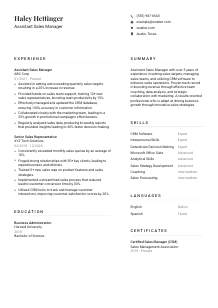
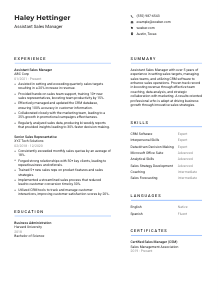
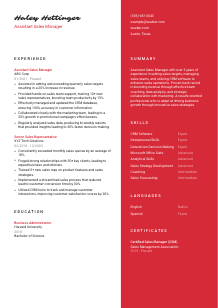
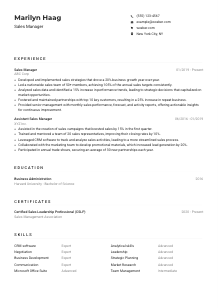
Driving sales, but your CV isn't closing deals? Check out this Assistant Sales Manager CV example, created with Wozber free CV builder. Learn how to pitch your sales acumen to match job demands, sparking your career's ascent on a high-value growth trajectory!
Assistant Sales Managers sit close to the numbers and close to the people. The work usually blends quota support, rep coaching, CRM discipline, and sales reporting, so a CV has to show that you can help a team hit targets while keeping pipeline data accurate enough to trust. Vague claims about being "results-driven" do not carry much weight here. Specific examples of revenue growth, team support, forecast input, or campaign coordination do.
A tailored CV also helps hiring teams quickly separate frontline sellers from candidates who can already operate at team-support level. Using Wozber's free CV builder makes it easier to align your wording with the posting, keep an ATS-compliant CV structure, and surface the mix of sales execution, reporting, and coaching that this role needs to show early.
Sales leadership roles move quickly, and the top of your CV should remove basic friction right away. Your contact details need to confirm who you are, what role you are targeting, and whether practical requirements such as location and communication are already covered.
Use your full name in the most prominent text on the page so it is easy to spot in a CV database or printed shortlist. Keep the styling simple and professional. For a sales role, polished presentation matters, but readability matters more than design flourishes.
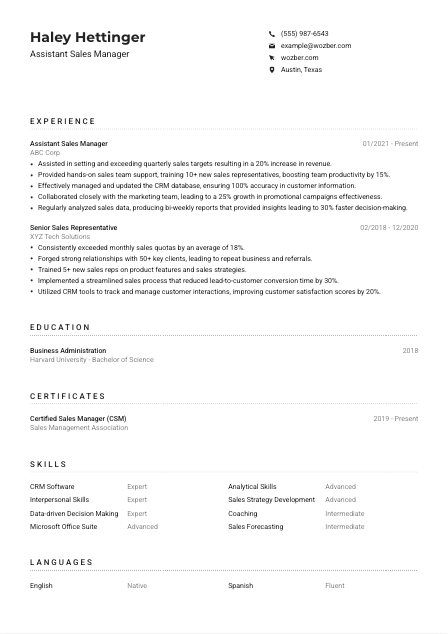
Place "Assistant Sales Manager" directly under your name if that is the role you are applying for. This helps frame the rest of your CV around team support, sales target contribution, CRM ownership, and reporting responsibility instead of reading like a general sales profile.
If the employer wants someone based in Austin or open to relocation, show that plainly in your personal details. In the example CV, listing Austin, Texas immediately removes a practical concern. For other openings, mirror the location expectation only when it is actually relevant to that employer.
A current LinkedIn profile can support your CV, especially if it reflects client-facing experience, promotions, account growth, or team leadership. Make sure job titles, dates, and major results match. In sales, inconsistency across profiles can raise avoidable questions.
Your personal details should answer the basics without delay: who you are, what position you want, how to reach you, and whether any location requirement is already covered. That gives the reader a clean start and keeps the focus on your sales record.




This section carries most of the decision-making weight for an Assistant Sales Manager. Hiring teams want to see how close you have worked to quotas, team coaching, CRM processes, reporting, and cross-functional execution, not just whether you held a sales title.
Study the posting and map your experience to the work involved. For this kind of role, that usually means assisting with sales targets, coaching reps, maintaining CRM data quality, partnering with marketing, and turning sales numbers into useful recommendations. If a past role touched those areas, say so directly instead of leaving it implied.
List roles in reverse chronological order with title, company, and dates presented consistently. For someone moving from Senior Sales Representative into management support, the structure should make that progression obvious. Promotions, training duties, and increased ownership over reporting or process improvement all help tell that story.
Do not stop at "supported the sales team" or "managed CRM records." Show what happened because of that work. The sample CV does this well with bullets tied to a 20% revenue increase, 15% productivity gain, and 100% CRM accuracy. That kind of phrasing tells a hiring manager you contributed to results, not just activity.
Assistant Sales Managers are often measured through team performance, forecast quality, conversion improvement, campaign lift, and decision speed. Use metrics that match those realities. Revenue growth, quota attainment, onboarding volume, reporting cadence, client retention, and lead-to-close improvements are all stronger than generic statements about success.
Prioritise bullets that show sales execution plus supervisory readiness. Client relationship wins, rep training, process improvements, CRM hygiene, and collaboration with marketing all belong here. Less relevant tasks can be trimmed so your strongest management-adjacent work is not buried.
By the end of the experience section, the reader should understand your scope, your results, and how ready you are to support a sales team beyond individual selling. Make the connection between your past work and target-setting, coaching, reporting, and CRM ownership easy to see.
For many Assistant Sales Manager openings, education is a checkpoint rather than the main selling point. It still matters because the posting may ask for a bachelor's degree in Business Administration, Marketing, or a related field, and recruiters often confirm that quickly before moving deeper into the CV.
If you hold a bachelor's degree in Business Administration, Marketing, or a closely related field, make that easy to find. In the example, a Bachelor of Science in Business Administration lines up cleanly with the requirement. When your degree is related but titled differently, keep the field clear so the connection is still obvious.
Include degree, field of study, school, and graduation year or date. Clear formatting matters because education is often scanned quickly by recruiters and ATS tools. There is no need to overbuild this section if you already have several years of sales experience.
Using the same language as the job description can help your CV align more naturally with both ATS parsing and human review. If the employer asks for Business Administration and that matches your background, use that wording directly rather than substituting a broader label.
Early-career candidates can include coursework, projects, or student leadership tied to sales, market analysis, customer behaviour, or team leadership. For more experienced candidates, those details usually matter less than quota performance, CRM work, and coaching results.
Honors, competition wins, or leadership roles in business organizations can help if they reinforce commercial thinking or leadership potential. Keep them only when they add something distinct to your sales profile, not as filler.
This section should confirm that you meet the degree requirement without distracting from your sales record. When presented clearly, it supports your candidacy and lets the reader move quickly to the experience that matters most.
Certifications are usually optional for Assistant Sales Manager roles, but the right one can reinforce leadership potential, sales process knowledge, or commitment to professional development. The key is relevance, not volume.
If certifications are not required, use them to strengthen areas that support the job such as sales management, CRM usage, account development, or coaching. Add them because they clarify your profile, not because you want a longer CV.
A credential such as Certified Sales Manager works because it supports the supervisory side of the role. In this example, that certificate complements experience in training reps and helping drive team targets. Similar logic applies to CRM, sales operations, or business development certifications when they match your actual background.
Listing the completion date or active period shows whether the credential is current. That matters more when the certificate reflects an evolving area such as CRM platforms, analytics, or sales methodology.
Sales environments change with tools, reporting expectations, and go-to-market strategy. If you have kept up through recent training, renewal, or advanced coursework, include it. Ongoing learning is especially useful when you are moving from individual contributor work into broader team support.
A focused certifications section can strengthen your management trajectory and professional credibility. Keep it tied to sales execution, team leadership, or operational skills that matter in the role.
For an Assistant Sales Manager, the skills section should reflect how the work actually gets done. That means a mix of sales tools, reporting ability, team-facing strengths, and commercial judgment, all selected to match the opening rather than copied from a generic list.
Start with the skills the employer named directly. Here, CRM software, Microsoft Office, analytical ability, interpersonal strength, forecasting, and sales strategy support are central. If those match your background, include them in language that stays close to the posting.
Assistant Sales Managers need to move between dashboards and conversations. Pair hard skills such as CRM management, Excel reporting, and sales forecasting with skills like coaching, client rapport, and cross-team communication. That combination reflects the real rhythm of the job.
Place the most role-relevant skills first. For this opening, CRM proficiency, analytical skills, interpersonal ability, and sales strategy support belong near the top because they connect directly to target management, reporting, and rep support. The sample skills list works best where it stays close to those priorities.
Your skills section should read like the operating toolkit of someone who can support a sales team, maintain clean data, and contribute to performance decisions. Relevance matters more than quantity.
Clear communication matters in sales, especially when the role includes coaching reps, working with clients, and reporting upward to management. If the posting mentions English proficiency, your language section should confirm that requirement first and then add any other useful language capability.
If the employer asks for strong English, list English first and state your level accurately. In this example, "Native" handles that requirement cleanly. A hiring team should not have to search for basic communication eligibility.
Additional languages can be valuable in sales environments that serve diverse customer bases or multilingual teams. Spanish, for example, can be a practical advantage in many markets, but only include languages you can actually use in business settings.
Use honest labels such as Native, Fluent, Advanced, or Conversational. Overstating your ability can become obvious in interviews, client interactions, or internal collaboration.
Extra languages matter most when they improve outreach, account coverage, customer service, or internal communication. If they do not add much to the target role, it is fine to keep this section brief.
If you are actively improving a second language that could help in the market you serve, you can include it at an appropriate level. Just keep the focus on practical usefulness, not aspiration alone.
This section should confirm that you can communicate clearly in the language the role requires and, where relevant, show added range with clients or teams. Keep it accurate and business-focused.
The summary sits at the top of the CV, so it needs to establish your level quickly. For an Assistant Sales Manager, that usually means showing your years in sales, your exposure to team support or supervision, and the business outcomes you influence through coaching, CRM discipline, and analysis.
Use the opening lines to reflect the actual shape of the job. Here, that includes sales experience, some level of managerial or supervisory exposure, CRM proficiency, and data-backed decision-making. Keep the focus on the blend of selling, support, and coordination the role requires.
State your title or closest equivalent, your years of experience, and one or two concrete strengths. The example summary works because it quickly establishes more than 5 years in sales-related work and ties that experience to targets, team management, and CRM use.
Choose strengths that match how Assistant Sales Managers are useful in practice. Revenue support, rep coaching, cleaner pipeline data, faster reporting cycles, better campaign coordination, or stronger client retention all work better than broad self-descriptions.
Aim for a short paragraph that can be read in seconds. Three to five lines is enough if each sentence carries real information. Avoid filler words and make sure every claim is supported later by your experience section.
A well-written summary should position you as someone who can support targets, guide reps, and turn sales data into action. When it is specific, the rest of your CV reads with a clearer purpose.
Your Assistant Sales Manager CV should now present a clear case for sales support leadership: relevant experience, measurable results, CRM and reporting capability, and communication strong enough for both clients and internal teams.
Use Wozber's free CV builder to tighten your structure, improve ATS optimisation, and shape an ATS-friendly CV format that reflects the language of the posting. The finished CV should make it easy to judge how well you can help a sales team hit targets and keep operations running cleanly.




