



Use Wozber and land your dream job
Create CV
No registration required
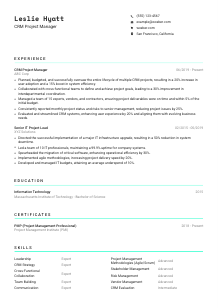
Bridging client needs and system solutions, but your CV feels like an unresolved case? Unravel this CRM Project Manager CV example, created with Wozber free CV builder. Learn how to match your project prowess with the job essentials, setting your career course for long-term customer satisfaction and professional success!
CRM Project Managers are brought in when customer platforms need more than maintenance. The work sits at the intersection of delivery, process change, and business adoption. Hiring teams want to see that you can move a CRM initiative from scope and budget through rollout, while keeping stakeholders informed and the system useful for sales, service, or operations teams. Your CV should make that delivery discipline visible early.
A tailored CV changes how quickly a reader can place you in the right lane, whether that is Salesforce delivery, Dynamics 365 optimisation, or broader CRM transformation work. Wozber's free CV builder helps you line up your language with the posting and keep an ATS-compliant CV easy to parse, so your project history reads clearly as CRM leadership rather than generic IT management. That distinction matters fast.
This section is short, but it still shapes the first read of your application. For a CRM Project Manager, it should present you as organised, reachable, and already aligned with the role's basics, especially title, location, and professional contact details.
Use your full name in a larger, clean font so it is easy to find on the page. CRM project work depends on clear documentation, clean status reporting, and structured communication, and your header should reflect that same discipline from the first line.
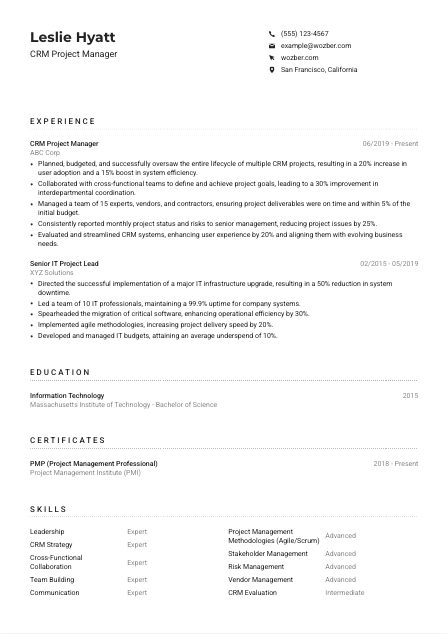
Place "CRM Project Manager" under your name if that is the role you are applying for. This helps both recruiters and ATS tools connect your background to the opening right away, especially if your recent title was broader, such as IT Project Lead or Systems Program Manager.
Include a phone number you answer, a professional email address, and only links that strengthen your candidacy. A LinkedIn profile can help if it reflects the same CRM platforms, project scope, and delivery results shown in your CV.
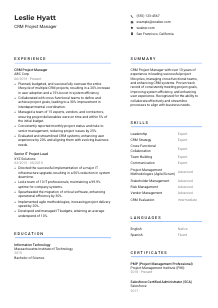
If a role requires a specific location, include your city and state in this section. In the example, listing San Francisco, California immediately addresses a stated requirement. Use that approach when geography affects eligibility, hybrid expectations, or local stakeholder coverage.
A personal website is optional, but it can work well if it includes implementation case studies, CRM transformation projects, or portfolio-style examples of delivery work. Skip it if it is sparse or unrelated. Every detail here should support your credibility as someone who runs complex CRM initiatives reliably.
Your personal details should remove friction, not add personality for its own sake. When the title, contact information, and location are handled cleanly, the reader can move straight to your CRM project experience.




For this role, the experience section does the heavy lifting. Employers are looking for proof that you can plan CRM initiatives, coordinate cross-functional teams, manage vendors or contractors, report risk clearly, and improve the system after launch instead of treating go-live as the finish line.
Read the posting line by line and mark the responsibilities that define success in the role. For a CRM Project Manager, that usually includes lifecycle ownership, budgeting, stakeholder coordination, risk reporting, and platform improvement. Use those priorities to decide which achievements to feature and which phrases to mirror naturally for ATS optimisation.
Start with your most recent position and include title, employer, and dates. If your past roles were not all labeled "CRM Project Manager," show how adjacent experience still supports the target role. In the example, a move from Senior IT Project Lead into CRM Project Manager creates a clear progression from broad delivery leadership into platform-specific ownership.
Do not stop at task lists such as "managed CRM projects" or "worked with stakeholders." Write bullets that show scope, action, and result. A line like "planned, budgeted, and oversaw the lifecycle of multiple CRM projects" works because it reflects the real operating range of the role and ties directly to business outcomes such as adoption, efficiency, or smoother cross-team execution.
Metrics give hiring managers a quick read on your control over delivery. Prioritise numbers tied to adoption, budget adherence, delivery speed, issue reduction, system efficiency, or uptime. The sample CV does this well with outcomes like a 20% increase in user adoption, delivery within 5% of budget, and a 25% reduction in project issues. Those are native measures for CRM program work, not generic "worked hard" claims.
Trim bullets that do not strengthen your case for CRM project management. Broad IT achievements can stay if they prove transferable strengths like Agile delivery, budget control, vendor management, or large-team coordination. What matters is that the section consistently points back to CRM implementation, optimisation, and stakeholder-led execution.
By the end of this section, a reader should understand the scale of projects you have run, the CRM-related outcomes you improved, and the way you manage delivery across business and technical teams. That is the core of the role.
Education is usually a supporting section for experienced CRM Project Managers, but it still matters when the posting asks for a business, IT, or related degree. Keep it straightforward and make sure the qualification is easy to find.
If the job calls for a bachelor's degree in Business, Information Technology, or a related field, list the credential that best aligns. The example's Bachelor of Science in Information Technology fits cleanly because it supports both the technical and systems side of CRM delivery.
Present degree, field of study, school, and graduation year in a consistent order. Hiring teams rarely spend long here, so clarity matters more than design flourishes. A clean entry helps the CV stay ATS-friendly and easy to scan.
A related degree can still work well if your career clearly shows CRM program ownership. If your field was adjacent, such as Management Information Systems or Business Administration, let your experience section carry the operational proof while education confirms the academic foundation.
For a candidate with several years of CRM delivery experience, detailed coursework is usually unnecessary. Include it only if it strengthens a gap or highlights directly relevant training in systems analysis, database management, business processes, or project management.
Extra academic detail belongs here only if it supports your current positioning. A capstone involving enterprise systems, process redesign, or customer data workflows can help early-career applicants. For more established candidates, keep the section lean and let professional project results take the lead.
For most CRM Project Managers, education confirms that you meet the stated requirement and supports the technical or business foundation behind your delivery work. Once that is clear, let your experience carry the argument.
Certifications can strengthen your profile quickly in CRM project management because they speak to process discipline and platform familiarity. They are especially useful when the employer mentions PMP, Salesforce, Dynamics 365, or other role-specific credentials as preferred rather than mandatory.
Review the posting and lead with certifications that match the work. For this kind of opening, PMP and CRM-specific credentials deserve top placement because they connect directly to project governance and platform fluency. That relevance matters more than a long list of unrelated courses.
List the certifications that support your ability to run CRM initiatives, work within Agile or Scrum environments, or manage a specific platform ecosystem. In the example, PMP and Salesforce Certified Administrator reinforce both project leadership and hands-on understanding of the CRM environment.
Add the year earned or active date range when it shows that your certification is current. This is helpful for credentials with renewal cycles and for platforms that change quickly through releases, admin practices, and ecosystem updates.
CRM programs evolve with new automation features, reporting models, integration patterns, and governance expectations. Ongoing certification or formal training shows that you keep pace with the way CRM delivery actually works, whether that means deeper platform knowledge or stronger project management discipline.
This section should tell the reader that your methods are current and your CRM knowledge is backed by recognized training. Used well, it adds confidence without taking attention away from your project results.
The skills section should reflect how CRM projects are really delivered. That means a mix of project controls, stakeholder-facing abilities, and platform-related knowledge. Generic leadership terms alone are not enough if the role also requires Agile delivery, vendor coordination, or CRM system improvement.
Look beyond the obvious keywords and capture the actual working mix described in the posting. Here, that includes CRM project management, Agile or Scrum, leadership, communication, cross-functional collaboration, budgeting, risk management, and system evaluation. Those terms help position you as someone who can run the work, not just participate in it.
A CRM Project Manager CV usually works best when it includes both operational and interpersonal strengths. Pair platform-facing skills such as CRM strategy, Salesforce, Dynamics 365, or process optimisation with delivery skills like stakeholder management, vendor management, sprint planning, or status reporting. The example handles this balance well by combining CRM Strategy with leadership, collaboration, and risk management.
Prioritise the skills that support the target job first. Grouping related strengths can help, but do not overload the section with every tool or soft skill you have ever used. A shorter, sharper list is more credible and makes the key capabilities easier to find in both human review and ATS scans.
Choose skills that make your CRM delivery style legible at a glance. A hiring manager should be able to see platform awareness, project control, and cross-functional leadership in one quick pass.
Language skills are a small section, but they can matter in CRM project work because these roles often sit between business teams, technical teams, vendors, and leadership. Clear communication is part of execution, and when a posting names a required language, that belongs high on the list.
If the job states fluency in English, list English prominently and show your level clearly. That is especially important in roles where project updates, steering committee communication, training support, and issue escalation all depend on precise language.
After the required language, include any additional languages that could help in your target environment. Multilingual ability can be useful for regional rollouts, vendor coordination, or support across distributed teams, but it should follow the employer's stated need first.
Even when not required, another language can strengthen your profile if the organisation works across markets or has diverse internal teams. In the example, Spanish adds useful breadth without distracting from English as the stated requirement.
Stick to clear levels such as Native, Fluent, Intermediate, or Basic. Overstating language ability can become a problem quickly in a role that depends on real-time stakeholder management and precise project communication.
Not every CRM Project Manager role needs multiple languages, but some do. If your target companies serve international sales teams, customer support centers, or distributed operations, language capability can reinforce your ability to manage adoption and communication across those groups.
Keep it factual and relevant. For CRM project work, language skills are most useful when they support stakeholder communication, training, or rollout coordination.
Your summary needs to place you quickly within CRM project delivery, not general project management. In a few lines, it should show your level of experience, the type of CRM work you lead, and the kinds of outcomes you improve, whether that is adoption, efficiency, project delivery, or platform alignment with business needs.
Before writing, decide what the employer cares about most in this opening. Here, the emphasis is on end-to-end CRM project management, cross-functional leadership, methodology fluency, and system improvement. Those priorities should shape the language of your summary.
Start with a direct line that names you as a CRM Project Manager and signals your experience range. A phrase like "CRM Project Manager with 10+ years of experience" works because it gives immediate context and anchors the rest of the summary in the right function.
Choose strengths that match the posting and back them with practical results. The example summary works because it references project lifecycle leadership, cross-functional team management, system efficiency, and user experience improvements. Those are relevant outcomes for CRM work and they read naturally, not like a keyword dump.
Aim for a short paragraph that can be read before the hiring manager reaches your experience section. Every line should help answer one question: why should this candidate be trusted to lead CRM delivery? If a sentence does not sharpen that answer, cut it.
A well-written summary makes your direction clear before the reader gets into the details. For this role, it should establish that you lead CRM programs, work effectively across teams, and improve delivery outcomes in measurable ways.
Once each section reflects the role's actual priorities, your CV becomes much easier to read as a CRM Project Manager application rather than a general project management profile. Keep the emphasis on lifecycle ownership, stakeholder coordination, reporting discipline, platform improvement, and results that can be measured.
Use Wozber's free CV builder, ATS-friendly CV templates, and ATS CV scanner to tighten the language, surface missing keywords, and keep the document aligned with the job description in an ATS-friendly CV format. The finished CV should make one point clear quickly: you can lead CRM projects from planning through improvement with control, clarity, and business impact.