



Use Wozber and land your dream job
Create CV
No registration required
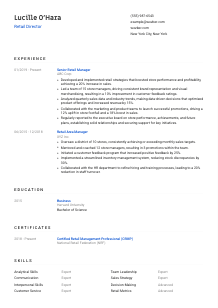
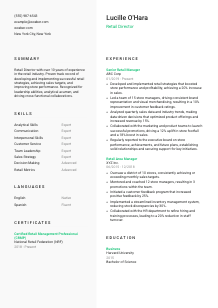
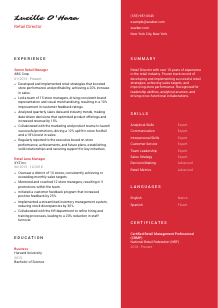
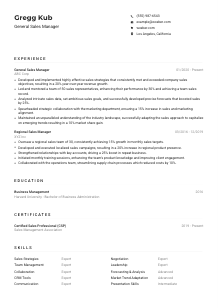
Leading store aisles, but your CV feels out of stock? Check out this Retail Director CV example, created with Wozber free CV builder. It shows how to merchandise your strategic vision and operational talents to match job requirements, ensuring your career shelves are always full of opportunities!
Retail Directors are hired to improve performance across stores, not simply to keep operations running. Your CV needs to show how you influence sales, profitability, customer experience, merchandising standards, and manager performance at scale. Hiring teams look for commercial judgment backed by numbers, whether that comes through revenue growth, stronger conversion, cleaner inventory control, or better customer feedback across a district or multi-store network.
When that impact is tailored clearly, the first screen becomes much easier to pass. Wozber's free CV builder helps you align your wording with the job description, build an ATS-compliant CV, and surface the retail metrics, leadership scope, and cross-functional work that matter most for a Retail Director opening. The result should make it immediately clear that you can lead stores toward stronger performance, not just manage daily activity.
This section is short, but it still carries practical hiring information. For a Retail Director, the header should quickly confirm who you are, how to reach you, and whether you meet straightforward filters such as location and professional title.
Place your name at the top in a clean, readable format. Keep the styling polished rather than decorative. Senior retail hiring often starts with a fast scan, so your header should feel as organised as the stores or teams you claim to lead.
Put "Retail Director" directly beneath your name when that is the role you are pursuing. This creates immediate alignment with the opening and helps frame the rest of the CV around store strategy, team leadership, and performance accountability rather than general retail management.
List a reliable phone number and a professional email address. Double-check both. At director level, small errors in contact details can undercut the polished impression you want to create, especially in a role built on communication with store managers, executives, and cross-functional partners.
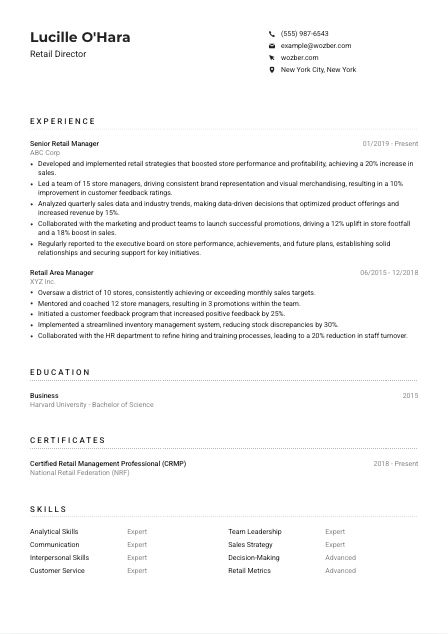
If the employer specifies a location, include it clearly in your header. In the example, "New York City, New York" directly supports a stated requirement and removes doubt about local availability. Use this only when it helps address an actual job filter.
If you have an up-to-date LinkedIn profile or personal site with leadership achievements, add it. For a Retail Director, this can reinforce your track record in multi-store oversight, promotions, merchandising initiatives, or executive-facing results reporting, as long as the information matches the CV.
Your personal details should confirm the basics quickly and without friction. When the header is clean, accurate, and aligned with the role, hiring teams can move straight to the part that matters most: your record of improving store performance.




For a Retail Director, experience is where the hiring decision usually sharpens. This section should show the size of the operation you led, the performance problems you improved, the teams you managed, and the business results you delivered across stores or regions.
Start by identifying the repeated priorities in the job description. Here, the emphasis is on retail strategy, sales targets, store performance, analytics, leadership, merchandising consistency, customer service, and reporting to senior management. Build your experience bullets around those themes so the employer sees direct relevance instead of broad retail experience.
Use reverse chronological order and include job title, company, and dates for every role. For director-track retail candidates, progression matters. Titles such as Retail Area Manager to Senior Retail Manager help show growth in scope, decision-making, and accountability for more stores, larger teams, or broader revenue responsibility.
Focus each bullet on what changed because of your leadership. Strong Retail Director bullets show actions tied to results, such as improving store profitability, raising customer feedback scores, increasing footfall through promotions, or reducing stock discrepancies. The example does this well by linking strategy and team leadership to sales growth and service improvements.
Numbers matter here because retail leaders are measured on them every day. Include sales growth, revenue lift, customer feedback movement, turnover reduction, inventory accuracy, promotion results, or the number of stores and managers you oversaw. A line such as increasing sales by 20% or reducing stock discrepancies by 30% gives hiring teams a much clearer picture of operating impact than a generic claim about leadership.
Prioritise achievements that show director-level judgment. That includes setting strategy, coaching store managers, partnering with marketing or product teams, and reporting performance upward. Leave out unrelated work that does not strengthen your case. The CV should read like someone trusted to drive consistent execution across locations, not someone limited to one store's day-to-day tasks.
A Retail Director CV should make your operational impact visible fast. When your bullets connect leadership decisions to store performance, profitability, customer experience, and team development, the employer can picture you running the business, not just supporting it.
Education usually will not carry the application on its own at this level, but it still matters when the posting names a degree requirement. Keep this section concise and make sure it supports the business and operational side of your retail background.
If the job asks for a Bachelor's degree in Business, Retail Management, or a related field, list that information clearly. In the example, a Bachelor of Science in Business aligns directly with the requirement and confirms the expected academic foundation for strategy, operations, and commercial decision-making.
Include degree, field of study, school, and graduation year in a simple structure. That is usually enough for a senior retail role. Hiring teams should be able to confirm your qualification in seconds without searching through extra text.
When your degree supports the role, name the field precisely. Business, retail management, supply chain, marketing, or similar studies can strengthen your fit because they connect naturally to sales analysis, merchandising decisions, and store operations leadership.
Most Retail Director CVs do not need a course list. Include relevant coursework only if it strengthens your case in a practical way, such as retail operations, consumer behaviour, finance, or analytics. Otherwise, your work history should do the heavier lifting.
Honors, leadership activities, or projects can stay if they are genuinely relevant and recent enough to matter. For established retail leaders, this section should stay lean unless the distinction clearly supports your management or commercial background.
At director level, education works best as confirmation rather than a focal point. Make the required degree easy to find, keep formatting straightforward, and let it support the stronger proof in your experience section.
Certifications are not always required for Retail Director roles, but they can strengthen your profile when they relate to retail operations, management, customer experience, or leadership development. Use this section to show relevant continued learning, not to pad the page.
Start with certifications that support how the role is actually performed. A credential such as Certified Retail Management Professional fits because it connects directly to store leadership, operational standards, and industry knowledge. If the posting does not ask for certificates, relevance matters more than volume.
Be selective. Include certifications that support your ability to lead store performance, analyse retail operations, improve customer experience, or manage teams. A shorter list of well-matched credentials is stronger than a long list of loosely related training courses.
Add the issue date or active date range when available. This helps show whether the credential is current and whether you have stayed engaged with evolving retail practices, management standards, or customer-facing operating models.
Retail strategy, analytics, inventory systems, and leadership practices change over time. Revisit this section whenever you complete training that supports your next step, especially if you are moving from area or senior store management into broader director-level responsibility.
A well-chosen certification section tells a simple story: you keep your retail leadership skills current. That matters most when the credentials support the same operating challenges and performance goals described elsewhere in your CV.
Retail Director skills need to reflect how you run the business. That means balancing commercial analysis, people leadership, customer experience, and cross-functional execution. The best skills section mirrors the language of the job description without turning into a keyword dump.
Start with the capabilities named in the role. In this case, that includes analytical skills, retail metrics, data-driven decision-making, communication, leadership, and interpersonal strength. Those terms matter for both human review and ATS optimisation because they describe how the employer expects store performance to be managed.
Include both hard and soft skills that genuinely match your experience. For Retail Director roles, useful combinations often include sales strategy, retail metrics, visual merchandising oversight, inventory planning, customer service leadership, team development, and executive reporting. The example skills list works because it balances analysis with leadership and customer-facing execution.
Present skills in a clean format so a hiring manager can absorb them quickly. Group related strengths if needed, and avoid overloading the section with every competency you have ever used. Prioritise the skills most likely to matter in store operations, profitability, and manager leadership for the target role.
This section should reinforce the same message as your experience bullets. When the skills list reflects retail metrics, team leadership, customer experience, and commercial decision-making, it supports your case for director-level responsibility immediately.
Language ability may not decide every Retail Director hire, but it can matter in customer-facing environments, diverse store teams, or markets with multilingual staff and shoppers. List languages clearly and keep the emphasis on practical communication value.
If the job requires fluency in English, place English first and state your level plainly. That removes any uncertainty around a stated requirement and supports the communication demands of leading managers, presenting updates, and coordinating across departments.
Include additional languages if they are relevant to the customer base, the store workforce, or the employer's market footprint. In retail leadership, another language can be especially useful when coaching frontline teams or handling customer experience across varied communities.
Use clear labels such as "Native," "Fluent," "Intermediate," or "Basic." Retail leadership often involves live conversations, performance discussions, and issue resolution, so inflated language claims are easy to expose and best avoided.
Some Retail Director roles are heavily local, while others support broader regions or internationally influenced brands. If language capability strengthens your ability to lead stores, support service standards, or connect with customers, it is worth including.
A second language is most valuable when it improves real communication, not when it simply fills space. If it helps you manage diverse teams, support training, or connect with a wider customer base, present it as part of your operating range.
Keep the section honest and relevant. For Retail Director positions, language skills matter most when they strengthen communication with store teams, customers, and partners across the business.
Your summary should read like an executive snapshot, not a generic career objective. In a few lines, show your level, your retail scope, and the kind of business results you are known for delivering.
Read the posting carefully before writing the summary. If the employer emphasizes strategy, sales growth, store performance, analytics, and leadership, your opening lines should reflect those same priorities. This helps position you correctly before the reader reaches the experience section.
Open with a direct statement that establishes your professional standing. A line like "Retail Director with over 10 years of experience in the retail industry" works because it immediately defines seniority and sector background without wasting space.
Pull in the strengths that matter most for the target job. For this kind of opening, that could include building retail strategy, achieving sales targets, improving store performance, mentoring managers, or using retail data to guide decisions. The example summary succeeds because it ties leadership and analytics to measurable retail outcomes.
Aim for three to five lines. Skip soft claims that are not supported elsewhere in the CV. A concise summary with clear commercial and operational language will do more for a Retail Director application than a long paragraph full of broad statements.
Your summary should quickly establish the scale of your retail background and the results you deliver. When it is tailored well, the reader starts the rest of the CV already expecting to see stronger store performance, sharper strategy, and confident team leadership.
A Retail Director CV works when it shows how you lead stores toward stronger sales, healthier operations, better customer outcomes, and more consistent execution. Every section should support that picture, from the title and location details to the metrics in your experience bullets.
Use Wozber's free CV builder, ATS-friendly CV template, and ATS CV scanner to align your wording with the job description, strengthen ATS optimisation, and present your background in a clean, ATS-friendly CV format. The final document should make one thing easy to judge: you know how to turn retail strategy into store performance.




