



Use Wozber and land your dream job
Create CV
No registration required
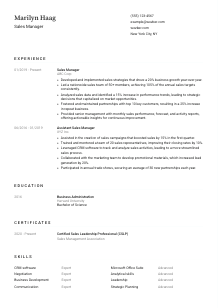
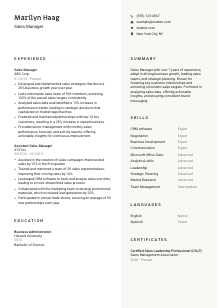
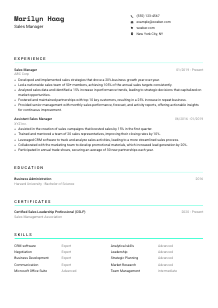
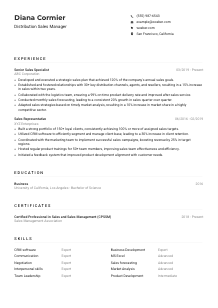
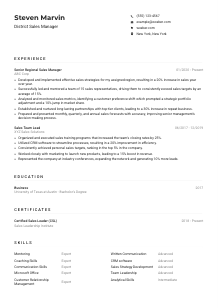
Sealing deals, but your CV isn't closing the gap? Check out this Sales Manager CV example, created with Wozber free CV builder. It shows how to highlight your leadership flair and sales strategy to match job specifics, positioning your professional journey for a sales surge ahead!
Sales managers are hired to turn targets into a repeatable plan. A CV for this role needs to show how you built pipeline, led reps, improved win rates, protected key accounts, and reported results in a way senior leadership could act on. Vague claims about being "results-driven" do very little here. Specifics around growth, team size, territory scope, forecasting, and customer retention carry far more weight.
A tailored CV changes how quickly your commercial impact becomes clear. When your language mirrors the role's priorities, such as strategy execution, team leadership, CRM use, and sales forecasting, hiring teams can separate quota-carrying managers from candidates with only adjacent experience. Wozber's free CV builder helps you shape that story in an ATS-friendly CV format, so the first read makes it easier to see your ability to lead revenue performance.
Sales is a credibility-driven function, and that starts before anyone reads your first achievement bullet. The personal details section should present you as accessible, professional, and already aligned with the basic requirements of the opening, especially when the employer has stated location or communication expectations.
Use your full name as the clearest identifier on the page, with formatting that is easy to scan. For a sales leadership role, clean presentation matters because it reflects judgment and professionalism, the same qualities expected in client-facing communication and executive reporting.
Place "Sales Manager" directly under your name when that is the role you are pursuing. This helps connect your background to the opening immediately and keeps your positioning consistent with the job description, especially when your recent title is close but not identical, such as Assistant Sales Manager moving into a larger leadership scope.
Include a working phone number and a professional email address, then verify both carefully. In sales hiring, responsiveness matters. A missed digit or outdated address can cost an interview just as quickly as a weak follow-up with a prospect.
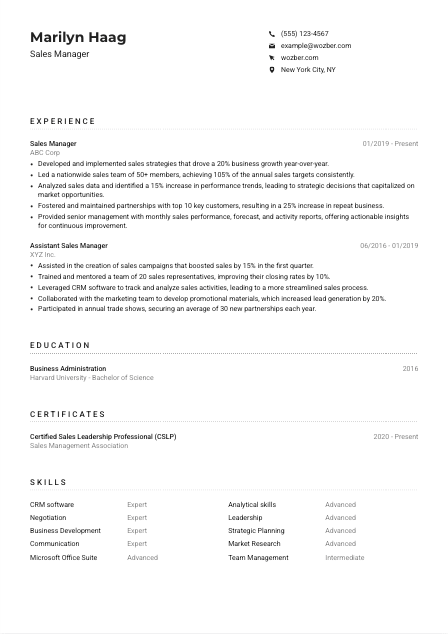
If the employer specifies a city, state your location clearly or note your willingness to relocate. In this example, New York City is listed as a requirement, so showing "New York City, NY" removes an avoidable question early in the review process.
If you include LinkedIn or a personal website, make sure it reinforces your CV with the same job titles, dates, and performance highlights. For sales managers, this can be a useful place to support your leadership brand, industry focus, and progression into larger teams, territories, or revenue responsibility.
This section should confirm that you are reachable, professionally presented, and aligned with any stated basics such as title and location. Keep it simple, accurate, and immediately usable.




This is the section most likely to decide whether you move forward. Sales management CVs are read for commercial results, leadership scope, market influence, and forecast discipline. Your bullets should show how you set direction, improved execution, and produced measurable outcomes through a team, not just how busy you were.
Start with the job description and identify the few responsibilities that define the role. Here, those are sales strategy, team leadership, performance analysis, customer partnerships, and reporting to senior management. Then make sure your experience bullets speak directly to those areas. If you developed a territory plan, improved close rates, expanded account revenue, or tightened forecast accuracy, say that plainly.
List your positions in reverse chronological order with company name, title, and dates shown clearly. Sales leaders are often evaluated on progression, so a clean timeline helps readers see movement from rep to assistant manager to manager, or from regional ownership into national leadership.
Lead with what changed because of your work. Strong sales manager bullets often cover revenue growth, target attainment, account expansion, team performance, conversion improvement, or sales process gains. The example does this well with specifics such as 20% year-over-year business growth and leading a nationwide team of 50+ to 105% of annual target.
Quantified impact is especially important in sales because performance is measured in percentages, quotas, pipeline value, retention, new business, and forecast quality. Metrics like repeat business up 25%, lead generation up 20%, or closing rates improved by 10% make your leadership tangible and much easier to compare against the role's growth expectations.
Prioritise experience that shows quota ownership, team direction, account growth, market expansion, CRM-based analysis, or cross-functional work with marketing and leadership. If an older role does not support your story as a sales manager, reduce it or remove it so the page stays centered on revenue leadership.
A hiring team should be able to skim this section and understand your sales scope, your management range, and the results you delivered. If those three things are clear, your experience section is doing its job.
For sales management, education usually plays a supporting role, but it still matters when the posting names a degree requirement. This section should make it easy to confirm that you meet the baseline academic criteria without distracting from your commercial track record.
If the job asks for a bachelor's degree in Business Administration, Marketing, or a related field, list your degree in a way that matches that language as closely as truthfully possible. The example's Bachelor of Science in Business Administration is a direct match and removes any ambiguity.
Keep the entry simple: degree, field of study, school, and graduation year or date. That structure works well for both ATS parsing and quick human review, especially when recruiters are checking minimum requirements before reading deeper into your experience.
For this profession, the field of study can matter more than educational detail. Business Administration, Marketing, Finance, or related disciplines support a sales management profile because they connect naturally to market analysis, customer strategy, and commercial decision-making.
If you are early in your management career or changing industries, relevant coursework or projects can help bridge the gap. Topics such as consumer behaviour, market research, business analytics, or sales strategy can add context. For experienced sales managers, this is usually unnecessary because performance history carries more weight.
Honors, leadership roles, or extracurriculars belong here only if they reinforce your profile. Examples might include sales competitions, business clubs, case competitions, or leadership positions that show early commercial initiative. Keep them brief so the section stays secondary to your results in the field.
This section should answer one main question quickly: do you meet the stated academic requirement? Once that is clear, let your sales performance and leadership record do the heavier lifting.
Certifications are rarely the deciding factor in sales management hiring, but the right ones can strengthen your profile. They work best when they support how you lead teams, build strategy, manage accounts, or improve revenue operations.
Prioritise credentials tied to sales leadership, account strategy, negotiation, CRM proficiency, or revenue growth. A certification like Certified Sales Leadership Professional supports a management profile because it points to structured development beyond day-to-day selling.
List only certifications that help explain your readiness for the position. A short, relevant list is stronger than a long one filled with generic training completions. For a sales manager, quality matters more than quantity.
Certification dates help employers see whether your development is current. This is useful in sales environments where leadership methods, CRM workflows, and forecasting practices continue to evolve.
If you actively maintain a credential or continue training in areas like sales coaching, customer success, negotiation, or data-driven forecasting, include that progress. It signals that you are improving the way you lead and manage revenue, not relying only on past wins.
A well-chosen certification section adds depth to your leadership profile. Keep every entry relevant to how you manage sales performance, teams, or customer growth.
The skills section should read like a practical snapshot of how you operate as a sales manager. Focus on capabilities that affect revenue, coaching, account growth, forecasting, and day-to-day sales execution, then express them in language that matches the job description naturally.
Review the job description for explicit skills and the ones implied by the work. Here, analytical ability, communication, negotiation, CRM familiarity, and Microsoft Office are stated directly. Beyond that, responsibilities point to forecasting, strategy development, team leadership, and customer relationship management.
Choose skills that are both relevant and supported elsewhere in your CV. If you claim strategic planning, there should be a bullet showing growth from a plan you built. If you list CRM software, your experience should reflect pipeline tracking, reporting, or opportunity analysis tied to that system.
Avoid turning this section into a long inventory of generic traits. Sales managers benefit from a focused mix of leadership and execution skills, such as negotiation, business development, forecasting, account management, communication, CRM software, pipeline analysis, and team management. The example strikes that balance by combining leadership skills with operational tools and commercial capabilities.
Every skill listed here should connect to a real part of your work, whether that is leading a team, growing accounts, analysing performance, or closing business. Relevance matters more than volume.
Language ability matters in sales when it affects communication with customers, internal teams, or regional markets. If the posting names a required language, make that easy to find. Any additional language should support your commercial reach rather than sit on the page without context.
If the role lists English fluency as a core competency, put English first and state your level clearly. This is especially important for sales managers who need to negotiate, coach, present forecasts, and communicate with senior leadership without friction.
Terms like "Native," "Fluent," or "Professional" work well because they are quick to understand. In this case, listing English as "Native" cleanly addresses the requirement without forcing the reader to infer it from the rest of the CV.
Extra languages can strengthen your profile when they support customer relationships, multilingual teams, or broader market access. Spanish, for example, may be useful in many sales environments, but it should be presented as an added asset rather than a substitute for the required English fluency.
Do not overstate proficiency. Sales conversations involve nuance, objection handling, and relationship management, so language claims are easy to test during an interview or client-facing exercise.
If a language has helped you open accounts, support a region, or work with a diverse customer base, it is worth including. If not, keep the section lean so it supports the role rather than distracting from your core sales leadership profile.
For a sales manager, languages matter when they improve communication, customer coverage, or team leadership. Make the required language obvious and treat additional ones as practical commercial assets.
The summary sits at the top of the CV, so it needs to establish your level quickly. For a sales manager, that means years of experience, leadership scope, and the business outcomes you are known for. Keep it brief, but make sure it points the reader toward the parts of your background that matter most for the opening.
Before drafting, identify the few things the employer needs to see first. In this case, that includes sales growth, management experience, strategy, forecasting, customer relationships, and communication. Your summary should reflect that mix in a compact form, not try to restate your entire CV.
Start with a direct line such as "Sales Manager with 7+ years of experience" or a similarly accurate version of your background. That immediately gives the reader your seniority and professional lane, which is especially useful when they are comparing candidates across different sales paths.
Choose strengths that connect to the employer's commercial goals. Good options include driving revenue growth, leading distributed teams, improving sales strategy, building key customer relationships, or producing accurate forecasts for senior leadership. The example summary does this effectively by combining business growth, team leadership, and analytical reporting.
Aim for a short paragraph that sounds grounded in actual performance. Avoid broad phrases that could apply to any salesperson. A hiring manager should finish the summary with a clear sense of your scale, your focus, and the type of sales environment you can lead.
Your summary should position you as a sales leader who can grow revenue, guide a team, and support decision-making with solid analysis. If those points are clear in a few lines, the rest of the CV has a strong opening.
A sales manager CV works when it shows the link between strategy, team execution, customer growth, and measurable revenue results. Each section should help the reader understand how you lead performance, not just that you have worked in sales.
Use Wozber's free CV builder to organise that story in an ATS-compliant CV, and use its ATS CV scanner and AI-powered tailoring tools to align your wording with the target role's priorities. The finished CV should make it easy to judge your ability to hit targets, lead people, and grow the business.