



Use Wozber and land your dream job
Create CV
No registration required
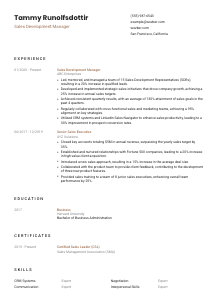
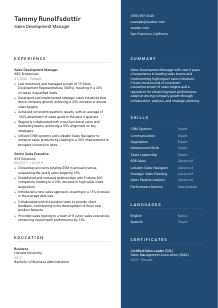
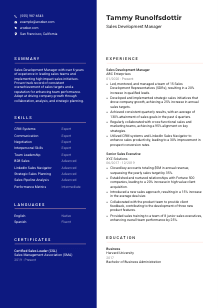
Crafting revenue strategies, but your CV isn't closing deals? Check out this Sales Development Manager CV example, created with Wozber free CV builder. Learn how to position your leadership and pipeline prowess to match job requirements, elevating your career to new sales heights!
Sales Development Managers sit close to one of the clearest pressure points in a revenue organisation. They are expected to build pipeline through people, tighten outbound execution, and keep SDR performance moving in the right direction week after week. A CV for this role needs to show that you can coach a team, translate targets into daily activity, and improve lead quality, conversion rates, or quota attainment in a measurable way.
When the CV is tailored well, hiring teams can quickly tell whether your background is centered on SDR leadership and pipeline management or weighted more toward individual closing. Wozber's free CV builder helps you line up your wording with the job ad, keep an ATS-friendly CV format, and surface the CRM, coaching, and performance metrics that matter first for this kind of sales leadership hire.
Sales leaders are expected to communicate clearly from the first touchpoint. Your Personal Details section should make it easy to contact you, confirm role alignment, and in some cases address practical requirements such as location without adding noise.
Use your full name as the most visible text on the page. Keep the formatting clean and professional so the document immediately reads like a polished business presentation rather than a design exercise. For a client-facing management role, that basic judgment matters.
Place "Sales Development Manager" directly below your name when that is the role you are pursuing. This helps frame your background around SDR leadership, pipeline ownership, and team performance from the first line instead of leaving the reader to infer your direction from past titles alone.
Include a reliable phone number, a professional email address, and your LinkedIn profile if it is current and consistent with your CV. For sales leadership roles, mismatched titles, outdated employers, or weak profile summaries on LinkedIn can undercut an otherwise strong application.
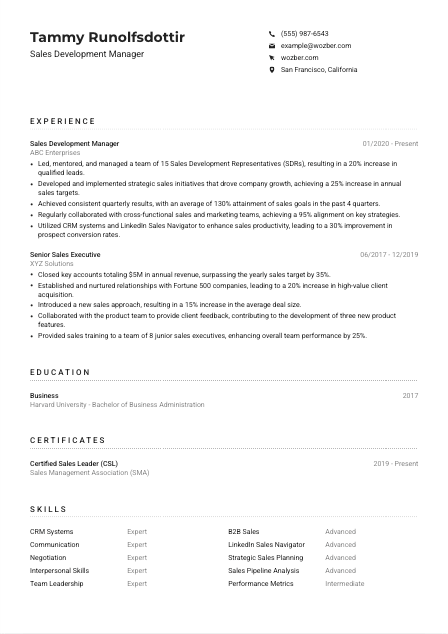
If the posting includes a location requirement, list your city and state clearly. In the example, "San Francisco, California" directly addresses the employer's stated location preference. Use this only when it is relevant to the opening, not as a default rule for every application.
Skip details such as age, marital status, headshots, or other personal identifiers unless a local market specifically requires them. For a Sales Development Manager CV, the priority is fast access to your contact information and immediate alignment with the role, not extra biography.
This section should confirm that you are reachable, professionally presented, and aligned with the target role before the reader reaches your sales results. Keep it clean and businesslike.




This is the section most likely to decide whether you move forward. For Sales Development Manager hiring, employers look for a pattern of leading SDRs, improving outbound execution, and turning activity into qualified pipeline and revenue contribution.
Before writing bullets, mark the core expectations in the posting. For this role, that includes managing SDRs, running strategic sales initiatives, working closely with sales and marketing, reviewing pipeline metrics, and conducting training and performance reviews. Those themes should shape what you emphasize under each position.
List roles in reverse chronological order and make the path to sales leadership easy to follow. Moving from an individual contributor role such as Senior Sales Executive into Sales Development Manager helps show readiness for team target setting, coaching, and cross-functional planning rather than just personal quota attainment.
Each bullet should show what you led and what changed because of it. Good bullets in this field often connect an action to a team or pipeline result, such as improving qualified leads, lifting conversion rates, raising attainment, or increasing average deal size. The example does this well by tying SDR management to a 20% increase in qualified leads and strategic initiatives to a 25% lift in annual sales targets.
Numbers matter here because sales leadership is tracked closely. Include quota attainment, lead volume, conversion rate, pipeline growth, revenue influenced, meeting generation, average deal size, or ramp improvement where you can support them. "130% of quarterly goal" and "$5M in annual revenue" tell a hiring manager far more than "strong performance."
Prioritise bullets that reflect coaching, process improvement, forecasting discipline, tool usage, and collaboration with marketing or account executives. If an older achievement does not connect to B2B sales, team management, or pipeline performance, it can usually be shortened or removed to leave more room for relevant wins.
Your experience section should make it easy to picture you running an SDR team, reading performance data, and improving pipeline output. Lead with results that connect management actions to measurable sales outcomes.
Education usually will not outweigh sales results for an experienced Sales Development Manager, but it still helps confirm that you meet baseline requirements. Present it clearly and make sure it supports the commercial and business context of the role.
Check whether the employer asks for a specific academic background. Here, a bachelor's degree in Business, Marketing, or a related field is requested, so that requirement should be easy to find in your education section.
List your degree, field of study, school, and graduation year in a straightforward format. Recruiters scanning sales CVs often move quickly, so there is no benefit in making this section harder to parse than it needs to be.
If your degree lines up with the posting, make that alignment visible. In the example, a Bachelor of Business Administration in Business maps neatly to the employer's preference and supports the candidate's positioning in sales leadership.
If you are early in your career, coursework in marketing, consumer behaviour, business strategy, analytics, or communications can help round out your profile. If you already have several years of B2B sales and management experience, keep the section brief and let your performance record carry more weight.
Honors, scholarships, leadership roles, or case competition wins can help if they reinforce commercial thinking, communication, or leadership potential. Do not overload the section. Add only what supports your candidacy for a quota-carrying or revenue leadership environment.
For this role, education should confirm that you meet the stated requirement and support your business credibility. Clear formatting and direct alignment are enough.
Certifications are not always required for Sales Development Manager roles, but the right one can strengthen your case, especially when it points to team leadership, modern sales practice, or structured coaching capability.
Start with the job ad. This one does not require a certification, which means your certificates should support the role rather than fill a mandatory box. That gives you room to be selective.
Prioritise credentials tied to sales management, prospecting strategy, coaching, CRM usage, or B2B revenue operations. A certification such as Certified Sales Leader fits because it supports the managerial side of SDR leadership instead of only individual selling technique.
List the year earned and, if relevant, whether the certification is current. That helps employers understand whether the training reflects your recent approach to coaching, pipeline management, or sales methodology.
If you are pursuing development, focus on learning that improves the way you run a team, review metrics, and coordinate with marketing and sales leadership. Training in sales enablement, forecasting, outbound strategy, or management coaching usually has more CV value here than broad motivational coursework.
A well-chosen certification can reinforce your leadership profile and commitment to current sales practice. If it does not strengthen your case for managing pipeline and people, leave it out.
A Sales Development Manager skill section should read like the operating toolkit behind your results. Focus on the mix of leadership, sales process, communication, and software fluency that drives team output in a B2B environment.
Start with the language used in the posting. Here, that includes CRM systems, LinkedIn Sales Navigator, communication, negotiation, interpersonal skills, and the ability to analyse performance metrics. These are not filler keywords. They point to how the team is expected to prospect, collaborate, and improve.
Build the list around what a Sales Development Manager actually uses to lead. Include team leadership, B2B sales, strategic sales planning, pipeline analysis, coaching, CRM hygiene, prospecting tools, and cross-functional collaboration where they reflect real experience. The example skill list works because it combines software, management, and commercial execution rather than leaning only on soft skills.
Do not crowd the section with every platform or trait you have ever used. Put the most relevant skills first, especially the ones that connect to team performance and sales infrastructure. A shorter list with CRM systems, LinkedIn Sales Navigator, team leadership, negotiation, and sales pipeline analysis is stronger than a long list of vague strengths.
This section should reflect how you lead SDRs, manage process, and work inside a modern sales stack. Keep it tight, relevant, and closely tied to the language of the role.
Language skills matter in sales when they support outreach, relationship building, team communication, or market coverage. For many Sales Development Manager roles, English proficiency is essential because coaching, reporting, messaging, and stakeholder communication all depend on it.
If the posting names a language requirement, list it clearly at the top. Here, strong English literacy is explicitly requested, so English should be easy to find and labeled accurately based on your proficiency.
Add other languages only if you can use them in a business setting at the level claimed. In sales, overstating fluency can become obvious quickly during interviews, client interactions, or internal collaboration.
A second language can be valuable if the territory, customer base, or internal team is multilingual. For example, Spanish may strengthen your profile in some B2B markets, but it is a bonus only when it reflects real communication ability and business relevance.
If a language has helped you prospect into new segments, support multicultural teams, or build stronger client relationships, it can add weight to your application. If it has not played a role in your work, keep the section simple and factual.
Stick to terms such as "Native," "Fluent," "Intermediate," or "Basic." Clear labels help employers understand whether you can write outreach, lead calls, or work internally in that language without guessing.
For this role, language details should clarify communication strength and, where relevant, broader market reach. Accuracy matters more than breadth.
The summary should establish your value in a few lines, with enough specificity to show that your background fits sales development leadership rather than general sales management. Use it to connect your experience, results, and operating strengths to the opening in front of you.
Read the posting closely before you write. This one emphasizes leading SDRs, hitting sales targets, collaborating with sales and marketing, and analysing pipeline performance, so those are the themes your summary should reflect first.
Begin with your title and experience level in a direct line. A summary such as "Sales Development Manager with 6+ years in B2B sales and team leadership" immediately tells the reader the context of your background and the level at which you operate.
Follow with concrete proof. Mention quota attainment, SDR team leadership, pipeline growth, conversion improvement, or coaching outcomes that match the employer's priorities. The sample summary works because it pairs leadership experience with consistent target overachievement and team performance improvement.
Aim for a short paragraph, not a biography. Every phrase should pull toward the same message: you can lead a sales development function, improve execution, and contribute to revenue growth. Cut generic adjectives that do not add business context.
A strong summary should make the reader expect evidence of SDR leadership, pipeline discipline, and target attainment in the sections that follow. If it does that, it is doing its job.
A Sales Development Manager CV works best when it connects people leadership to measurable pipeline and revenue outcomes. If your bullets show how you coached SDRs, improved prospecting execution, used tools such as CRM systems and LinkedIn Sales Navigator, and consistently delivered against targets, the hiring team can quickly understand your value.
Use Wozber to tighten that alignment, improve ATS optimisation, and present your experience in an ATS-compliant CV that reflects the language of the role. The final result should make one thing clear without effort: you are ready to lead a sales development team and raise performance.




