



Use Wozber and land your dream job
Create CV
No registration required
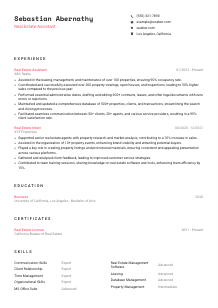
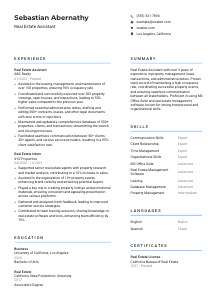
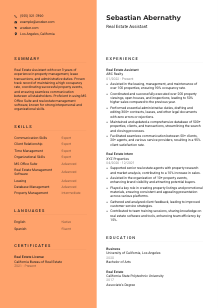
Juggling properties but your CV feels displaced? Unearth the harmony with this Real Estate Assistant CV example, created with Wozber free CV builder. Learn how to present your support skills in a way that aligns with the right job, building a career as solid as a foundation.
Real Estate Assistant work sits at the intersection of client service, property operations, and transaction support. Hiring teams want to see that you can keep listings, leases, viewings, and paperwork moving without details slipping, because missed follow-ups and document errors quickly affect occupancy, closings, and client trust.
A tailored CV helps your background read clearly against the actual workflow of the job, especially when an ATS is scanning for terms tied to leasing, property management, contracts, and database upkeep. Wozber's free CV builder makes it easier to align that language in an ATS-friendly CV format, so the first read shows whether you can support agents, clients, and properties with the right level of precision.
For a Real Estate Assistant, the top of the CV should feel organised and business-ready. This section handles the basics, but it also removes friction around contactability, local availability, and professional presentation before the reader gets into your leasing or admin experience.
Use your full name in a clean, slightly larger font so it stands out immediately. In a role built around client communication, scheduling, and document handling, a polished header sets the tone for the rest of the application.
Place "Real Estate Assistant" directly under your name if that is the role you are pursuing. Matching the posting's wording keeps your positioning clear and helps your CV line up with both ATS filters and quick recruiter scans.
Include a professional email address and a phone number you answer reliably. Add a LinkedIn profile or professional website only if it supports your candidacy with relevant real estate experience, listings work, transaction support, or client-facing credibility.
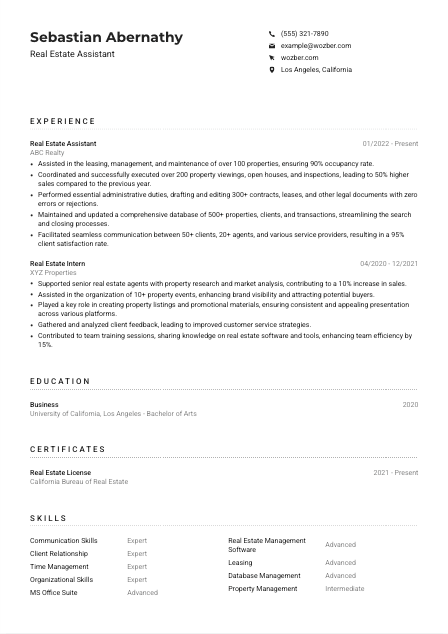
If the employer specifies a location requirement, include your city and state. In the example, listing Los Angeles, California instantly supports a posting that requires local presence, which is especially useful for roles involving property viewings, inspections, and office coordination.
If you maintain an online profile, make sure it reflects the same job titles, dates, and real estate focus shown on your CV. A profile with transaction support, property coordination, or leasing activity can reinforce your application. A sparse or inconsistent link can do the opposite.
This section should answer the practical questions fast: who you are, what role you target, how to reach you, and whether you meet any location requirement. Get that right, and the reader can move straight to your property and transaction experience.




This is where a Real Estate Assistant CV earns attention. Employers look past generic admin claims and want proof that you have supported leasing activity, kept property records current, handled contracts carefully, and coordinated communication across clients, agents, and vendors.
Start by marking the work the employer actually needs covered. Here, that includes leasing support, property management and maintenance coordination, viewings and inspections, contract and lease preparation, database upkeep, and communication with multiple parties. Your bullets should mirror those functions where they match your background.
Present your most recent position first, then work backward. For each role, include employer name, title, and dates so the reader can quickly trace how your real estate exposure developed, whether through assistant work, property management support, internships, or related operations roles.
Focus each bullet on a task that matters in real estate operations, then show the result. The example does this well with points such as assisting in the leasing, management, and maintenance of more than 100 properties and coordinating over 200 viewings, open houses, and inspections. That kind of phrasing tells the employer what you handled, at what scale, and why it mattered.
Use metrics that belong naturally to the work. Occupancy rate, number of properties supported, contracts drafted, inspections coordinated, clients served, or satisfaction scores all make your contribution easier to understand. Numbers like a 90% occupancy rate, 300+ legal documents handled, or a 95% client satisfaction rate are more persuasive than broad claims about being organised.
Keep the section centered on property operations, leasing support, transaction paperwork, database accuracy, and stakeholder coordination. If you include adjacent experience, frame it through real estate value. The internship example works because market research, listing support, and client feedback all connect back to sales and property activity.
A hiring manager should be able to scan this section and picture you handling the daily flow of a real estate office: documents out on time, viewings scheduled, records updated, and communication kept tight across clients and service providers.
Education matters here because many employers use it as an early screen, especially when the role supports contracts, leasing activity, and property operations. Present it clearly, and make it easy to see whether your academic background matches the business or real estate focus the posting asks for.
If the posting asks for a bachelor's degree in Business, Real Estate, or a related field, make sure that qualification is easy to spot. In the example, a Bachelor of Arts in Business directly supports the requirement, while the Associate's Degree in Real Estate adds useful field-specific depth.
List each school with degree, field of study, and graduation year. Keep the structure clean so the reader can confirm your credentials quickly without searching through extra wording.
When your degree aligns closely with the role, let that connection speak for itself. Business, real estate, property management, finance, marketing, or legal-adjacent coursework can all be relevant depending on the employer's mix of leasing, operations, and client support.
If you are early in your career or your degree title is broad, selected coursework can help. Classes in real estate law, contract administration, property management, business communication, or market analysis can support your case. If you already have solid experience, keep this brief.
Additional training can help when it supports daily real estate work, such as lease administration, property systems, compliance, or customer service. Just keep formal education separate from licenses and certifications so the section stays easy to read.
This section does not need a long story. It needs to show, without clutter, that your education supports the mix of business judgment, paperwork accuracy, and property-related knowledge the role requires.
Licenses and certifications carry real weight in real estate because they point to industry knowledge, compliance awareness, and commitment to the field. For assistant roles, this section can also clarify whether you already meet a licensing preference or are on track to do so.
Read the posting closely for any license language. Here, a valid real estate license or willingness to obtain one within six months is important, so that detail should appear clearly if you already hold it or are actively pursuing it.
List certifications that support leasing, property management, compliance, transaction coordination, or software use. For this kind of role, a real estate license carries more value than a long list of unrelated certificates.
Show when the credential was earned and who issued it, especially for licenses that need to stay current. The example's "Real Estate License" from the California Bureau of Real Estate gives the employer both relevance and credibility at a glance.
If you are still growing in the field, add recent training that supports the role's day-to-day demands, such as fair housing, lease administration, property operations, CRM use, or real estate management software. Ongoing learning matters most when it connects directly to the work you would be doing.
A focused certificates section helps the employer see whether you already meet licensing expectations and how seriously you take the operational and regulatory side of real estate support.
For a Real Estate Assistant, the skills section should reflect how the work actually gets done. That usually means a blend of office systems, property or transaction software, document handling, scheduling, client communication, and the organizational discipline to keep many moving parts current at once.
Start with the explicit requirements in the posting. Here that includes MS Office Suite, real estate management software, interpersonal communication, and written communication. Then add adjacent skills that support those tasks, such as leasing coordination, database management, contract drafting, and calendar management, if they are part of your real experience.
Do not list only soft skills. Real estate teams need assistants who can update property records, work in spreadsheets, manage documents, and use office or property platforms accurately. The example balances both sides well with MS Office Suite, real estate management software, leasing, database management, communication skills, and client relationship strengths.
Choose skills that connect clearly to the role's workflow. A shorter list built around property coordination, document support, software proficiency, and stakeholder communication is far more useful than a crowded section filled with generic traits.
When this section is done well, the employer can quickly see that you are equipped for the office, client, and property-side demands of the job, not just generally good at administration.
Language ability can matter more in real estate than candidates sometimes expect. Assistants often field calls, explain next steps, coordinate appointments, and support clients through paperwork, so communication skills are practical tools, not just background details.
If the role requires work in an English-speaking environment, list English plainly with an honest proficiency level. That addresses a stated requirement and reassures the employer that you can manage calls, emails, contracts, and scheduling in the working language of the office.
Additional languages can be valuable in markets with diverse buyers, renters, owners, and vendors. In the example, Spanish is worth listing because multilingual communication can help with property inquiries, follow-ups, and relationship building in many real estate markets.
Describe each language accurately with terms such as Native, Fluent, Intermediate, or Basic. Overstating proficiency becomes obvious quickly in a role that depends on live communication and written coordination.
Only include languages that add professional value or reflect genuine ability. For client-facing property roles, a second language can strengthen your profile when it supports smoother communication during tours, leasing conversations, or service coordination.
If you are actively improving a useful language, you can mention it when the level is meaningful enough to discuss honestly. Keep the focus on communication you can actually deliver in day-to-day real estate interactions.
This section should tell the employer how you can communicate in the environments their properties and clients operate in. Clear, honest language levels are what make it useful.
The summary is your fastest chance to frame your value before the reader reviews the full CV. For a Real Estate Assistant, it should immediately connect your experience to leasing support, property coordination, document accuracy, and communication with clients, agents, and vendors.
Start with your current or target title and your years of relevant experience. That gives the reader immediate context, especially when they are sorting candidates with mixed backgrounds in administration, sales support, and property operations.
Name the parts of your background that align most closely with the posting. The example summary does this effectively by mentioning property management, lease transactions, and administrative duties, which map directly to the responsibilities in the job description.
Add a measurable result or two if you have space. High occupancy support, strong client satisfaction, document accuracy, or large property and database volumes can all work well here because they quickly show scale and reliability.
Aim for three to five lines that read cleanly on first pass. Skip broad adjectives and use specific language tied to real estate operations, software, communication, and transaction support so the summary feels grounded rather than generic.
Your summary should make one thing clear right away: you understand the administrative and operational pace of real estate work, and your background supports that pace from day one.
A well-tailored Real Estate Assistant CV makes the operational side of your experience easy to see: leasing support, document handling, property coordination, database accuracy, and steady communication across clients, agents, and vendors.
Use Wozber's free CV builder, ATS-friendly CV template, and ATS CV scanner to align your wording with the posting and strengthen ATS optimisation. The finished CV should make it easy for a hiring team to judge whether you can step into the workflow and keep real estate activity moving smoothly.




