



Use Wozber and land your dream job
Create CV
No registration required
Navigating properties, but your CV feels uncharted? Explore this Realtor CV example, created with Wozber free CV builder. Learn how to clearly map your real estate expertise to match job criteria, paving the way for your career to stake its claim in success!
Real estate hiring moves quickly when a CV makes one thing clear: you know how to turn client relationships, property knowledge, and negotiation skill into closed transactions. For a Realtor, broad sales language is rarely enough. Hiring teams want to see listing activity, buyer representation, pricing judgment, showing coordination, and the kind of local market awareness that affects offers, timelines, and final terms.
A tailored CV changes how your background is read in both the ATS and the first human review. Wozber's free CV builder helps you line up your wording with the job description, keep an ATS-compliant CV structure, and surface the details that matter most for this work, such as deal volume, client-facing responsibilities, and market-specific expertise. That makes it easier to see whether you can step into active transactions and represent clients with confidence.
In real estate, contact details do more than identify you. They show whether you are reachable, licensed, and positioned to work in the market the employer serves. Keep this section clean, current, and aligned with any location requirement in the posting.
Your name should be the clearest text on the page. Realtors often build business through reputation, referrals, and repeat clients, so present it in a polished, easy-to-read format that feels consistent with a client-facing profession.
Place "Realtor" directly under your name when that is the role you are pursuing. Matching the posted title helps the hiring team quickly place your background and also supports ATS alignment when the employer is screening for licensed real estate talent.
Include a phone number and professional email address you check regularly. In real estate, response time matters. A hiring manager should be able to imagine you handling inquiries, showings, and follow-up without friction.
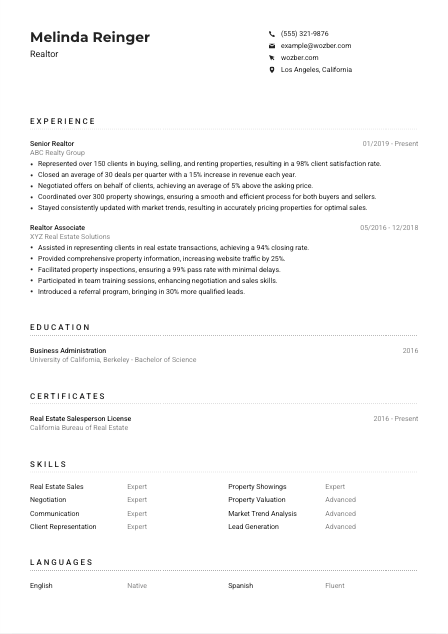
If the employer requires candidates to be based in a specific market, show that clearly in this section. Here, listing Los Angeles, California directly supports the stated requirement and signals local familiarity with neighborhoods, pricing patterns, and client expectations.
Include a LinkedIn profile or personal website if it strengthens your candidacy. For Realtors, that might mean a profile with transaction history, testimonials, neighborhoods served, or a polished bio that reinforces your sales record and market presence.
Keep the top of the CV practical and market-aware. Clear contact details, the right title, and the right location help employers move quickly to the experience that proves you can represent clients effectively.




This section carries the most weight for a Realtor. Employers look for transaction activity, client representation, negotiation outcomes, and signs that you understand how to move a deal from first conversation to closing. Focus less on generic duties and more on results, scope, and the kind of properties or clients you handled.
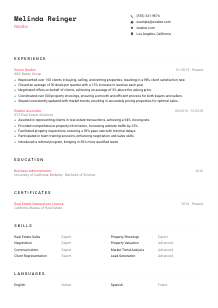
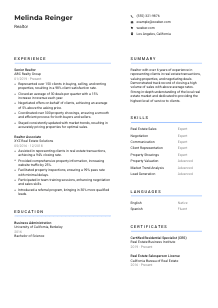
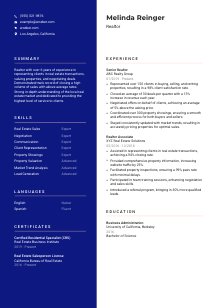
Start with positions tied directly to buying, selling, renting, or supporting real estate transactions. The example CV does this well by leading with Realtor titles rather than broader sales language, immediately connecting past work to property showings, negotiations, and closings.
Numbers matter in real estate because they show pace, consistency, and production. Include metrics such as deals closed, clients represented, revenue growth, closing rate, referral growth, or satisfaction scores. "Closed an average of 30 deals per quarter" and "represented over 150 clients" are strong examples because they show both scale and sustained performance.
Negotiation is a core hiring point for this profession, so show how your work improved terms, price, or speed to close. If you secured offers above asking, reduced days on market, protected contingencies, or helped clients navigate competitive bidding, say so clearly. The sample bullet about averaging 5% above asking price speaks directly to that strength.
A Realtor is expected to read local trends, compare property values, and advise clients with current market context. Add bullets that show how you priced listings, interpreted neighborhood activity, or used market data to guide buyers and sellers. That is especially useful when the posting asks for strong understanding of local property values and trends.
Deals are not won on negotiation alone. Mention the coordination work that keeps transactions moving, such as scheduling showings, managing inspections, communicating with lenders or escrow partners, and resolving delays before closing. In the example, coordinating more than 300 property showings adds practical credibility because it reflects daily execution, not just final sales numbers.
Your experience should show that you can generate business, advise clients credibly, negotiate well, and keep transactions on track. When those points are backed by numbers and concrete deal work, your CV reads like a Realtor who can contribute from day one.
Education usually sits behind experience in Realtor hiring, but it still helps frame your commercial judgment, client communication, and business foundation. Present it clearly, and add detail only when it supports the kind of real estate work you want to do.
List your most advanced degree first, including school, degree type, field of study, and graduation year. A degree such as Business Administration can reinforce skills that matter in real estate, including sales strategy, finance, and client communication.
Use a simple format so the reader can absorb the essentials quickly. For most Realtor CVs, the school, degree, field, and date are enough. The goal is to support your professional profile without distracting from transaction experience and licensing.
If you studied real estate, finance, marketing, contract law, or valuation and you are earlier in your career, adding a brief note can help. For established Realtors, this is optional unless the education directly supports a niche such as investment properties or commercial leasing.
If you completed post-degree coursework in real estate, negotiation, housing regulations, or market analysis, include it when it sharpens your relevance. This can be particularly helpful if you are targeting a brokerage that values ongoing professional development.
Awards, scholarships, or involvement in business and real estate organizations can be worth listing if they reflect initiative, leadership, or early industry focus. Keep them brief and only include what adds signal for client-facing sales work.
Use this section to reinforce your professional foundation, not to compete with your deal history. For most Realtors, concise education details are enough when the rest of the CV already shows strong market performance.
For a Realtor, certifications are not decorative. They establish legal eligibility, show commitment to the profession, and can differentiate you in residential or specialty markets. Put the required license first and make renewal status easy to read.
An active license is essential, so give it top placement. Include the full credential name, issuing authority, and active dates. In this case, the California real estate license is especially important because the role requires state-compliant licensing.
If you hold certifications such as CRS or other residential, luxury, investment, or buyer-representation designations, include them after the core license. These credentials can reinforce your expertise with specific property types, client segments, or transaction complexity.
Dates matter here. Employers need to know that your license or certification is active and current, especially in regulated client-facing work. A date format such as "2016 - Present" works well because it answers that question immediately.
Real estate changes with market cycles, disclosure standards, and local regulations. Ongoing certifications or renewal-related education show that you stay current on the rules and practices that affect pricing, contracts, and client guidance.
This section should leave no doubt that you are licensed, current, and serious about the profession. Lead with the credential required to practice, then use additional certifications to show depth in the areas you sell.
A Realtor skills section should reflect how deals are won and managed in the field. That means blending sales ability with market judgment, client communication, and transaction coordination. Keep the list specific enough to match the posting and broad enough to cover the work you actually do.
Start with the employer's wording and match it to your real strengths. For this role, that includes real estate sales, negotiation, communication, property values, and market trends. Mirroring accurate terminology improves ATS optimisation and helps the CV feel closely aligned with the opening.
Do not stop at broad soft skills. Combine relationship-based strengths such as client representation and communication with practical skills such as property valuation, market trend analysis, lead generation, and showing coordination. That mix reflects the day-to-day reality of the job.
Order matters. Lead with skills that support active transactions and client outcomes, especially if they also appear in the posting. In the example, placing "Real Estate Sales," "Negotiation," and "Communication" near the top immediately supports the employer's priorities.
Every skill on the page should connect to work you can discuss in an interview. When the section mirrors the language of the job and the realities of the field, it strengthens both ATS alignment and hiring confidence.
Language ability can be a real business asset in residential real estate, especially in diverse markets where trust and clarity shape every stage of the transaction. List languages in a straightforward way and tie them to client communication where relevant.
If the job calls out English proficiency, list it at the top with an accurate level. For this posting, English is a stated requirement, so make that easy to confirm right away.
Extra languages can strengthen your reach in multilingual communities and help with buyer consultations, seller updates, and relationship building. Spanish, for example, may be especially useful in many Los Angeles client markets, though that will vary by brokerage and territory.
Stick with familiar terms such as "Native," "Fluent," "Intermediate," or "Basic." These are easy for employers to interpret and set accurate expectations for client-facing communication.
If a second language helped you serve a broader client base, improve communication during showings, or support smoother negotiations, make sure that benefit is evident somewhere in the CV. The language section can hint at that value, while experience bullets can prove it.
Only list languages you can use with confidence in a professional setting. In real estate, misunderstandings can affect offers, disclosures, and client trust, so accuracy matters more than an inflated list.
When listed accurately, languages can strengthen your profile as a client-facing Realtor who can work effectively across a broader market. Keep the section short, clear, and grounded in real communication ability.
The summary is often where employers decide whether to read your transaction history closely. For a Realtor, it should quickly establish your experience level, the kind of client work you handle, and the business results you consistently produce. Keep it focused on real estate practice, not broad ambition.
Start with your title and years of experience in real estate sales or client representation. This immediately tells the reader whether you meet a baseline requirement such as 3+ years in the field.
Mention the skills that shape client outcomes, such as negotiation, market knowledge, property valuation, and communication. Use language that reflects actual Realtor work rather than generic sales buzzwords.
A summary becomes more credible when it includes outcomes like deal volume, pricing success, client satisfaction, or closing performance. The sample summary works because it pairs years of experience with a track record of high-volume sales and above-average results.
Aim for 3 to 5 lines with no filler. If a sentence does not clarify what you sell, who you represent, or how well you perform, cut it. A concise summary with market and transaction language will do more work than a longer paragraph full of broad claims.
Your summary should quickly frame you as a Realtor who knows the market, handles clients well, and closes business. When it is specific, quantified, and aligned with the posting, the rest of the CV gets read with more interest and confidence.
A Realtor CV should read like someone who can guide clients through real decisions, price property with confidence, negotiate firmly, and keep transactions moving. When each section reinforces that picture, the application feels grounded in actual sales performance and market work, not generic customer service language.
Use Wozber's free CV builder to tighten the structure, align your wording with the posting, and build an ATS-friendly CV template around your real experience. The final result should make one thing easy to judge: whether you can step into this market and close business with credibility.




