




Use Wozber and land your dream job
Create CV
No registration required
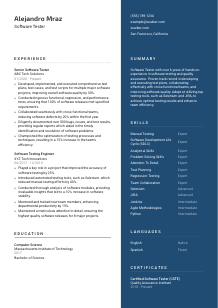
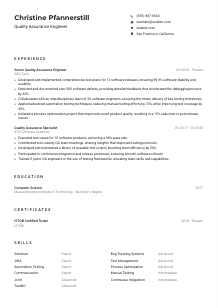
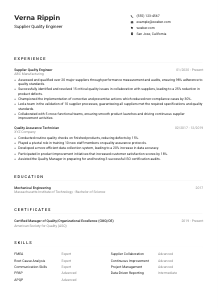
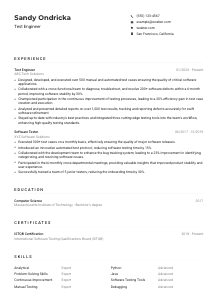
Breaking code, but your CV doesn't pass the test? Debug it with this Software Tester CV example, created with Wozber free CV builder. Learn how to line up your QA acumen and test scenarios with job requirements, scripting your career for zero-defect success!
Software testing work is judged in the shipped product long before anyone notices the test cases behind it. Hiring teams look for people who can turn requirements into reliable coverage, catch defects before release, and work closely with developers and product teams when regressions, flaky builds, or edge-case failures start surfacing. Your CV needs to show that kind of execution clearly, with real testing scope and outcomes rather than broad claims about quality.
A tailored Software Tester CV changes how quickly your background reads as relevant for the role's testing environment. When your CV mirrors the posting's language around SDLC, Agile, automation, bug tracking, and release validation, Wozber's free CV builder helps you shape that experience into an ATS-compliant CV that is easier to rank for the right requirements and easier for reviewers to connect to day-to-day QA work.
This section is simple, but it still does real work. For Software Tester roles, clean contact details and accurate location information show the same care you bring to defect logging, test documentation, and release reporting.
Use your full name as the most visible text on the page. Keep the formatting straightforward and readable. QA work depends on precision, and that standard should show up even in the first line of the CV.
Place "Software Tester" directly under your name if that is the role you are pursuing. This helps recruiters and ATS tools connect your CV to the opening immediately, especially when the posting uses that exact title rather than a close variant like QA Analyst or Test Engineer.
Add a phone number you answer and a professional email address. If you include a website or LinkedIn profile, make sure it supports your application with relevant QA experience, project work, bug tracking exposure, or automation samples rather than generic social presence.
Some testing roles are flexible, others are tied to a team, lab, or office. In the example posting, being located in San Francisco, California is a stated requirement, so listing that in your contact details removes an obvious screening question early.
A polished LinkedIn profile, GitHub, or portfolio can help if it shows test frameworks, Python scripts, QA projects, or collaboration with CI pipelines. Keep the details aligned with the CV so a hiring manager sees the same story across both.
Your personal details should confirm that you are reachable, professionally presented, and aligned with any practical requirement the employer flagged. Keep it clean and exact, the same way you would document a defect or test result.




This is the section most hiring managers read first for a Software Tester role. They want to see what you tested, how you tested it, which tools and workflows you used, and whether your work improved release quality, defect detection, or team efficiency.
Read the posting like a test scope document. Mark the responsibilities and tools that define the role, such as creating test plans, running functional or regression coverage, using Selenium, JIRA, or Jenkins, and working inside Agile delivery cycles. Those are the terms your experience bullets should reflect when they match your background.
List your jobs in reverse chronological order with title, company, and dates. For QA hiring, this layout helps readers track your progression from test execution into broader ownership, whether that means automation work, release readiness, reporting, or mentoring other testers.
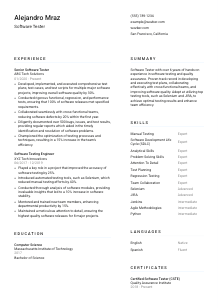
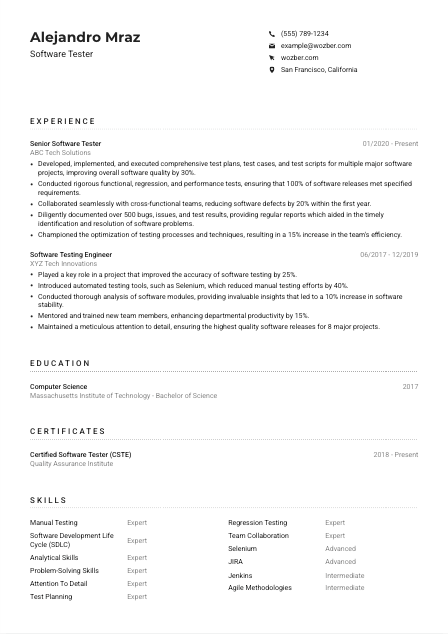
Each bullet should connect an action to a result. Focus on the testing activity itself, such as designing test cases, automating suites, validating releases, documenting defects, or partnering with developers to resolve recurring issues. The sample CV does this well with bullets that show test planning, automation adoption, and measurable improvements in software quality and defect reduction.
Numbers give context to your work when they reflect how testing is actually measured. Include release pass rates, defect reduction, bug volume handled, manual effort saved through automation, coverage gained, or team efficiency improvements. The example's references to 500+ documented bugs, 40% less manual testing, and 100% of releases meeting requirements are the kind of specifics that make experience more credible.
Prioritise experience that proves testing judgment, tool fluency, and contribution to release quality. If a bullet does not connect to QA workflows, software quality, collaboration with engineering, or process improvement, rewrite it or remove it. Space on the page should go to evidence that you can test software in the environment described by the employer.
By the end of your experience section, a reviewer should understand your testing scope, your tools, and the business effect of your work on software quality. That is the standard this section needs to meet.
Education matters most when it confirms the technical base behind your QA work. For Software Tester roles, that usually means showing a degree tied to computer science, software engineering, or a related field that supports testing logic, systems thinking, and SDLC awareness.
If the posting asks for a Bachelor's degree in Computer Science or a related field, reflect that wording as closely as your actual education allows. In the example, "Bachelor of Science" in "Computer Science" lines up directly with the requirement and removes ambiguity during screening.
List degree, field of study, school, and graduation date in a clean structure. This section is usually scanned quickly, so clarity matters more than decoration.
Not every Software Tester has a pure Computer Science degree. If your background is in information systems, engineering, mathematics, or another related discipline, present it clearly and let the rest of the CV reinforce the connection through testing work, automation, and technical skills.
Early-career candidates can strengthen this section with software testing projects, QA coursework, capstones, or class work involving automation, debugging, or SDLC collaboration. That gives employers more than a degree title to work with.
If you completed relevant labs, research, or training tied to testing, scripting, or software quality, include them selectively. The point is to add technical context, not to overload the section with every academic detail.
Your education section should confirm that you have the technical grounding to understand software behaviour, test design, and development workflows. Keep it concise, accurate, and relevant to QA work.
Certifications are not required for every Software Tester opening, but they can add weight when they reinforce your testing discipline, tool knowledge, or commitment to current QA practices. They are especially helpful when you want to underline specialization beyond your degree and job titles.
Start with certifications tied to software testing, quality assurance, automation, or related process knowledge. The example includes Certified Software Tester (CSTE), which supports the candidate's positioning even though the posting itself does not require a certification.
Choose certifications that relate directly to the role's demands. For a Software Tester, that means QA credentials, test automation training, Agile certifications, or tool-specific learning that actually connects to how you work.
Include earned dates, and if relevant, renewal or active status. In fast-moving software environments, dates help employers judge whether your training is current enough to reflect today's testing practices and tools.
Testing work changes with new frameworks, CI workflows, and release practices. Ongoing certification or structured learning shows that you keep updating your methods, whether that is in automation, performance testing, API testing, or Agile QA processes.
This section should reinforce your credibility, not pad the CV. List certifications that make your QA background clearer and more relevant to the role you are targeting.
A Software Tester skills section should read like a practical snapshot of how you work. Hiring teams want to see the mix of testing methods, tool familiarity, technical understanding, and collaboration skills that support reliable releases.
Start with the job description and pull out the capabilities the employer actually named. Here, that includes manual and automated testing tools, SDLC knowledge, Agile methods, analytical thinking, problem-solving, and English communication. Use those priorities to decide what appears in your skills section first.
Lead with the skills most tied to daily testing work, such as manual testing, test planning, regression testing, Selenium, JIRA, Jenkins, and SDLC familiarity if you truly have them. The sample CV handles this well by combining process knowledge with named tools rather than listing only broad soft skills.
Separate technical tools, testing methods, and interpersonal strengths if your format allows it. That makes it easier to read your toolkit at a glance, especially when hiring managers are checking for automation exposure, bug tracking experience, and cross-functional collaboration in the same pass.
Your skills should support the experience section, not repeat it blindly. When the tools, methods, and collaboration strengths line up with the job posting, your QA profile reads as much more complete.
Software testing is collaborative work. Test results, bug tickets, reproduction steps, and release risk updates all depend on clear communication, so language proficiency matters when the role requires active coordination across teams.
If the job specifically asks for comfort communicating in English, list English prominently with an honest proficiency level. That is especially important in QA roles where clear bug descriptions and test status updates affect engineering response time.
After the required language, list other languages you can use professionally. Extra languages are not always a deciding factor, but they can be useful in global teams, multilingual documentation environments, or customer-facing product organizations.
Use realistic labels such as Native, Fluent, Advanced, or Intermediate. Overstating language ability can become obvious quickly when the role includes standups, defect triage, reporting, or written test documentation.
Some Software Tester positions involve frequent interaction with offshore teams, external stakeholders, or distributed product groups. In those cases, language skills can support smoother defect discussion, requirement clarification, and handoff quality.
If you are learning another language and it relates to the team or market you are targeting, you can include it briefly. Keep the emphasis on usable communication skills, not personal hobbies.
For Software Tester roles, language proficiency is really about communication quality. Your CV should make it clear that you can explain issues, document findings, and work smoothly with the people building the product.
Your summary should give a hiring manager an immediate sense of your level, your testing focus, and the environments where you add value. In a Software Tester CV, that usually means years of experience, core testing strengths, tool familiarity, and one or two results that show the scale of your contribution.
Use the job description to identify what matters most in the opening. For this one, that means software testing and quality assurance experience, test plan execution, collaboration, and comfort with tools like Selenium or JIRA. Build your summary around the requirements that overlap with your actual background.
Start with a direct statement of who you are professionally. A line like the example's "Software Tester with over 6 years of hands-on experience in software testing and quality assurance" works because it establishes scope immediately and stays close to the role's language.
Use the next sentence or two to highlight relevant areas such as manual and automated testing, Agile team collaboration, defect tracking, release validation, or process improvement. Keep these strengths tied to real QA work rather than generic claims about being detail-oriented.
Three to five sentences are enough. Focus on the kind of testing work you do, the tools or workflows you know, and the results you have helped deliver. A summary should sharpen the reader's understanding of your profile, not repeat the whole CV in paragraph form.
A good summary helps the employer place you quickly in the right QA context. After reading it, they should already understand your experience level, your testing focus, and why your background fits the role.
A Software Tester CV works when it makes your testing process, toolset, and results easy to follow from top to bottom. If the role calls for SDLC knowledge, Agile teamwork, Selenium, JIRA, Jenkins, and clear reporting, those details should appear naturally across your summary, skills, and experience instead of being buried in one section.
Wozber's free CV builder can help you organise that story in an ATS-friendly CV format, and its ATS CV scanner can highlight missing requirements, strengthen wording, and improve ATS optimisation against the job description. The final version should make one thing easy to judge: whether you can step into the team's QA workflow and improve release quality from day one.