



Use Wozber and land your dream job
Create CV
No registration required
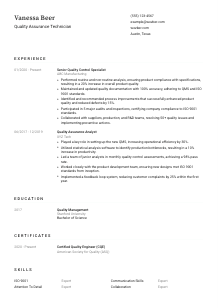
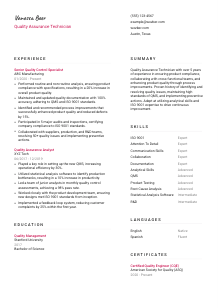
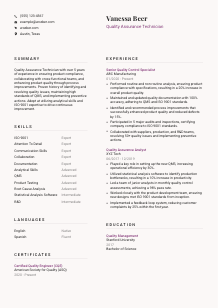
Spotting flaws, but your CV isn't picture-perfect? Inspect this Quality Assurance Technician CV example, created with Wozber free CV builder. It shows how to tune your quality control skills to meet job criteria, so your career trajectory stays in the excellence zone!
Quality Assurance Technicians work where small misses turn into scrap, rework, audit findings, or customer complaints. Hiring teams look for people who can trace a defect back to the process, keep records clean inside a QMS, and work across production, suppliers, and R&D without losing control of the details. Your CV should make that operating standard visible from the first section.
CV tailoring changes how quickly a reviewer can separate hands-on quality work from general operations support. With Wozber's free CV builder, you can align your wording with the posting, keep an ATS-compliant CV structure, and surface terms like ISO 9001, non-routine analysis, preventive actions, and quality documentation in the places where they matter. That makes it easier to see whether you can support compliance, investigate issues, and improve product quality in a real production environment.
For a Quality Assurance Technician role, the contact section does more than identify you. It confirms basic alignment fast, especially when a posting includes location requirements, clear communication expectations, or a role title that sits close to adjacent jobs like Quality Control Analyst or QA Specialist.
Use your full name at the top in a clean, readable format. Quality work is associated with accuracy and order, and even this first line should reflect that standard.
Place "Quality Assurance Technician" directly under your name when that is the role you are pursuing. This helps position you correctly for openings focused on compliance testing, documentation control, audits, and process improvement, rather than broader operations or lab support work.
Add a reliable phone number and a professional email address. QA roles often involve cross-functional follow-up, audit coordination, and issue escalation, so your contact details should look dependable and straightforward, not casual or cluttered.
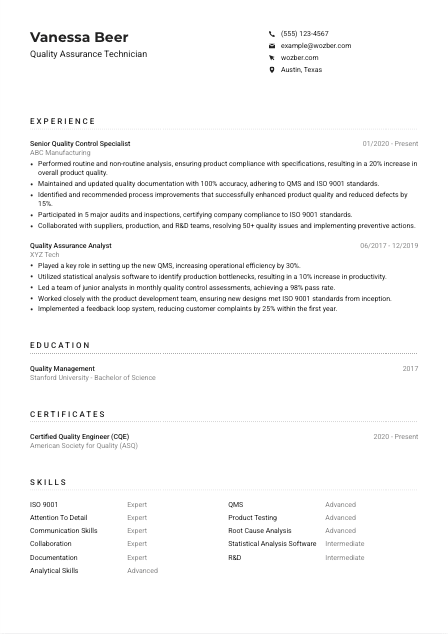
If a posting calls for someone based in a specific area, reflect that clearly in your location line. In the example, listing Austin, Texas directly supports the employer's stated requirement and removes a common screening question before it slows the application down.
Add LinkedIn or a professional website only if it reinforces your QA background. Useful links might show regulated manufacturing experience, audit participation, process improvement projects, or technical work tied to quality systems. Skip anything that does not strengthen your profile for quality-focused hiring.
This section should confirm who you are, which role you are targeting, and whether any practical requirement like location is already covered. Keep it exact and easy to review.




This is the section where Quality Assurance Technicians show how they protect standards in day-to-day operations. Hiring managers want to see product compliance work, documentation discipline, audit exposure, defect reduction, and the ability to work with production or engineering teams to solve recurring issues.
Before editing bullets, identify the work the employer repeats or emphasizes. For this role, that includes QMS use, ISO 9001, routine and non-routine analysis, documentation control, process improvements, and collaboration with suppliers, production, and R&D. Those priorities should shape which accomplishments you feature first.
Start with your most recent position and include job title, employer, and dates. In QA hiring, progression matters. Titles such as Quality Assurance Analyst, Quality Control Specialist, or Quality Technician can all be relevant when the bullet points show inspection work, root cause analysis, CAPA support, audit participation, or process improvement.
Each bullet should connect your action to a quality result. Good examples include improving compliance rates, reducing defects, tightening documentation accuracy, resolving supplier issues, or supporting successful audits. In the sample CV, phrases like maintaining documentation to QMS and ISO 9001 standards or implementing preventive actions work because they tie daily QA tasks to compliance and product quality.
Metrics give your work operational weight. Use figures tied to pass rates, defect reduction, complaint reduction, audit volume, issue resolution, throughput improvement, or documentation accuracy. The example's 20% increase in product quality, 15% defect reduction, and 50+ quality issues resolved are strong because they show measurable effect on the process, not just activity.
Prioritise experience that sounds native to quality assurance. If you have broader manufacturing or operations work, keep the bullets that involve inspections, test methods, nonconformance handling, statistical analysis, standards compliance, or process controls. Remove unrelated tasks so the hiring team can quickly read you as someone ready to support product compliance and continuous improvement.
Your experience section should make it easy to picture you handling documentation, analysis, audits, and corrective action follow-through in a live quality environment. That is what moves a QA CV forward.
Education matters in Quality Assurance because it helps explain your technical base, especially when a role calls for a bachelor's degree or relevant scientific, manufacturing, or quality-focused training. Keep this section straightforward and aligned with the level of qualification the employer asked for.
Read the posting carefully and match the level first. Here, the employer accepts either a bachelor's degree in a relevant field or 3+ years of QA or QC experience. If you have the degree, make sure it is easy to find so the reviewer can confirm the requirement in seconds.
List degree, field of study, school, and graduation year or date. This is enough for most experienced QA candidates. The goal is quick confirmation, not a long academic profile.
If your degree connects clearly to quality, manufacturing, engineering, biology, chemistry, or a related discipline, let that relevance stand out. In the example, a Bachelor of Science in Quality Management maps cleanly to the opening because it supports QMS, compliance, and process improvement work.
Early-career candidates can include selected coursework, labs, or projects tied to quality systems, statistics, process control, validation, or manufacturing compliance. For established professionals, this is usually less important than proven workplace results.
Mention honors, research, or project work only if they connect to the role. A capstone involving statistical process control, defect analysis, or ISO-aligned documentation is useful. Generic student achievements that do not support QA work can stay out.
This section should confirm that you meet the baseline qualification and, when relevant, show a technical foundation that supports quality analysis, documentation, and standards-driven work.
Certifications are especially useful in Quality Assurance because they show formal training in standards, methods, and continuous improvement practices. Even when a posting does not require one, the right credential can reinforce your credibility in audit-heavy or process-driven environments.
List credentials that relate directly to QA, QC, compliance, auditing, or process improvement. A certification such as Certified Quality Engineer fits well because it supports the kind of analytical and standards-based work employers expect in technician and analyst roles.
Do not overload this section with general training. Prioritise certificates tied to ISO standards, quality systems, root cause analysis, statistical methods, auditing, or manufacturing quality. A short, relevant list is easier to trust and easier to scan.
Show issue date, expiration date, or active status when applicable. This is useful for current credentials and for regulated environments where recency matters. The example's "2020 - Present" format signals an active certification without extra explanation.
Quality practices evolve with standards updates, audit expectations, and process methods. Ongoing certification or recent training shows that your understanding of compliance, documentation, and improvement work is current enough for today's shop floor or manufacturing environment.
The right certification tells employers that your quality knowledge is structured, current, and applicable to real compliance and process improvement work.
A Quality Assurance Technician skills section should read like the toolkit you use to maintain standards, investigate issues, and improve process consistency. The most effective lists balance technical quality skills with the communication and coordination needed to work across departments.
Look for standards, systems, and methods named in the posting. In this case, ISO 9001, QMS, statistical analysis software, attention to detail, analytical skills, and cross-functional communication are all worth mirroring if you genuinely use them. That helps both ATS matching and human review.
Select skills you can support with bullets elsewhere in the CV. If you claim QMS expertise, your experience section should show documentation updates, records control, audit support, or nonconformance handling. If you list statistical analysis software, there should be a result tied to analysis, trend spotting, or process improvement.
Lead with the tools and methods most central to the target job. For this opening, quality systems, ISO 9001 knowledge, documentation, product testing, root cause analysis, and analytical skills belong near the top. Proficiency labels can help, as in the sample, but they should remain believable and consistent with your experience level.
A hiring team should be able to connect your skills list directly to audits, compliance checks, data analysis, defect prevention, and cross-functional problem solving. If they cannot, refine it further.
Quality Assurance work depends on precise communication. Whether you are documenting deviations, discussing corrective actions, or supporting an audit, language ability matters when the role requires clear written and verbal communication in English.
If the employer calls for strong English communication skills, list English clearly and give an honest proficiency level. That is especially important in QA roles where records, specifications, and audit responses need precise wording.
Lead with English when it is the operating language of the role. This makes the match immediate and avoids any doubt about your ability to handle documentation, issue reporting, and team communication.
Additional languages can help in supplier communication, multilingual production environments, or global manufacturing settings. The sample includes Spanish, which could be useful in some workplaces, but it is a bonus rather than a universal requirement for QA Technician roles.
Terms like Native, Fluent, Advanced, or Intermediate are clear and widely understood. Avoid vague descriptions. Hiring teams should be able to judge whether your language level supports meetings, documentation, training, or audit interaction.
Do not overstate language skills if the job is primarily focused on testing, records, and compliance support. Include them when they strengthen your ability to communicate quality issues accurately across teams.
Your language section should confirm that you can communicate findings, document issues, and work across teams without creating confusion in the quality process.
A Quality Assurance Technician summary should quickly establish your experience level, your quality systems background, and the kind of results you have delivered. This is where you connect your profile to the role before the reader gets into the detailed bullets.
Start with the themes the employer cares about most. For this role, that means product compliance, QMS documentation, ISO 9001 familiarity, analytical work, and collaboration across production, suppliers, and R&D. Those should shape your opening lines.
Lead with your title and years of experience in quality assurance or quality control. That immediately places you in the right hiring lane. If your background leans more toward manufacturing quality, lab quality, or supplier quality, reflect that if it supports the target opening.
Choose details that show how you work. Useful examples include improving product quality, reducing defects, maintaining accurate quality records, supporting audits, or resolving recurring quality issues through preventive actions. The sample summary works because it ties years of experience to compliance, cross-functional work, and process improvement rather than relying on generic claims.
Aim for three to five lines. That is enough room to show your specialty, standards knowledge, and strongest results without repeating the entire experience section. Tight writing is especially valuable in QA, where precision is part of the professional signal.
A good summary should tell the reader, quickly and concretely, that you can maintain standards, investigate issues, and improve quality performance in a controlled environment.
A Quality Assurance Technician CV should show control, traceability, and measurable improvement, the same qualities the job itself demands. If your sections clearly present QMS experience, ISO 9001 familiarity, defect reduction, audit support, and collaboration with production or R&D, you give hiring teams a much clearer picture of how you will operate on the job.
Wozber's free CV builder and ATS CV scanner can help you tailor that story with cleaner structure, stronger keyword alignment, and an ATS-friendly CV format that keeps your qualifications easy to process. The final result should make one thing obvious: you can support compliance, solve quality problems, and help the operation produce better output with fewer defects.




