



Use Wozber and land your dream job
Create CV
No registration required
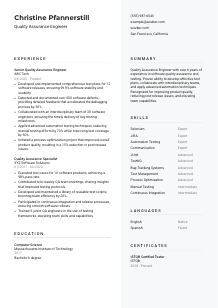
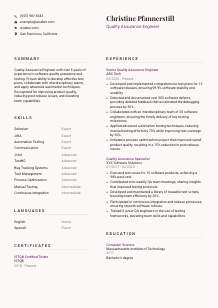
Maintaining standards, but your CV feels glitchy? Debug your doubts with this Quality Assurance Engineer CV example, created with Wozber free CV builder. Learn how to present your testing talents in line with job criteria, ensuring your career path passes every quality checkpoint!
Quality Assurance Engineers are hired to catch what others miss, reduce release risk, and improve how software is tested over time. A CV for this field needs to show more than general software experience. It should surface the parts of your work that matter in QA hiring: test planning, defect reporting, automation coverage, collaboration with engineers, and the effect your testing had on stability, reliability, or release quality.
When that information is tailored to the target role, the CV is easier to sort in both an ATS and a technical review. Wozber's free CV builder helps you align your wording with the posting, keep an ATS-friendly CV format, and bring forward the testing frameworks, bug-tracking tools, and delivery outcomes that make your QA scope clear at a glance.
For QA roles, the contact section does a small but important job. It should immediately confirm who you are, what role you do, and whether any practical requirement, such as location for an on-site or relocation-based position, is already covered.
Use your full name as the top line of the CV and keep it easy to read. QA work depends on clarity and consistency, and that standard starts with a clean header rather than decorative formatting.
Place "Quality Assurance Engineer" directly under your name if that matches the job you are applying for. This helps recruiters and ATS filters connect your CV to software testing, automation, and release-quality work right away.
Include a reliable phone number and a professional email address. If your LinkedIn or portfolio includes test automation projects, framework work, bug-triage examples, or CI-related contributions, make sure those links are current before you add them.
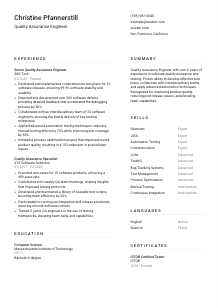
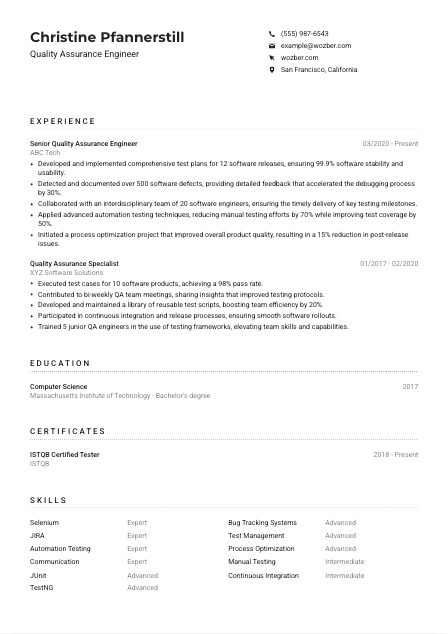
If the job requires you to be in a specific city or open to relocation, address that in this section. In the example, listing "San Francisco, California" immediately supports a stated requirement from the posting and removes a basic point of uncertainty.
A personal website, GitHub, or LinkedIn profile can strengthen your application when it shows relevant QA material such as automation scripts, testing documentation, or tooling work. Skip the link if it is outdated or too thin to support your testing background.
This section should confirm the basics quickly and cleanly. Once your title, contact details, and any location requirement are clear, the reader can move straight to your testing experience.




This is the core of a QA CV. Hiring teams want to see how you tested software, what kinds of defects or risks you uncovered, which tools and frameworks you used, and how your work affected release confidence, coverage, or post-release quality.
Read the posting for the work patterns it emphasizes, not just the tool list. Here, the clearest priorities are test plans, test cases, test scripts, defect tracking, automation, manual testing, collaboration with engineers, and process improvement. Those themes should be visible across your bullets, not buried under generic software language.
Start with your most recent QA role and work backward. That structure helps the reader see your current level with automation frameworks, defect management, release support, and cross-functional work without hunting through older experience first.
Each bullet should show what you owned and what changed because of it. Good QA bullets mention deliverables such as test plans, reusable scripts, regression suites, defect reports, coverage improvements, or release-readiness support. In the example, bullets about implementing test plans, documenting 500+ defects, and cutting manual testing by 70% speak directly to the work described in the posting.
Numbers matter when they reflect actual testing impact. Include measures such as defect volume, pass rates, automation coverage, reduction in manual effort, release count, post-release issue reduction, debugging turnaround, or uptime and stability improvements where relevant. Metrics like 99.9% software stability or a 15% drop in post-release issues tell a much clearer story than "responsible for testing."
Keep bullets that strengthen your case for the target job. Prioritise automation tooling, defect lifecycle work, test execution, CI participation, release support, and process improvement over unrelated engineering tasks. A focused experience section makes it easier to understand the scale and maturity of your QA practice.
Your experience section should show how you plan testing, execute it, report defects, and improve release quality over time. If a hiring manager can quickly see your tools, scope, and results, this section is doing its job.
Education matters most when the role asks for a specific degree or technical background. For Quality Assurance Engineers, it usually functions as a qualification check, especially when the posting calls for Computer Science, Engineering, or a related field.
If the job asks for a bachelor's degree in Computer Science, Engineering, or a related area, list that information plainly. The example does this well by showing a bachelor's degree in Computer Science without forcing extra explanation.
Include the institution, degree, field of study, and graduation year or date. QA CVs benefit from clean structure, and the education section should be quick to scan rather than overloaded with academic detail.
Use wording that aligns naturally with the posting if your background genuinely matches it. This helps with ATS parsing and avoids making the reviewer guess whether your education meets the requirement.
Early-career candidates can benefit from listing software testing, automation, software engineering, or QA-related projects, especially if those projects included frameworks, scripting, or defect analysis. For experienced candidates, this detail is usually less important than professional testing results.
Honors, technical competitions, or relevant student organizations can be useful if they reinforce your software or testing background. Leave them out if they distract from stronger evidence in your experience section.
This section does not need to do heavy lifting if your experience is strong. It should simply confirm the technical foundation the role asks for and make that confirmation easy to spot.
Certifications are not required for every QA opening, but they can strengthen your profile when they support testing discipline, automation knowledge, or current practice. They are especially helpful when employers value structured QA processes or industry-recognized standards.
Prioritise credentials tied to software testing, quality processes, automation, or related tooling. An ISTQB certification, for example, supports a profile centered on test design, defect management, and QA methodology even when the posting does not explicitly require it.
List certifications that reinforce the kind of QA work you want to do. A CV aimed at automation-heavy roles should favor credentials that support test frameworks, tooling, and process maturity rather than broad technical certificates with no testing relevance.
Dates help reviewers understand whether the certification is current, recently earned, or actively maintained. In a field where tools and release practices evolve quickly, that timing adds useful context.
If you are renewing certifications or adding new ones related to automation, CI, performance testing, or quality engineering, include them. This helps show that your QA knowledge is keeping pace with current development and testing workflows.
Certifications work best when they reinforce what the rest of the CV already shows: disciplined testing, current methods, and continued growth in QA practice.
The skills section should quickly map your toolkit to the target role. For QA hiring, that usually means testing frameworks, automation methods, bug tracking, test management, and the collaboration skills needed to work with developers, product teams, and release processes.
Start with the terms that appear in the job description and match your real background. In this case, that includes Selenium, JUnit, TestNG, JIRA, automation testing, bug tracking systems, and test management. These are stronger signals than generic entries like "software" or "problem solving."
Put the most important QA tools and methods first, especially if the role leans heavily on automation and tooling. Soft skills such as communication belong here too, but they should support the technical profile rather than crowd it out.
Group skills logically if you have enough depth to justify it, such as Automation Tools, Test Frameworks, QA Process, and Collaboration. A well-structured skills section helps the reader connect your stack to the work described in the posting without digging through paragraphs.
A hiring team should be able to glance at this section and see whether your testing stack fits the role. Keep it focused on the frameworks, systems, and working methods you actually use.
QA work involves more writing than many candidates expect. Test cases, defect tickets, reproduction steps, release notes, and feedback to engineers all depend on clear language, so this section can matter when communication is specifically called out in the posting.
If the posting states that you must write clearly in English, list English prominently and use an accurate proficiency label. That immediately supports your ability to write defect reports, document issues, and collaborate in written channels.
Lead with the language most important to the job, then add others in descending order of fluency or business usefulness. This keeps the section aligned with workplace communication rather than turning it into a general profile note.
Extra languages can help in distributed teams, global product environments, or customer-facing testing contexts. They are a secondary advantage, but they can still distinguish you when collaboration stretches across regions or functions.
Choose clear labels such as Native, Fluent, Intermediate, or Basic. Overstating language ability can become a problem quickly in QA work, where precise written communication affects defect quality and handoff accuracy.
If language is not a major differentiator for the job, keep this section brief. For most QA openings, it supports the application best when it confirms strong English communication and then gets out of the way.
Language skills matter here because QA work depends on clear documentation and cross-team communication. Use this section to reinforce that you can communicate testing work precisely.
The summary sits at the top of the CV, so it should establish your testing focus fast. For Quality Assurance Engineer roles, that means naming your level of experience, your QA specialty, and the kind of quality outcomes you have helped deliver.
Before writing the summary, note the few requirements that define the role. In this posting, automation, test planning, defect tracking, collaboration, and process improvement show up as recurring priorities. Those themes should shape your opening lines.
Start with a direct line such as "Quality Assurance Engineer with 6+ years of experience in software testing and automation." This tells the reader your discipline and seniority immediately, which is especially useful in technical screening.
Use the next sentence to highlight the testing capabilities that match the job, such as building test plans, improving automation coverage, managing defects, or partnering with interdisciplinary engineering teams. The example summary works because it stays close to actual QA responsibilities instead of drifting into vague claims.
Aim for a short paragraph that combines specialization with results. A summary that mentions improved product quality, reduced post-release issues, or stronger automation efficiency gives the reader a practical reason to continue into the experience section.
By the end of the summary, the reader should already understand your testing niche, your level, and the kind of release quality you influence. That makes the rest of the CV easier to read in the right frame.
A Quality Assurance Engineer CV should make your testing scope easy to follow from top to bottom: the frameworks you use, the defects you catch, the releases you support, and the process improvements you drive. When those details are tailored to the posting, both ATS screening and human review become far more favorable to your application.
Wozber's free CV builder can help you structure that story, sharpen role-specific wording, and improve ATS optimisation with tools such as an ATS CV scanner and ATS-friendly CV template. The final result should make one thing clear quickly: you know how to improve software quality before it reaches production.