



Use Wozber and land your dream job
Create CV
No registration required
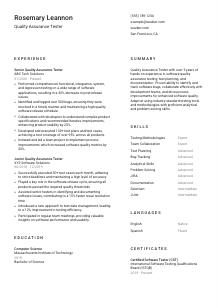
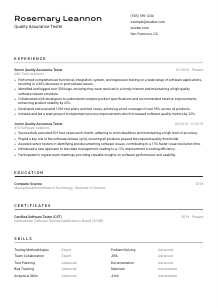
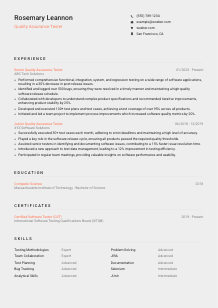
Polishing software, but your CV feels a bit rough? Check out this Quality Assurance Tester CV example, created with Wozber free CV builder. It shows how to present your meticulous bug-hunting skills to match the job, making your career path as smooth as a perfectly functioning app!
Quality assurance CVs are often too vague for the work they represent. Hiring teams want to see how you test software in practice: how you build coverage across functional, integration, system, and regression testing, how you document defects, and how your work improves release quality. If your CV only says you are detail-oriented or thorough, it misses the core of what QA actually contributes to a product team.
CV tailoring changes which kind of tester you appear to be. When the wording reflects the target environment, whether that means test planning, bug tracking, automation exposure, or process improvement, reviewers can place you faster and ATS filters can match your background more accurately. Wozber's free CV builder helps you shape that language into an ATS-compliant CV that makes your testing scope, documentation habits, and collaboration with developers easy to recognize.
This section is brief, but it still does real work. For a Quality Assurance Tester, it should immediately confirm who you are, how to reach you, and whether you meet any practical hiring requirements before the reader moves into test coverage, defects, and release work.
Use your full name in a clean, readable format at the top of the page. It should be easy to find above everything else, especially on a CV that may move through an ATS-friendly CV format and then into a fast human review.
Place the job title directly under your name when it reflects the role you are applying for. Using "Quality Assurance Tester" helps anchor the CV right away and keeps your positioning consistent with the opening you want.
List a professional email address and a phone number you check regularly. QA work depends on precision, so small errors here can create the wrong impression before anyone reads your testing experience or bug documentation examples.
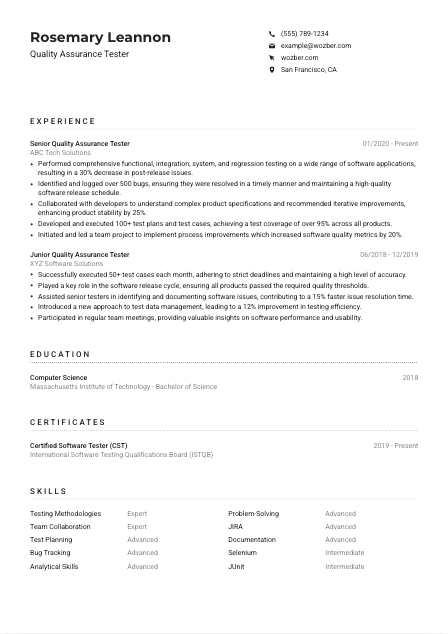
If the posting names a location requirement, show it clearly in your contact section. Here, "San Francisco, CA" matters because the employer asked for candidates based there. Treat that as a tailoring choice tied to this opening, not a rule for every QA CV.
Include LinkedIn or a personal site only if it supports your application with useful context such as projects, test automation work, or a fuller career history. Make sure the content aligns with the CV, especially if it mentions tools like Selenium, JIRA, or test case documentation.
When this section is accurate and tailored, it clears basic screening questions immediately and lets the hiring team focus on your testing depth. That is exactly where a Quality Assurance Tester should earn attention.




For QA roles, experience is where the CV starts to become credible. Hiring teams look for more than job titles. They want to see what kinds of testing you handled, how you reported defects, how closely you worked with developers, and whether your efforts improved release quality, speed, or coverage.
Read the job description like a test scope document. Mark the responsibilities and requirements that define the role, such as functional, integration, system, and regression testing, bug tracking, test plan execution, documentation, and process improvement. Those terms should reappear naturally in your experience when they match work you have actually done.
List positions in reverse chronological order with title, company, and dates. That structure helps reviewers quickly understand your progression from junior execution work to broader ownership, such as leading test planning, improving workflows, or influencing release readiness across multiple applications.
Focus each bullet on actions that matter in QA: executing test suites, creating test cases, logging defects, reproducing issues, validating fixes, and partnering with engineering on product changes. The example CV does this well with details like logging over 500 bugs and building more than 100 test plans, which immediately tells the reader what kind of testing volume and documentation discipline the candidate handled.
Metrics make QA experience easier to trust when they are tied to actual testing outcomes. Useful measures include post-release issue reduction, test coverage, defect volume, resolution speed, release quality, or efficiency gains from process changes. A bullet such as a 30% decrease in post-release issues works because it connects testing work to product stability, not just activity.
Keep the section centered on quality assurance work that matches the opening. If a bullet does not show testing methods, defect management, collaboration with developers, process improvement, or automation exposure, rewrite it or remove it. Every line should help the reader understand how you contribute to software quality in a live development cycle.
A strong experience section lets a hiring team picture you inside their release process. They should be able to see your testing scope, your documentation habits, and the kind of quality improvements your work has already produced.
Education is usually not the main deciding factor for an experienced QA hire, but it still sets the technical baseline. In software testing roles, it helps confirm your grounding in systems, development concepts, and structured problem-solving, especially when the posting asks for a degree in Computer Science, Information Technology, or a related field.
If the role asks for a bachelor's degree, make that qualification easy to spot. A Bachelor of Science in Computer Science, Information Technology, or a closely related field directly supports roles that involve test planning, defect analysis, and collaboration with engineering teams.
List the degree, field of study, school, and graduation date. Keep it simple so the reader can confirm the requirement quickly without digging through extra text.
When your major maps cleanly to the role, let that connection do its job. In the example, a Computer Science degree supports the technical side of QA work, including understanding application behaviour, reproducing issues, and communicating clearly with developers about defects and fixes.
Relevant courses can help early-career testers or candidates changing tracks. Include them when they reinforce software testing, databases, programming, systems analysis, or software engineering concepts that connect to the target role.
Projects, honors, or extracurricular work are useful when they show applied technical skill. For QA, that could include a software project where you wrote test cases, worked with version control, validated requirements, or contributed to release quality in a team environment.
This section does not need to be long. It needs to make the academic requirement easy to verify and support the technical context behind your testing experience.
Certifications can add useful weight in software testing, especially when they reinforce method, terminology, or tool familiarity. They are not a substitute for hands-on testing work, but they do show continued investment in quality standards and current practice.
Some QA roles require certifications, others only prefer them, and many leave them open. When the posting does not name a credential, choose certifications that still make sense for the discipline, such as ISTQB-related paths or other recognized testing credentials.
List certifications that support the kind of work you want to do. For a Quality Assurance Tester, that usually means certifications connected to software testing principles, test design, quality processes, or automation foundations. A certification such as Certified Software Tester from ISTQB-related bodies is relevant because it speaks the language hiring teams already know.
Add the year earned and, if relevant, the active date range. This helps readers understand whether the certification reflects current knowledge, especially in a field where testing frameworks, tooling, and release practices evolve over time.
Update certifications when your work moves into new areas such as automation, API testing, performance testing, or test management. That is particularly helpful when your day-to-day experience is broader than your current job title suggests.
The best certifications sharpen the story your experience already tells. In QA, they work best when they support your testing methods, tool exposure, and commitment to better software quality.
The skills section should read like the toolkit behind your testing results. For a Quality Assurance Tester, that means showing a mix of testing methods, defect management, documentation discipline, analytical thinking, and any tool knowledge that fits the role, especially when automation is mentioned.
Start with the capabilities the job calls out directly. Here that includes testing methodologies, test planning, documenting and tracking issues, analytical skill, problem-solving, and communication. If automation tools such as Selenium or JUnit are mentioned, include them when you have genuine exposure.
Lead with the tools and capabilities that define your usefulness on the job. For QA roles, that often means testing types, bug tracking systems, test case design, documentation, and automation support before broader traits. The example skill list works because it combines core QA practices with named tools like JIRA, Selenium, and JUnit.
Do not turn this section into a full inventory of every platform or soft skill you have touched. Choose the skills that support the testing environment you are targeting and that also show up in your experience section. That consistency helps both ATS optimisation and human review.
A hiring manager should be able to scan this section and understand how you approach testing, document defects, and contribute to product quality. If the list feels generic, tighten it until it matches the work.
Language skills matter in QA because testing is not only execution. It also involves writing clear defect reports, discussing edge cases with developers, and documenting results in a way the team can act on. That makes communication level worth stating plainly when a posting names it.
If the role requires English communication, list English clearly with an honest proficiency level. This job asks for effective communication in English, so that detail should be visible right away rather than buried later in the CV.
Additional languages can support collaboration across distributed teams, customer-facing testing, or multilingual product environments. In the example, Spanish adds value, but it remains secondary to the English requirement that the role explicitly calls for.
Choose plain labels such as Native, Fluent, Advanced, or Conversational. Avoid vague wording. QA communication often depends on precision in bug reports, reproduction steps, and test result summaries, so clarity here matters.
Not every QA role needs multiple languages, so keep this section proportional. It matters more when teams are global, products are localized, or the role interacts across support, product, and engineering groups in different regions.
List language ability when it strengthens how you are read as a tester. Clear communication helps with issue triage, requirement clarification, and cross-team coordination, all of which are part of quality assurance work beyond running test cases.
For QA roles, language proficiency should support how you communicate bugs, test results, and product behaviour. If it helps a team work with you more effectively, it belongs here.
Your summary should quickly establish what kind of QA professional you are. In a few lines, it needs to connect years of experience, testing scope, core strengths, and relevant tools so the reader knows whether to expect manual testing depth, automation support, process improvement, or a blend of those areas.
Start with a direct statement that identifies your professional profile. For example, "Quality Assurance Tester with 5+ years of experience" immediately frames the level of responsibility the rest of the CV will support.
Name the areas that define your work, such as software quality assurance testing, test planning, documentation, regression coverage, bug tracking, or collaboration with development teams. The example summary is effective because it stays close to the actual work rather than drifting into broad claims.
Aim for 3 to 5 lines. That is enough room to establish your QA profile, mention one or two strengths, and reference a useful area such as process improvement or automation exposure without repeating full experience bullets.
Adjust the summary for each application so it reflects the terminology used in the posting. If the employer emphasizes test planning, issue tracking, and process improvement, those ideas should appear naturally in your wording. Wozber's AI CV builder can help surface missing terms and strengthen ATS alignment while keeping the summary readable and specific to your real background.
By the time someone finishes these lines, they should understand your QA level, your main testing strengths, and the kind of software quality work you are ready to own. That clarity makes the rest of the CV easier to trust.
A Quality Assurance Tester CV works when it reads like someone who has tested real software, managed real defects, and improved real release outcomes. Keep the language close to the target role, tie your bullets to measurable quality results, and make sure your tools, methods, and documentation habits are visible where they matter most.
Wozber's free CV builder can help you turn that experience into an ATS-friendly CV template, and its ATS CV scanner can help you check whether the right testing terms, tool references, and role requirements are showing up clearly. The final version should make one thing easy to judge: how you strengthen software quality from test planning through resolution.




