



Use Wozber and land your dream job
Create CV
No registration required
Guarding product standards, but your CV seems out of spec? Get inspired by this Quality Assurance Officer CV example, created with Wozber free CV builder. Learn how to present your quality vigilance to match job expectations, putting your career on a path of excellence and precision!
Quality assurance work is judged in the details long before an interview starts. Hiring teams want to see how you maintain standards under routine pressure, whether that means running audits, tracking defect patterns, tightening process controls, or driving corrective actions across teams that do not always share the same priorities. Your CV should make that operating discipline visible, not just say that you are detail-oriented.
A tailored CV also helps separate quality professionals who only support inspections from those who can own a quality management system, interpret audit findings, and turn metrics into process improvements. Wozber's free CV builder helps you shape that story in an ATS-friendly CV format, so your experience with audits, compliance, reporting, and continuous improvement is easier to read and easier to match to the role.
For a Quality Assurance Officer, the header needs to remove friction fast. Contact details, title alignment, and location can affect whether your CV moves forward, especially when the employer has clear requirements around communication and on-site availability.
Use your full name in a clean, readable format at the top of the CV. Keep the styling professional rather than decorative. In quality roles, presentation matters because hiring managers often read the document as a reflection of your documentation habits and attention to detail.
Place "Quality Assurance Officer" beneath your name if that is the role you are applying for. Matching the posted title helps clarify your direction immediately and supports ATS alignment. If your current title is slightly different, such as Quality Assurance Manager or Quality Control Specialist, your experience section can show the progression.
List a reliable phone number and a professional email address, ideally in a simple format such as firstname.lastname@email.com. Avoid informal handles. Quality roles often involve audit follow-ups, report reviews, and coordination with production, operations, or compliance teams, so your contact details should look dependable and business-ready.
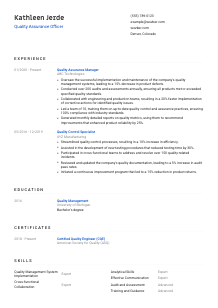
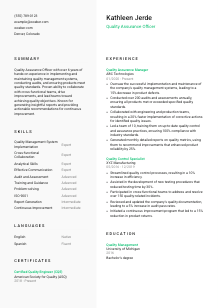
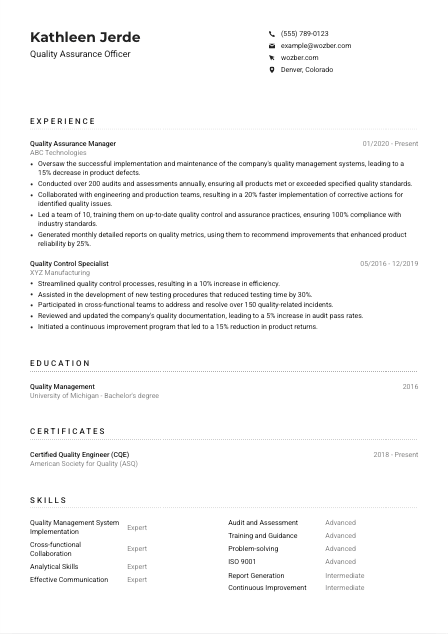
When a posting specifies location, reflect it clearly in your header. Here, Denver, Colorado matters because the employer states that candidates must be located there or willing to relocate. The sample CV handles this well by listing Denver, Colorado directly, which removes an avoidable screening question early.
A LinkedIn profile or professional website can help if it reinforces your quality background with consistent job titles, certifications, or project history. If you include one, make sure it supports the same story told in your CV, especially around audit work, quality systems, training, or continuous improvement.
Your personal details should confirm that you are reachable, professionally presented, and logistically aligned with the opening. That clarity lets the hiring team focus on your quality record rather than basic missing information.




This section carries the most weight for a Quality Assurance Officer. Employers want to see how you have maintained standards in live operations, found breakdowns through audits or controls, and worked with other teams to fix root causes instead of documenting problems and stopping there.
Start by identifying the work the employer needs done now. In this case, the priorities include maintaining the quality management system, conducting audits, guiding staff, coordinating corrective actions, and reporting on quality metrics. Build your bullet points around those same functions when they match your actual experience.
Use reverse chronological order and give the most space to positions with direct quality assurance ownership. Titles such as Quality Assurance Manager, Quality Assurance Officer, or Quality Control Specialist all work if the bullets show relevant scope. The sample CV does this effectively by leading with a role that includes system oversight, audits, team training, and reporting.
Do not stop at statements like "responsible for audits" or "handled quality issues." Show what changed because of your work. For this profession, useful measures include defect reduction, audit volume, pass rates, product reliability, return rates, corrective action cycle time, testing efficiency, and compliance results. The example bullets are strong because they tie quality work to outcomes such as a 15% drop in product defects and 25% improved product reliability.
Numbers carry more weight when they reflect how quality teams are actually evaluated. Include counts of audits completed, percentage improvements in compliance or defect trends, reductions in product returns, faster implementation of corrective actions, or gains in process efficiency. A bullet about conducting more than 200 audits annually says far more than a generic claim about being thorough.
Prioritise experience that shows control over standards, documentation, investigations, CAPA-style follow-through, cross-functional coordination, and continuous improvement. If an older role is less relevant, keep it brief. The goal is to make the hiring manager quickly understand that you can run quality processes, interpret findings, and improve outcomes in a real operating environment.
After reading your work history, the employer should be able to see that you do more than inspect for problems. You build quality into the process, track results, and move teams toward better performance.
Education is usually a supporting section in experienced quality CVs, but it still matters because many employers set a degree requirement before they look deeper. Present it clearly, especially when your degree aligns with quality management, business operations, engineering support, or a related field.
If the employer asks for a bachelor's degree in Quality Management, Business Administration, or a related field, make sure your qualifying degree is easy to find. When your background matches closely, as it does in the example with a bachelor's degree in Quality Management, that alignment is worth making obvious.
List the degree, field of study, school, and graduation year in a consistent structure. Hiring teams often scan this section quickly to confirm baseline eligibility, so simple formatting helps more than extra description.
If your degree title or field closely matches the posting, use the formal wording from your transcript. That can improve ATS matching and reduce ambiguity. For example, "Bachelor's degree in Quality Management" maps cleanly to this employer's stated requirement.
Early-career candidates can benefit from listing coursework related to quality systems, statistics, process improvement, operations management, compliance, or auditing. If you already have more than 5 years of relevant experience, coursework is usually less important than your audit record, reporting scope, and process results.
Honors, research, capstone projects, or student initiatives can help if they relate to process control, quality methodology, operational improvement, or documentation discipline. Keep the emphasis on details that support your professional direction rather than general campus activity.
This section should quickly show that you meet the academic requirement and, when relevant, that your training connects naturally to quality systems and process improvement work.
Certifications carry real weight in quality assurance because they point to established standards and methods, not just internal company practices. They are especially useful when the employer prefers formal training in ISO frameworks, auditing, or quality engineering.
When a job mentions ISO 9001 or ASQ credentials, move those to the top of your certifications section if you hold them. This posting explicitly prefers quality management certification, so credentials such as Certified Quality Engineer or ISO 9001 training deserve clear placement.
List certifications that reinforce your ability to manage standards, audit processes, investigate quality issues, or improve systems. A short, relevant list is stronger than a long list of unrelated learning badges. The sample CV stays on track by highlighting CQE and ISO 9001 rather than adding marginal credentials.
Many quality certifications require renewal, continuing education, or current standing. Include dates or active ranges so the employer can tell whether your credential is current. This is particularly useful for regulated environments or organizations that rely heavily on standard-based audits.
Quality frameworks evolve through updated standards, audit expectations, and process-improvement practices. If you have recent certification work, refresher training, or active membership tied to quality disciplines, include it to show you stay engaged with current methods and compliance expectations.
Well-chosen certifications tell the employer that your quality knowledge is grounded in recognized standards. That matters when the role includes system ownership, audits, and staff guidance.
A Quality Assurance Officer's skills section should reflect how the work gets done. That means combining process-oriented technical strengths with communication skills needed to train staff, present findings, and push corrective actions across departments.
Start with the language in the posting and pull out both explicit and implied skills. Here, that includes analytical thinking, problem-solving, communication, audit work, quality management systems, and collaboration across functions. Those are stronger anchors than generic traits such as hardworking or organised.
Use terminology that reflects your real experience while staying close to the posting's wording. For quality roles, that might include Quality Management System Implementation, Audit and Assessment, CAPA or corrective action management, report generation, process improvement, and cross-functional collaboration. The sample CV does this well by pairing technical quality skills with communication and training capability.
Choose skills that support the responsibilities you want the employer to remember. A focused list does more than a crowded one. For a Quality Assurance Officer, that usually means balancing system knowledge, analytical work, documentation discipline, reporting, root-cause problem-solving, and stakeholder communication.
Every skill you include should be backed up somewhere else by a result, tool, or responsibility. That connection makes the section credible and useful in both ATS screening and human review.
Language ability matters in quality assurance when the role involves writing reports, training staff, documenting findings, and communicating corrective actions clearly. List languages with the same accuracy you would use in an audit record.
If the posting requires English proficiency, list English prominently and state your level clearly. This employer asks for English language efficiency, so your CV should remove any doubt about your ability to write reports, discuss findings, and communicate standards.
Place the languages most relevant to the work environment at the top of the section. In many QA roles, that means English first because of reporting, documentation, policy training, and cross-functional communication.
Extra languages can be valuable when quality teams work with diverse production staff, suppliers, regional operations, or international stakeholders. They are not a substitute for core QA qualifications, but they can strengthen your profile when communication across groups is part of the job.
Use clear labels such as Native, Fluent, Professional, Conversational, or Basic. Avoid overstating ability. In quality work, unclear communication can create documentation errors, training gaps, and misunderstandings around standards or corrective actions.
If the company works across multiple sites, countries, or supplier networks, language skills may add practical value beyond the job ad itself. Mention them when they improve your ability to train teams, interpret documentation, or coordinate quality issues across locations.
This section should show that you can communicate clearly in the language the role requires and, where relevant, support broader coordination across teams or locations.
Your summary should quickly position you as someone who can maintain standards, find issues early, and improve processes with measurable results. For a Quality Assurance Officer, this is where you connect years of experience to the kind of quality ownership the employer needs.
Read the posting closely and identify the themes that matter most. In this case, the employer wants someone who can maintain the quality management system, run audits, guide staff, solve quality issues, and report on metrics. Your summary should reflect that operating scope, not a generic interest in quality.
Lead with your title or closest equivalent and your years of relevant experience. A line such as "Quality Assurance Officer with 6+ years of experience in quality management systems, audits, and process improvement" gives immediate context and aligns with the 5-year requirement.
Choose two or three strengths that directly match the opening, such as audit execution, cross-functional corrective action, compliance training, or quality reporting. The example summary works because it highlights quality systems, audits, collaboration, and improvement rather than broad claims about being dedicated.
Aim for a short paragraph that reads smoothly and includes at least one concrete result or area of impact. In quality assurance, phrases tied to defect reduction, compliance performance, product reliability, or continuous improvement carry more weight than general statements about excellence.
By the time someone finishes these opening lines, they should already understand your level, your quality scope, and the kind of operational improvements you bring to a QA team.
A strong Quality Assurance Officer CV shows control over systems, audits, corrective actions, reporting, and training in terms that match the target role. When those points are supported by metrics such as defect reduction, audit volume, compliance performance, or faster corrective action cycles, the hiring case becomes much clearer.
Use Wozber's free CV builder to organise that experience into an ATS-compliant CV, then refine the language with its ATS CV scanner so the final version reflects the quality methods, standards, and outcomes the employer is actually hiring for. The finished CV should make it easy to see that you can maintain quality standards and improve them.