



Use Wozber and land your dream job
Create CV
No registration required
Navigating clean currents, but your CV feels like an old turbine? Plug into this Renewable Energy Project Manager CV example, created with Wozber free CV builder. Learn how to spotlight your green leadership to match job requirements, powering your career growth to sustainable heights!
Renewable energy projects move through long timelines, tight budgets, permitting requirements, contractor coordination, and constant technical tradeoffs. A CV for a Renewable Energy Project Manager needs to show that you can keep a project moving from early planning through delivery while managing risk, reporting clearly, and coordinating teams that do not all speak the same operational language.
When that story is tailored well, hiring teams can quickly separate candidates who have owned project delivery from those who have only supported isolated workstreams. Wozber's free CV builder helps you shape that experience into an ATS-compliant CV, using the right project language and structure so your timeline control, budget ownership, and cross-functional coordination are easy to spot from the first scan.
For this role, the header needs to do one practical job fast: confirm who you are, how to reach you, and whether you meet any basic screening requirements. Keep it clean, professional, and easy to parse so nothing slows down the first review.
Use your full name as the most prominent text on the page. Keep the styling simple and readable. Renewable energy hiring often involves multiple reviewers across operations, engineering, and HR, so a clean header helps every reader orient quickly.
Place the role title directly under your name when it accurately reflects your background and target position. Using "Renewable Energy Project Manager" immediately connects your profile to the opening and reinforces the direction of the rest of the CV.
List a current phone number and a professional email address with no formatting mistakes. If you include a website or LinkedIn profile, make sure it supports the same story as your CV, especially project scope, energy sector experience, and leadership responsibility.
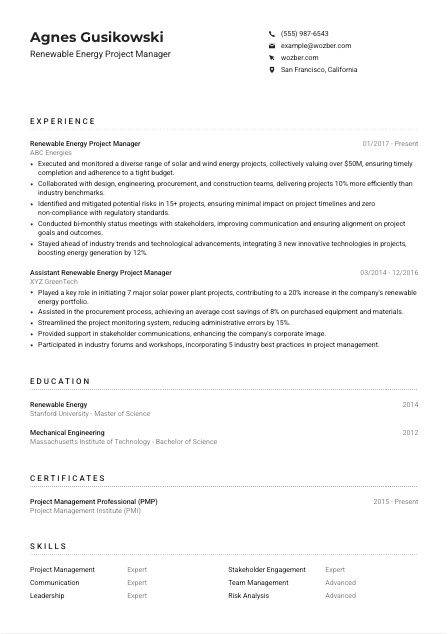
Some employers use location as an early filter, especially for site-based or hybrid project roles. Here, the posting asks for someone located in San Francisco, California, so showing that in your header removes an avoidable question before the hiring team gets to your project history.
A LinkedIn profile or professional site can strengthen your application if it adds useful context such as project portfolio details, certifications, or sector-specific accomplishments. Keep it current and consistent with your CV dates, titles, and major results.
Your personal details should remove friction, not create it. If this section clearly confirms your identity, contact information, and any stated screening requirement such as location, the reader can move straight to your project credentials.




This is the section that carries the most weight for a Renewable Energy Project Manager. Hiring teams want to see what kinds of projects you handled, how much responsibility you owned, which teams you coordinated, and what happened to schedule, budget, compliance, and output under your management.
Start by identifying the work patterns in the posting, not just the nouns. In this case, the employer wants someone who can plan, execute, and monitor projects, coordinate design through construction, manage risk, report progress, and stay current with industry practices. Those are the priorities your bullets should reflect.
List your positions in reverse chronological order with title, company, and dates. For project management roles, clear progression matters. It helps the reader see whether you moved from support responsibilities into ownership of schedules, budgets, vendors, permitting, reporting, or full project delivery.
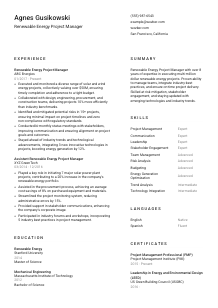
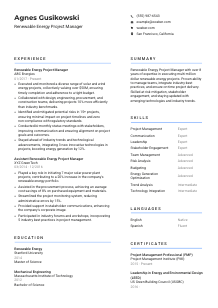
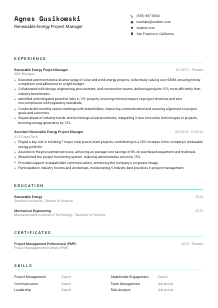
Open bullets with the work that mattered most: project type, scale, delivery responsibility, and result. The example CV does this well by leading with solar and wind projects valued at more than $50M, then tying that scope to on-time delivery and budget control. That tells a hiring manager far more than a generic line about "overseeing projects."
Quantified results are especially persuasive in this field. Include metrics tied to project value, cost savings, schedule performance, efficiency gains, energy generation, compliance outcomes, or number of sites managed. Numbers such as 10% efficiency improvement, 8% procurement savings, or zero regulatory non-compliance give substance to your leadership claims.
Feature experience that aligns most closely with the employer's portfolio and delivery model. If your background spans several energy or infrastructure sectors, give more space to work involving renewable generation, EPC coordination, risk mitigation, stakeholder reporting, or policy-driven implementation. Save less relevant achievements for the interview unless they strengthen the same project management story.
Your experience section should make it easy to understand the scale you managed, the functions you coordinated, and the results you delivered. Run it through Wozber's ATS CV scanner to check whether your wording reflects the posting's project lifecycle, reporting, and compliance language without sounding forced.
In renewable energy project management, education matters because it often signals how comfortably you can work across engineering, sustainability, commercial planning, and delivery conversations. Present your academic background so the reader can quickly connect it to the technical and operational demands of the role.
If the posting asks for a degree in Renewable Energy, Engineering, Project Management, or a related field, make sure that match is obvious. Put the degree, field, school, and graduation year in a clean format so the qualification is easy to confirm at a glance.
Start with your highest completed degree, then work backward. For a mid-career project manager, this creates a fast read. A Master of Science in Renewable Energy followed by an engineering bachelor's, for example, immediately reinforces both sector knowledge and technical grounding.
The name of your program can help position you. A degree in Renewable Energy, Mechanical Engineering, Civil Engineering, Environmental Engineering, or Project Management carries different emphasis, so include the field in full rather than shortening it. In this guide's example, the combination of renewable energy and mechanical engineering maps well to both technology and delivery.
Most experienced candidates do not need to list classes, but it can help if your degree title is broad or your background is transitioning into renewables. Include coursework or thesis work only if it points directly to grid integration, energy systems, project controls, sustainability, or construction delivery.
Capstone projects, research, or leadership in energy-focused programs can strengthen this section when they connect to your current target. That is most useful early in your career or when the work demonstrates practical exposure to renewable technologies, policy, or project execution.
Your education should confirm that you can operate comfortably in a technically informed project environment. Keep it direct, relevant, and easy to scan so it supports the story already established in your experience section.
Certifications carry real weight in project-based hiring when they map to delivery discipline or sustainable building knowledge. For Renewable Energy Project Manager roles, they often serve as a quick shorthand for formal training in project controls, process rigor, or sustainability standards.
If the employer calls out certifications, bring those to the top of this section. Here, PMP and LEED are listed as preferred, so they deserve prominent placement because they align directly with project governance and sustainability-focused work.
Choose certifications that strengthen your case for managing renewable projects, construction interfaces, compliance, sustainability, or technical coordination. A short, relevant list is stronger than a long catalogue of unrelated training badges.
Show the certifying body and the date earned or active range, especially for credentials that require maintenance. That gives the reader confidence that your certification is current and professionally maintained, as shown in the example with PMP and LEED listed alongside their issuing organizations.
Renewable energy changes quickly through policy shifts, storage technology, procurement models, and design standards. If you hold additional training in areas like energy systems, safety, construction management, or environmental compliance, include it when it supports the type of projects you want to lead.
Certifications should sharpen your profile, not pad it. When they are relevant and current, they reinforce that you bring structured project management practice and up-to-date knowledge into renewable energy delivery.
For this role, a skills section should read like the operating toolkit behind successful project execution. Focus on the capabilities that help you move a renewable energy project through planning, coordination, reporting, risk control, and completion.
Read the posting for repeat themes and convert them into skill language grounded in the job. This description points to project planning, budget management, cross-functional coordination, risk mitigation, stakeholder communication, and leadership. Those belong on the CV because they describe how the work gets done.
Include both core project management skills and capabilities that matter in renewable energy settings. Alongside communication and leadership, skills such as risk analysis, budgeting, procurement coordination, regulatory awareness, and energy generation optimisation can help distinguish you from a generalist project manager.
Do not overwhelm the section with every tool or soft skill you have used. A tighter list makes your strengths easier to absorb and gives more weight to each entry. The example CV keeps this fairly focused by combining management skills with role-specific strengths like stakeholder engagement and technology integration.
This section should quickly confirm that you can run the mechanics of a renewable energy project, not just participate in one. Use terminology that matches your real experience, and present it in an ATS-friendly CV format so the keywords are readable to both software and hiring teams.
Language ability matters in project management because progress depends on clear coordination, reporting, and stakeholder communication. Even when the role is based in one market, multilingual ability can support vendor discussions, community engagement, or cross-border project collaboration.
Check the posting first. Here, proficient English communication is required, so English should appear clearly in this section with an honest proficiency level such as Native or Fluent.
List required or primary working languages at the top, then add others in descending order of usefulness. For a Renewable Energy Project Manager, this helps the reader quickly confirm whether you can handle meetings, reports, contractor communication, and executive updates in the expected language.
Extra languages can add value when projects involve diverse contractors, international suppliers, or community-facing communication. For example, Spanish may be useful in many construction and operations environments, but include it because you can use it professionally, not just because it looks impressive.
Stick to clear labels such as Native, Fluent, Intermediate, or Basic. Avoid vague wording. Hiring teams need a realistic sense of how comfortably you can manage meetings, documentation, and negotiations.
If you are applying to roles with regional, international, or multi-stakeholder complexity, language range becomes more relevant. In more locally focused roles, this section may be brief, but it should still accurately reflect communication capacity where it affects delivery.
Keep the languages section honest and practical. For project leadership roles, it should tell the reader whether you can communicate clearly in the environments where the work actually happens.
The summary sits at the top of the CV, so it needs to frame your value quickly and in the language of project delivery. For Renewable Energy Project Manager roles, that usually means years of experience, project scope, sector focus, and a few core strengths such as budget control, stakeholder management, or risk mitigation.
Use the posting to decide what belongs in the first three lines. Here, the employer cares about end-to-end project management, budget and timeline control, team leadership, regulatory awareness, and strong communication. Those themes should shape the wording of your opening profile.
Start with your current professional identity and years of relevant experience. A line such as "Renewable Energy Project Manager with 8+ years of experience" immediately gives the reader role alignment and seniority, which is exactly what the sample CV does well.
Follow with one or two details that show the level at which you operate. Multi-million-dollar solar or wind projects, cross-functional team leadership, risk mitigation, procurement coordination, or compliance performance are all stronger than broad claims about being results-driven.
Aim for a short paragraph with clear, information-rich language. Three to five lines is usually enough. The best summaries read like an executive snapshot of your delivery record, not a list of personality traits.
By the time someone finishes your summary, they should understand your sector, your project scope, and the kind of delivery leadership you bring. Wozber's ATS CV scanner and ATS-friendly CV templates can help you tighten that message so the top of the page already sounds aligned with the role.
A Renewable Energy Project Manager CV works best when every section points back to execution. Your header confirms key requirements, your experience shows scope and results, your education and certifications support technical credibility, and your summary makes your project leadership easy to understand before the first interview.
Use Wozber's free CV builder, ATS optimisation tools, and ATS-friendly CV template to align your wording with the posting and present your background in a clean, ATS-friendly CV format. The finished CV should make one thing clear right away: you can lead renewable energy projects from planning through completion with control, coordination, and measurable results.




