



Use Wozber and land your dream job
Create CV
No registration required
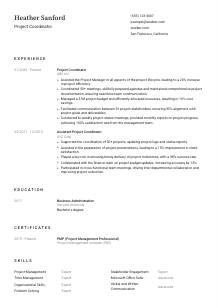
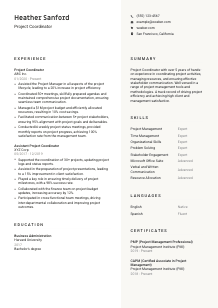
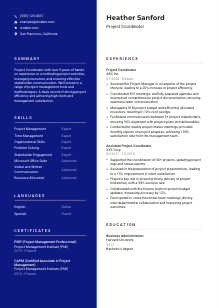
Juggling tasks, but your CV feels uncoordinated? Coordinate with this Project Coordinator CV example, created with Wozber free CV builder. Learn how to outline your organizational strengths to match job blueprints, ensuring your career plans mesh as seamlessly as your project timelines!
Project coordinators sit at the centre of execution. When timelines slip, meeting notes go nowhere, or stakeholders are working from different assumptions, projects slow down fast. Your CV needs to show that you bring order to that kind of environment through scheduling, documentation, follow-up, reporting, and day-to-day coordination that keeps delivery on track.
Hiring teams often sort project support candidates by one practical question first: who has already handled the mechanics of project delivery well enough to support a project manager without constant direction. That is where tailored wording matters. Using Wozber's free CV builder and an ATS-friendly CV format helps you match the language of project lifecycle support, status reporting, budgets, and stakeholder communication so both the ATS and the reader can quickly see your operating range.
This section is simple, but it still does screening work. For a Project Coordinator role, your header should present you as organised, reachable, and already aligned with the basics of the opening.
Use your full name at the top in a clean, readable format. Project coordination is detail-heavy work, so even your header should feel tidy and deliberate rather than cluttered or styled for effect.
Place "Project Coordinator" directly under your name when that is the role you are pursuing. It immediately connects your profile to the position and helps separate you from adjacent titles such as administrative assistant or operations coordinator.
List a professional email address and a phone number you answer regularly. Double-check formatting and typos. If a hiring manager wants to schedule an interview after reviewing your project reporting or coordination background, your contact section should not create friction.
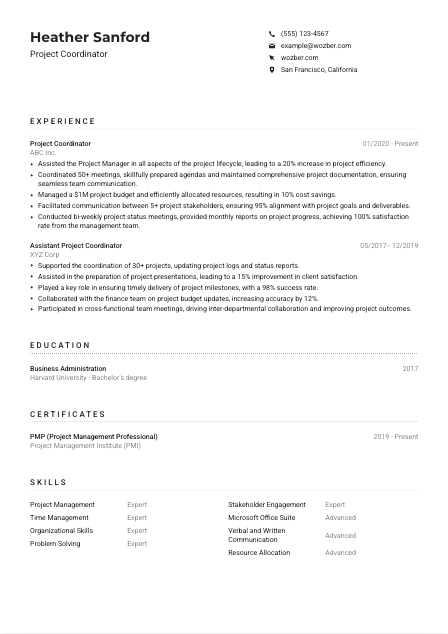
If the posting requires local candidates, add your city and state. In this example, "San Francisco, California" directly addresses a stated requirement and removes doubt about availability for on-site or local coordination needs.
Include LinkedIn or a professional website only if it supports your candidacy. For project coordinators, that usually means a polished profile with consistent dates, titles, and possibly added context on tools, certifications, or cross-functional project work.
Your personal details should confirm the practical basics quickly: who you are, what role you do, how to reach you, and whether you meet any stated location requirement. Clean setup here reinforces the organizational standard expected in project work.




This is where employers look for proof that you can keep projects moving between kickoff and closeout. Focus less on vague support language and more on the operational work you handled: schedules, documentation, meetings, budgets, resource coordination, status reporting, and stakeholder follow-through.
Start by marking the responsibilities that define the role. For this opening, that includes supporting the full project lifecycle, coordinating meetings, maintaining documentation, tracking schedule and budget, aligning stakeholders, and reporting progress. Those themes should appear clearly in your bullets if they reflect your actual work.
Use reverse chronological order and include employer name, title, and dates for each position. Project coordination hiring often depends on seeing steady progression in related work, such as moving from assistant coordinator responsibilities into fuller ownership of schedules, reports, and stakeholder communication.
Your bullets should describe what you coordinated and what changed because of it. Strong examples include running status meetings, maintaining project logs, updating action items, preparing agendas, tracking milestones, or managing document flow across teams. The sample CV does this well by tying coordination tasks to project efficiency, alignment, and delivery results.
Quantify scope where you can. Metrics such as number of meetings coordinated, budget size, number of stakeholders supported, milestone delivery rates, reporting cadence, or cost savings make project work easier to judge. A line like managing a $1M budget with 10% cost savings says much more than "helped with budget tracking."
Keep the section centered on work that resembles project coordination. Administrative tasks can stay if they supported schedules, documentation, reporting, vendor follow-up, or cross-functional communication. Drop unrelated achievements that do not help explain how you contribute to timelines, team alignment, or project execution.
A hiring manager should be able to scan your experience section and understand how you support delivery in practice. Show the rhythm of the work, the scope you handled, and the results your coordination helped produce.
Education is usually a straightforward section for project coordination roles, but it still helps confirm that you meet baseline requirements. Keep it clean, accurate, and aligned with the field the employer asked for.
If the role calls for a bachelor's degree in Business Administration, Project Management, or a related field, list that qualification clearly. In the example, a bachelor's degree in Business Administration maps neatly to the posting and should be easy for both a recruiter and an ATS to recognize.
Include degree, field of study, school name, and graduation year or date. Project Coordinator CVs benefit from orderly formatting everywhere, and education is no exception.
Write out the degree and major clearly instead of abbreviating too much. When your academic background is directly related to planning, business operations, or project work, that connection should be visible at a glance.
If you are early in your career, you can include coursework or academic projects tied to scheduling, operations, business communication, or project planning. For experienced candidates, this is usually unnecessary unless it adds something your work history does not already cover.
Honors, leadership roles, or major university projects can be useful if they show organisation, coordination, or cross-team execution. Keep them only when they strengthen your case for project-based work.
Your education section should quickly confirm that you meet the formal requirement and, where relevant, reinforce your grounding in business or project-related work. Clear formatting is enough here.
For Project Coordinator roles, certifications often serve as an extra indicator that you understand project frameworks, terminology, and structured delivery. When a posting mentions PMP or CAPM, make those credentials easy to find.
If the job description names PMP or CAPM, list either credential prominently when you have it. That kind of direct match can help your CV move forward quickly, especially when certification is a preferred filter.
Prioritise credentials tied to project planning, coordination, scheduling, or formal project management methodology. In the example, PMP and CAPM both speak directly to the employer's preference and support the candidate's project background.
Add the certifying body and the date earned, especially for credentials that expire or require maintenance. This helps show that your knowledge is current and that the certification is active rather than outdated.
If you do not yet hold a major certification, include other meaningful project training only when it supports the role, such as coursework in project planning tools, Agile fundamentals, reporting workflows, or stakeholder communication. Keep the list focused on project execution rather than general learning.
Relevant certifications reinforce that you understand the language and structure of project work. They are especially valuable when the employer explicitly mentions them as preferred qualifications.
A Project Coordinator skills section should mirror the actual mechanics of the job. That means balancing tools and execution skills with the communication and organisation needed to keep teams aligned.
Review the posting for both named and implied skills. Here, project management software, Microsoft Office Suite, communication, scheduling, budgeting, documentation, and stakeholder coordination all belong. Add the ones you genuinely use in your work so the section matches both ATS terms and real capability.
Be selective. Prioritise skills that help manage timelines, documentation, reporting, team coordination, and resource tracking. Broad strengths only help when they connect to how projects actually run.
Organise your skills in a way that lets a hiring manager scan quickly. You might separate technical tools from coordination strengths, or list them in order of job relevance. The sample CV combines project management, stakeholder engagement, Microsoft Office, communication, and resource allocation, which creates a practical picture of how the candidate works.
The best skills section for this role feels specific to project execution. A reader should come away seeing how you track work, communicate updates, and support delivery across teams.
Project coordination depends on clear updates, accurate documentation, and smooth communication across teams. If a posting explicitly asks for strong English, make that visible without overcomplicating the section.
When the job description calls for strong English, list English prominently with an accurate proficiency level. For this role, that matters because meeting notes, agendas, status reports, and stakeholder communication all depend on precise language.
Include additional languages if they are relevant to your background or the organisation. They can be useful in client-facing environments or cross-regional teams, though they are usually secondary to the core coordination skills of the role.
Choose standard labels such as Native, Fluent, Intermediate, or Basic. Hiring teams should be able to understand your level immediately, especially if the role involves written updates or live meeting support.
Extra languages are most helpful when they connect to stakeholder communication, vendor coordination, or multilingual teams. They are a bonus, not a replacement for experience managing schedules, documentation, and project follow-up.
Be honest about your level. If you may need to write reports, summarise meetings, or handle project updates in another language, your listed proficiency should reflect what you can actually do in a professional setting.
For a Project Coordinator, language skills matter most when they support clear reporting and stakeholder communication. Lead with the language the role requires, then add others only if they strengthen that picture.
Your summary should quickly tell the reader what kind of project support you provide and at what level. Keep it focused on experience, scope, and the parts of delivery you handle well.
Use the job description to identify what belongs in your opening lines. For this role, that means project lifecycle support, meeting coordination, documentation, schedule and budget tracking, and stakeholder communication. Build your summary around the parts you have done, not a generic statement about being organised.
Start with your title and your level of experience, such as "Project Coordinator with 5+ years of experience." That gives immediate context before you move into project scope, tools, or delivery strengths.
Mention outcomes or areas of ownership that matter in project coordination, such as improving reporting cadence, supporting on-time milestones, managing project documentation, or coordinating budgets and stakeholders. The example summary works because it connects years of experience with resource management, communication, and efficiency gains.
Aim for a short paragraph that can be read in seconds. Skip soft claims that are not backed elsewhere in the CV. A concise summary with concrete project language creates a much stronger opening than broad statements about passion or dedication.
Your summary should make one thing immediately clear: you understand the moving parts of project execution and know how to keep them organised. When that comes through in a few crisp lines, the rest of the CV has context.
Before sending your application, read the CV against the posting one more time. Check that the language around project lifecycle support, schedules, budgets, documentation, status meetings, and stakeholder communication appears where your experience genuinely supports it. Wozber's free CV builder, ATS-friendly CV templates, and ATS CV scanner can help you tighten that alignment and produce an ATS-compliant CV that is easy to review.
When the document is tailored well, a hiring team can quickly see that you are ready to support delivery, keep project information accurate, and help a project manager move work from kickoff to closeout with fewer gaps.