



Use Wozber and land your dream job
Create CV
No registration required
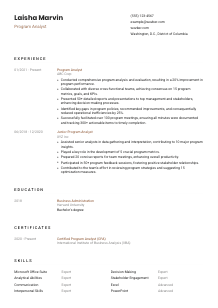
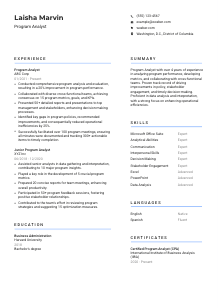
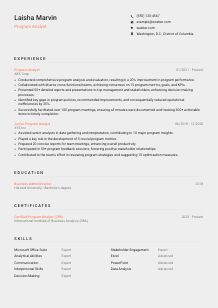
Cracking codes, but your CV doesn't translate? Check out this Program Analyst CV example, built with Wozber free CV builder. It shows how to align your analytical insights with job specs, ensuring your career trajectory hits execute on the right command!
Program Analysts are hired to turn messy operational data, policy questions, and stakeholder input into decisions that move a program forward. That means your CV has to show more than general business support. It should make clear that you can interpret performance trends, shape useful metrics, spot process gaps, and keep action items moving across teams.
CV screening for Program Analyst roles often narrows quickly around whether your background maps cleanly to program review work. Wozber's free CV builder helps you align your language with the job description, organise accomplishments in an ATS-friendly CV format, and surface the Excel, reporting, KPI, and stakeholder work that hiring teams need to see early. The faster they can connect your experience to program performance, the stronger your read as a candidate.
For a Program Analyst, the header should read like a clean business document. Hiring teams are looking for a straightforward match on title, contact details, and any practical requirement that affects next-step eligibility. Keep this section concise, accurate, and aligned with the posting.
Use your full name in a clear, readable format at the top of the page. This is basic, but it matters. Program Analyst roles often involve formal reporting, presentation decks, and executive-facing documents, so even the first line of your CV should reflect that level of professionalism.
Place "Program Analyst" under your name when that is the role you are applying for. Matching the job title helps frame the rest of the CV around program evaluation, reporting, KPI tracking, and policy review instead of leaving the reader to infer your direction.
List a current phone number and a professional email address. If you include a LinkedIn profile or personal site, make sure it supports the CV with relevant work, presentations, or credentials. Broken links and casual email handles create avoidable friction in roles where detail handling is part of the job.
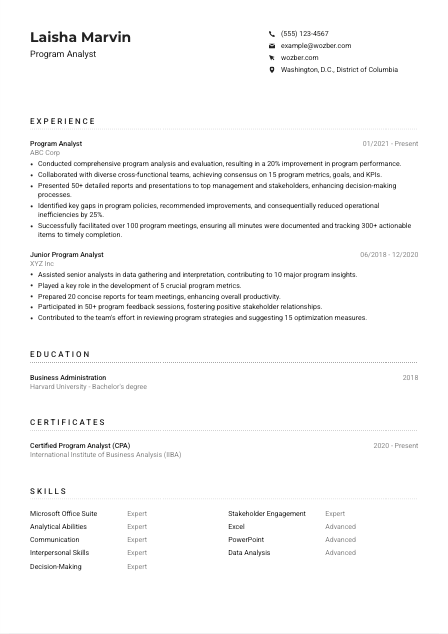
If a job specifies a location, include your city and state in the header. In the example, listing Washington, D.C., District of Columbia immediately addresses a stated requirement. Use that approach when location is part of eligibility, but do not overemphasize it for postings where geography is not a deciding factor.
A portfolio is not always necessary for Program Analysts, but a polished LinkedIn profile, publications page, or project site can help if it shows dashboards, reporting work, cross-functional initiatives, or analytical projects. Treat it as supporting documentation, not filler.
This section should confirm who you are, how to reach you, and whether you meet any practical requirement called out in the posting. For a Program Analyst, clean presentation here sets the tone for the structured thinking the rest of the CV needs to prove.




This is the section that usually decides whether a Program Analyst CV moves forward. Hiring managers want to see how you handled data, reporting, stakeholder coordination, policy or process review, and measurable program improvement. Job duties alone are rarely enough. Show the outcomes of your analysis.
Before editing bullets, mark the responsibilities that define the role. In this case, that includes program performance analysis, metric development, reporting to management, policy review, and meeting follow-through. Those themes should guide which accomplishments you feature and how you phrase them.
List your positions from newest to oldest, with job title, employer, and dates clearly shown. For Program Analyst hiring, recency matters because reporting tools, KPI frameworks, and cross-functional processes evolve quickly. A current or recent role that already includes program evaluation work should carry the most weight.
Each bullet should show what you analysed, changed, improved, or helped leaders decide. The example does this well by tying work to outcomes such as a 20% improvement in program performance, 15 agreed program metrics, and 25% lower operational inefficiency. That is much stronger than simply saying you "supported analysis" or "prepared reports."
Program analysis is easier to trust when the scale is visible. Use numbers tied to reports delivered, meetings facilitated, KPIs built, action items tracked, process improvements made, or performance gains achieved. Figures like "50+ presentations," "100 meetings," or "300+ action items" help the reader understand volume, consistency, and organizational reach.
Prioritise experience that shows analysis, business judgment, coordination, and execution follow-through. If older work is less relevant, reduce it to fewer bullets or focus only on transferable contributions such as data interpretation, process review, or stakeholder communication. The section should read like a progression toward stronger program oversight work.
Your experience section should show that you can analyse performance, influence program decisions, and keep initiatives moving after the meeting ends. When the bullets connect analysis to measurable outcomes, your candidacy becomes much easier to trust.
Education matters here because many Program Analyst postings still screen for a bachelor's degree in business, finance, public administration, or another related field. Present it clearly so the hiring team can confirm the requirement quickly and move on to your analytical experience.
If the posting asks for a bachelor's degree in Business Administration, Finance, or a related field, use the exact degree and field wording from your record. The example's Bachelor's degree in Business Administration aligns cleanly with the requirement, which removes any ambiguity at the screening stage.
List degree, field of study, school, and graduation year in a consistent order. Program Analyst CVs benefit from clarity over decoration. Hiring teams are usually checking for qualification match, not reading this section for a long narrative.
When your academic background directly supports the role, make that easy to spot. Business Administration, Finance, Economics, Public Policy, and similar fields all help frame you as someone comfortable with analysis, reporting, and structured decision support.
Coursework can help early-career candidates or career changers, especially if it includes statistics, financial analysis, operations management, policy evaluation, or data visualization. If you already have solid program analysis experience, keep this section lean unless the coursework strengthens a specific gap in your profile.
Honors, scholarships, or relevant student leadership can be useful when they reinforce analytical discipline, presentation work, or project coordination. For candidates with several years of experience, these details should stay secondary to professional results.
This section should make the degree requirement easy to confirm and support the business or analytical foundation behind your experience. Once that is clear, the CV can stay focused on the program work that matters most.
Certifications are usually a supporting asset for Program Analyst roles, not the main hiring driver. They help when they strengthen your analytical profile, show commitment to process improvement, or connect you to recognized business analysis practices.
List certifications that support the actual work of the role, such as business analysis, project support, process improvement, data analysis, or program management. The sample certification works because it reinforces the candidate's analytical specialization instead of adding a generic credential with no clear connection to the job.
Include the year earned and, if relevant, the active period or renewal window. This is especially helpful for certifications tied to current frameworks, methodologies, or continuing education expectations. Clear dates show whether the credential is current and still relevant.
A thoughtful certification section can show that you keep building skills beyond formal education, especially in areas like Excel-based analysis, reporting, stakeholder communication, or process improvement. Keep it selective and current so it adds substance rather than noise.
One well-matched credential can strengthen your profile, especially when it connects to analytical methods or program operations. Keep the section focused on certifications that add real relevance to the role you want.
The skills section should mirror the tools and working strengths used in program analysis every week. That usually means a mix of spreadsheet and presentation tools, quantitative analysis, reporting, stakeholder communication, and the judgment to translate data into recommendations.
Start with the specific capabilities the employer named. Here, Excel, PowerPoint, quantitative analysis, communication, and stakeholder collaboration are central. Those requirements tell you what belongs near the top of your list and what can stay off the page if it is less relevant.
Your skills should reinforce the experience section, not repeat buzzwords. If your bullets show KPI development, report delivery, and meeting facilitation, list skills such as data analysis, stakeholder engagement, decision support, Excel, and presentation development. The sample does this well by balancing Microsoft Office proficiency with analytical and interpersonal strengths.
Avoid loading the section with every platform or soft skill you have ever used. Program Analyst hiring tends to reward relevance and clarity. A shorter list built around analysis, reporting, process review, and communication will read much better than a long inventory of loosely related abilities.
This section should make it obvious that you can work with data, communicate findings, and support program execution across teams. When the skills align tightly with your experience, the CV reads as consistent and credible.
Program Analysts spend a lot of time translating data into updates, recommendations, and meeting follow-up. Language proficiency matters most when it affects reporting, stakeholder communication, or eligibility for the role. Present it simply and honestly.
If the posting specifies English proficiency, place English at the top of the section with an accurate rating such as "Native" or "Fluent." For this role, that requirement supports written reports, presentations, meeting facilitation, and collaboration across teams.
Additional languages can strengthen your profile if the organisation works with multilingual stakeholders, public-facing programs, or international teams. They are a plus, but they should stay secondary unless the role specifically calls for them.
Choose standard labels such as Native, Fluent, Intermediate, or Basic. Program work depends on precision, so avoid vague descriptions that leave the reader guessing how well you can actually communicate in a professional setting.
If a program touches diverse communities, partner organizations, or global teams, language skills can make coordination easier and broaden the scope of work you can support. Include them when they strengthen the picture of how you operate in real settings.
For Program Analyst applications, language skills should confirm that you can communicate clearly in the environments the role requires. Lead with the required language, then add others only when they contribute meaningful context.
The summary sits at the top of the CV, so it should quickly establish your level, your analytical focus, and the kind of program work you have handled. Skip broad self-description. Use those lines to connect your experience to performance analysis, metrics, reporting, and operational improvement.
Read the posting closely and identify the work that defines success. For this one, the recurring themes are data analysis, KPI development, reporting, stakeholder communication, and process improvement. Your summary should echo those priorities in natural language.
Begin with a concise description of who you are professionally. Mention your years of experience and the kind of analytical work you do, such as evaluating program performance, building metrics, or supporting management decisions. That gives the reader immediate context for the rest of the CV.
Choose details that carry weight in Program Analyst hiring, such as improving efficiency, developing program metrics, presenting findings to leadership, or identifying policy gaps. The sample summary works because it ties experience to program performance, stakeholder engagement, and operational efficiency rather than relying on generic traits.
Aim for a short paragraph that sounds grounded in actual work. Four to five lines is usually enough. If every sentence points to analysis, reporting, decision support, or measurable improvement, the summary is doing its job.
Your summary should tell the reader, quickly and clearly, that you understand program performance and can turn analysis into action. When those opening lines are specific, the rest of the CV lands with more force.
A Program Analyst CV works best when each section supports the same conclusion: you can interpret data, communicate findings clearly, and help programs improve through measurable follow-through. Keep the strongest evidence around metrics, reports, policy or process improvements, and stakeholder coordination near the top of the document.
Use Wozber's free CV builder to shape that experience into an ATS-compliant CV with clean structure, focused wording, and stronger alignment to the job description. When your CV makes your analytical scope and program impact easy to read, you are ready to apply with confidence.




