



Use Wozber and land your dream job
Create CV
No registration required
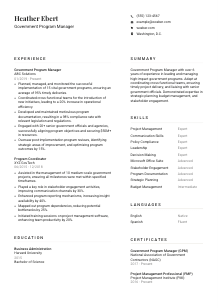
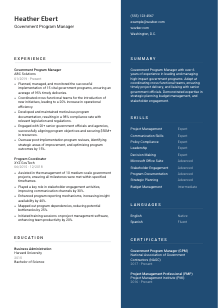
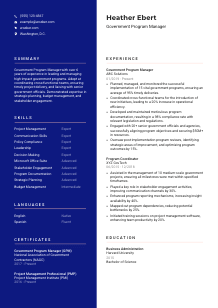
Overseeing grand initiatives, but your CV feels like a bureaucratic maze? Navigate through this Government Program Manager CV example, created with Wozber free CV builder. Learn how to showcase your public sector prowess in line with job requirements, positioning your career to serve the greater good with ease!
Government Program Managers are hired to keep complex public initiatives moving across agencies, timelines, budgets, and compliance requirements. A CV for this work needs to show more than general coordination experience. It should make it easy to see the scale of programs you have led, the stakeholders you have managed, and how you kept delivery on track while working within policy and reporting standards.
Screening for this role often narrows quickly when a CV does not clearly connect program outcomes to public sector execution. Using Wozber's free CV builder helps you shape an ATS-compliant CV with the right language for program schedules, documentation, budgets, stakeholder engagement, and post-implementation review. That makes it easier for hiring teams to recognize whether you can run a government program with structure and credibility.
Government hiring often starts with straightforward checks before anyone reads deeply into your program work. Your personal details should confirm that you are reachable, professional, and aligned with practical requirements without adding anything irrelevant.
Place your name at the top in a clean, readable format, then use the exact or near-exact target title beneath it. For a Government Program Manager application, matching the title helps frame the rest of the CV around program delivery, compliance, stakeholder coordination, and resource management from the first line.
Include a reliable phone number and a professional email address, ideally based on your name. Add a LinkedIn profile or professional website only if it supports your candidacy with consistent public sector experience, project leadership, publications, or program results. Broken links or outdated profiles create doubts you do not need.
If the posting names a location requirement, reflect it clearly in this section. Here, listing "Washington, D.C." matters because the role specifically requires candidates to be located there. That is a tailoring move tied to this opening, not a rule for every Government Program Manager CV.
A website can help if it shows material that belongs in a public sector leadership profile, such as policy work, program case studies, speaking engagements, or cross-agency initiative summaries. If your online presence is personal, sparse, or unrelated to government operations, leave it off.
Do not include age, marital status, photo, or other personal data that has no bearing on managing programs, budgets, reporting, or stakeholder communication. Keep the section focused on information that supports a formal hiring process and a clean ATS read.
This section should confirm the basics quickly and remove any avoidable friction. When your name, title, contact details, and location are handled well, the reader can move straight to the part that matters most for this role, your record of delivering public programs.




This is the section where Government Program Manager CVs usually win or lose momentum. Hiring teams want to see how you handled program execution in real operating conditions, including schedules, interdepartmental coordination, compliance, reporting, and measurable results.
Start by marking the operating language in the job description. For this role, that includes planning and monitoring implementation, coordinating cross-functional teams, maintaining budgets and documentation, engaging senior officials, and running post-implementation reviews. Your experience bullets should reflect these functions where they are genuinely part of your background, using close terminology so both ATS systems and human reviewers can connect the match quickly.
List positions in reverse chronological order and give the most space to work that involved government programs, regulated environments, agency coordination, or public service delivery. If your exact title was different, such as Program Coordinator, use the bullets to show the program management elements of the role, including scheduling, reporting, stakeholder updates, or dependency tracking.
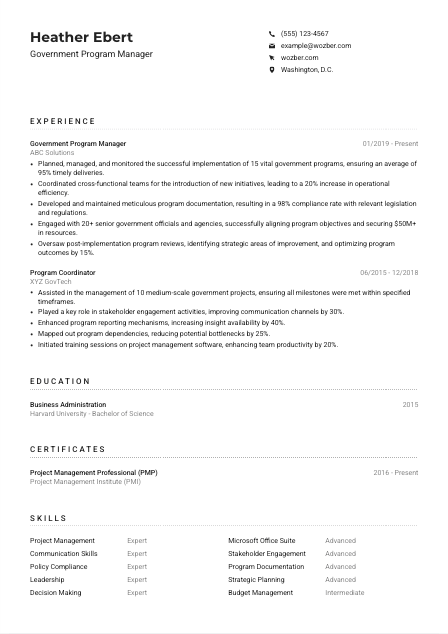
Metrics carry weight when they reflect program performance. Use figures tied to delivery rates, compliance outcomes, funding secured, operational efficiency, reporting improvements, or implementation volume. The example CV does this well by citing 15 programs managed, 95% on-time delivery, 98% compliance, and more than $50M in secured resources. Those numbers make the scope and effect of the work immediately clear.
Choose accomplishments that reinforce your ability to run structured initiatives, not just participate in them. Strong bullets mention schedules, budgets, legislation, stakeholder communication, corrective actions, or review processes. If an achievement does not help prove you can manage public programs with accountability, it probably belongs off the CV.
Verbs such as "planned," "coordinated," "developed," "monitored," "engaged," and "oversaw" work well because they show control over program activity and decision flow. Pair them with concrete outputs. "Coordinated cross-functional teams for new initiatives, improving operational efficiency by 20%" is much stronger than a generic line about supporting teamwork.
Your experience section should leave no doubt about your ability to deliver programs in a government or public sector setting. When the bullets show scope, compliance, stakeholder coordination, and measurable outcomes, the CV starts to read like someone who can step into active program oversight.
For Government Program Manager roles, education is usually a qualification check before it becomes a differentiator. Present it clearly, match the field of study when relevant, and make it easy to confirm that you meet the stated academic requirement.
If the posting asks for a bachelor's degree in Business Administration, Public Administration, or a related field, make sure your degree and field are written in full. That direct match matters in ATS screening and in early review. In the example, "Bachelor of Science in Business Administration" clearly covers the requirement.
Include degree, field of study, school, and graduation year or date. This section does not need extra explanation unless your education is a major selling point. A clean entry gives the reviewer what they need without interrupting the flow of your program management story.
If your degree is adjacent rather than exact, use the wording that best shows its relevance to government operations, administration, policy, or business execution. Public Administration, Political Science, Business Administration, and related fields can all work when the connection to program leadership is clear.
Clubs, honors, research, or student leadership are worth mentioning mainly when you are early in your career or when they directly reinforce public service, administration, budgeting, policy work, or organizational leadership. For experienced candidates, those details usually matter less than program outcomes in the work history.
Additional training in project management, compliance, budgeting, public policy, procurement, or performance measurement can strengthen this section or support your certifications. This is especially useful if the role asks for structured program oversight and your recent learning shows you stay current on tools and standards.
This section should confirm that you meet the academic baseline and, where relevant, reinforce your preparation for public sector program work. Once that is clear, the hiring team can focus on the operational experience that usually drives the decision.
Certifications matter more in program management than in many other fields because they suggest structured methods, shared standards, and current professional practice. In government settings, that can strengthen your profile when the work involves documentation, oversight, and multi-stakeholder accountability.
When a role highlights certifications such as PMP or GPM, list them prominently if you hold them. That is one of the easiest ways to align with the posting's preferences. The example CV includes both, which immediately supports the candidate's credibility in formal program management environments.
Feature credentials tied to program delivery, project controls, government operations, compliance, procurement, risk management, or leadership. General certificates that do not strengthen your case for running public programs should stay off the CV if space is tight.
Add issue dates, renewal ranges, or current status where appropriate. That helps the reviewer understand whether the certification is recent and maintained. For credentials that require ongoing standing, showing that they are current adds confidence.
Government programs change with policy, funding structures, technology, and reporting expectations. Continuing education in areas like PMO practices, public administration, grant management, or performance analytics shows that your approach is current and disciplined, not static.
Well-chosen certifications tell the reader that you understand structured program management and have invested in methods that matter in accountable environments. They are especially useful when they directly echo the preferences listed in the posting.
A Government Program Manager skills section should read like an operating toolkit, not a generic mix of buzzwords. Focus on capabilities that support planning, oversight, reporting, stakeholder coordination, compliance, and delivery in a public sector setting.
Use the posting to identify both direct requirements and implied operating skills. Here that includes project management software, Microsoft Office Suite, communication, program documentation, budgeting, stakeholder management, and post-implementation review. Add only the skills you can support elsewhere in the CV with actual work.
Government Program Managers need both execution tools and coordination ability. A credible list might include project management, policy compliance, budget management, performance reporting, stakeholder engagement, leadership, and communication. The example CV handles this well by mixing operational skills such as Microsoft Office Suite and program documentation with higher-level capabilities like strategic planning and decision making.
Put the most role-critical skills first, especially those named in the posting. If the job emphasizes compliance, cross-functional coordination, and communication with senior officials, those should appear before less central abilities. Keep the list tight enough that each item feels intentional.
When this section is aligned well, it reinforces the mechanics of how you run programs, not just the fact that you have held the title. That helps the hiring team picture you managing schedules, documentation, reporting, and stakeholder communication from day one.
Language skills can matter in government work because programs often involve agencies, community partners, contractors, and diverse populations. Still, this section should stay practical. List what is required first, then add other languages that could support outreach or collaboration.
If the posting requires English, list it first and state your level clearly. This job explicitly asks for the ability to communicate in English, so making that visible removes any doubt at the start of the section.
Use a straightforward label such as "Native" or "Fluent." There is no advantage in vague wording here. The reader should be able to confirm quickly that you can manage meetings, reports, status updates, and stakeholder communication in English.
Additional languages can be valuable when programs involve community engagement, multilingual populations, or interagency coordination across varied groups. In the example, Spanish adds practical range, but whether extra languages matter depends on the mission and audience of the specific role.
Use honest proficiency labels such as "Fluent," "Advanced," "Intermediate," or "Basic." Government work often involves formal communication, so overstating language ability can create real problems once interviews or job duties shift into meetings, presentations, or written correspondence.
Only include languages that add professional value. If a second language helps with constituent communication, public outreach, partner coordination, or accessibility of services, it strengthens the section. If not, it is optional rather than essential.
For this kind of role, language skills are most useful when they support communication across programs and stakeholders. Keep the section factual and tied to how the work gets done.
The summary sits at the top of the CV, so it should establish your level, your domain, and the kind of results you deliver. For Government Program Manager roles, the best summaries quickly connect years of experience with public sector program execution, stakeholder management, and measurable outcomes.
Review the role and pull out the few themes that define success. In this case, those are government program implementation, cross-functional coordination, documentation and compliance, communication with senior officials, and continuous improvement through post-review. Your summary should reflect that mix instead of offering a generic management statement.
Start with your current professional identity and relevant years of experience. A line like "Government Program Manager with 6+ years of experience leading public sector programs" works because it establishes level and domain immediately. The example summary uses this structure effectively.
Choose strengths that directly support the target role, such as program delivery, stakeholder engagement, budget oversight, compliance management, or strategic planning. If possible, hint at impact by referencing outcomes like timely implementation, resource alignment, or program optimisation rather than listing soft skills alone.
Aim for three to five lines with clear nouns and verbs. Avoid broad claims about being passionate, dynamic, or results-driven unless you back them up with actual context. This section works best when it sounds like a concise briefing on the kind of programs you manage and the outcomes you deliver.
A sharp summary helps the rest of the CV land faster. By the time the hiring team reaches your experience section, they should already understand that your background centers on running structured government programs, coordinating stakeholders, and delivering accountable results.
A Government Program Manager CV needs to show control over execution, not just familiarity with administrative work. When each section supports that story with clear role alignment, quantified results, and public sector language, the document becomes much easier to evaluate in a serious hiring process.
Use Wozber's free CV builder, ATS-friendly CV templates, and ATS CV scanner to refine wording, strengthen ATS optimisation, and map your experience to the requirements that matter most. The finished CV should make one thing clear right away: you know how to lead government programs from planning through review.




