



Use Wozber and land your dream job
Create CV
No registration required
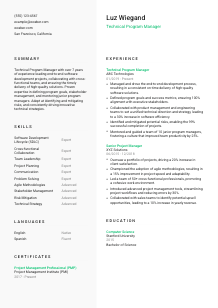
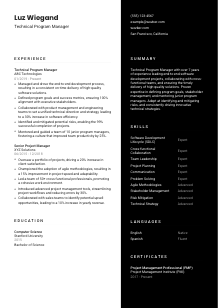
Juggling complex projects, but your CV feels like a beta version? Browse this Technical Program Manager CV example, created with Wozber free CV builder. It shows how to seamlessly align your programmatic prowess with job expectations, designing a career roadmap that always leads to successful product launches!
Technical Program Managers sit at the point where delivery discipline meets technical judgment. Hiring teams want to see more than project coordination. They look for someone who can keep software programs moving through planning, build, risk review, and release while staying credible with engineering, product, and executive stakeholders. Your CV should make that operating range visible fast.
Screening usually narrows quickly when a CV reads like a generic project manager profile instead of a software delivery leader. Wozber's free CV builder helps shape an ATS-compliant CV around the language that matters here, including SDLC, agile delivery, cross-functional leadership, and program metrics, so reviewers can quickly understand the scale of programs you led and how you kept execution on track.
For a Technical Program Manager, the header should remove friction immediately. Keep it clean, professional, and aligned with the practical requirements of the opening so a recruiter can confirm who you are, how to reach you, and whether you meet basic location or communication expectations.
Use your full name as the most visible text in the header. Keep formatting simple and polished so the page opens with clarity, especially for roles where executive communication and structured reporting are part of the job.
Place "Technical Program Manager" directly under your name when that matches the role you are pursuing. This helps both recruiters and ATS systems understand your positioning right away, and it prevents your CV from reading like a general operations or project management profile.
List a current phone number and a professional email address with no distractions. Technical Program Manager hiring often moves through recruiter screens, stakeholder interviews, and panel loops, so any typo or outdated contact detail can stall the process unnecessarily.
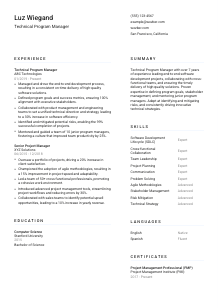
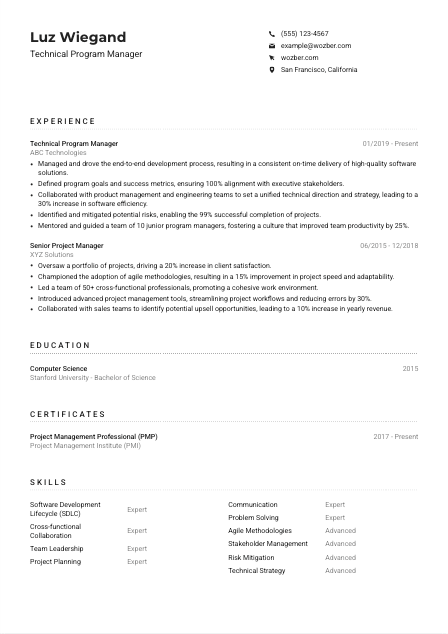
Add your city and state if the job has a location requirement. In the example, "San Francisco, California" supports a posting that specifically asks candidates to be based there. If a job is remote or flexible, match that context instead of copying location conventions blindly.
Include LinkedIn or a professional site if it reinforces your CV with the same roles, scope, and accomplishments. For Technical Program Managers, that profile should reflect delivery leadership, cross-functional work, and technical program scope rather than a generic networking page.
Your header should answer the basics in seconds and reflect the operational professionalism expected from someone who manages software programs, stakeholder communication, and delivery risk.




This section carries the most weight for a Technical Program Manager. Hiring teams look for signs that you can move complex software initiatives from planning to launch, coordinate across engineering and product, manage risk early, and keep leadership informed with measurable progress.
Read the description closely and mark the work that defines the role: end-to-end development ownership, SDLC fluency, agile execution, stakeholder communication, technical strategy, and risk mitigation. Then shape your bullets around comparable work you have already done. In the example CV, the strongest points directly echo those priorities without sounding copied, such as driving the development process and defining program success metrics.
Start with your most recent position and show title, company, and dates in a format that is easy to scan. For Technical Program Manager candidates, progression matters. A move from project management into broader program ownership, larger cross-functional scope, or more technical influence helps reviewers understand your growth.
Focus each bullet on a program responsibility and the result it produced. Strong Technical Program Manager bullets often cover release delivery, roadmap execution, dependency management, stakeholder alignment, risk reduction, process improvement, or team leadership. The example does this well by connecting collaboration with product and engineering to a 30% increase in software efficiency.
Quantify with measures that fit software delivery. Useful metrics include on-time delivery, project completion rate, cycle time, quality improvements, productivity gains, adoption of agile practices, or team size. A line such as mentoring 10 junior program managers or reaching 99% successful project completion gives hiring teams a concrete sense of scale and effectiveness.
Keep the section centered on software programs, technical coordination, and leadership. If an older role includes achievements in sales support or unrelated operations, keep only the parts that strengthen your case for program delivery, agile execution, or cross-functional influence. Relevance keeps your profile from drifting away from the role you want now.
By the end of your experience section, a reviewer should understand what kinds of software programs you have led, how you handled delivery pressure, and what results followed from your decisions.
Education is usually a baseline check for this role, but it still matters. A Technical Program Manager often works closely with engineers on planning, tradeoffs, and delivery decisions, so a degree in a technical field strengthens your credibility from the start.
If the posting asks for a bachelor's degree in Computer Science, Engineering, or a related technical field, state your degree and field in direct terms. The example, "Bachelor of Science in Computer Science," works because it answers the requirement without interpretation.
List school, degree, field of study, and graduation year or date in a consistent format. Simple structure improves ATS readability and makes it easy for reviewers to confirm that you meet the educational bar without searching through the page.
When your degree supports the role directly, let that connection be obvious. Technical Program Managers do not need to present themselves as engineers, but a technical academic background helps explain why you can work comfortably with software teams, SDLC discussions, and architecture-adjacent decisions.
Relevant coursework can help if you are earlier in your career or if your degree title is broad. Prioritise classes or projects tied to software systems, engineering methods, product development, or technical analysis. Skip filler that does not deepen your fit for program work.
Honors, research, capstone projects, or leadership in technical organizations are worth listing when they reinforce technical depth or structured problem-solving. For an experienced Technical Program Manager, keep these details brief unless they remain directly relevant to the target role.
Your education section should confirm that you meet the technical baseline and can operate comfortably in software-focused program environments.
Certifications are not mandatory in every Technical Program Manager search, but they often help when the role emphasizes agile execution, formal program management discipline, or credibility with cross-functional teams. Include the ones that sharpen your positioning.
If a posting mentions credentials such as PMP or Certified ScrumMaster, move those to the front of the section. The example CV does this effectively by listing both PMP and CSM, which supports the job's stated preferences around program management and agile practice.
List certifications that support software delivery, agile workflows, technical program leadership, or stakeholder management. A short, focused section is stronger than a long list of unrelated badges that do not help explain how you run programs.
Add earned or active dates when they help show the certification is current. This is especially useful for credentials tied to ongoing renewal, because it shows continued engagement with program management standards and delivery practices.
Technical Program Managers work in environments where processes, tooling, and delivery models keep changing. Updated certifications or continuing education signal that you stay current on agile methods, leadership practices, and the mechanics of modern software execution.
A focused certification section strengthens your CV when it supports the way you lead software programs, communicate across teams, and manage delivery with structure.
A Technical Program Manager skills section should read like the toolkit of someone who can run complex software initiatives, not like a broad collection of business buzzwords. Prioritise the capabilities that directly support planning, execution, coordination, and technical credibility.
Pull the capabilities that define success in the role, then match them to your real experience. For this type of position, that usually includes SDLC, agile methodologies, cross-functional collaboration, stakeholder management, risk mitigation, technical strategy, and clear communication. The example skills list mirrors those themes well without becoming bloated.
Put the highest-value skills first, especially the ones the role repeats or depends on heavily. For Technical Program Managers, delivery frameworks, coordination across engineering and product, and program-level planning usually deserve higher placement than generic soft skills.
Use clear labels and a simple layout so both recruiters and ATS tools can identify your qualifications quickly. An ATS-friendly CV format works best when skill names are explicit, role-relevant, and supported elsewhere in the document through bullets and summary language.
Your skills should confirm that you understand software delivery mechanics and can lead programs across technical teams, timelines, dependencies, and stakeholder expectations.
Technical Program Managers spend a large part of the job translating across audiences. You may be aligning engineers on scope, updating executives on status, or working through priorities with product and design. If language requirements are listed, reflect them clearly and honestly.
If the role requires clear communication in English, list English prominently with an accurate proficiency level. In the example, English appears first as a native language, which directly supports a job that asks candidates to express ideas clearly in English.
List languages in order of importance for the role, then by proficiency. This makes the section easy to scan and helps recruiters quickly confirm whether you meet communication requirements for stakeholder meetings, documentation, or distributed team collaboration.
Extra languages can be useful when programs involve global partners, offshore engineering teams, or international stakeholders. They are a plus, not a substitute for delivery experience, so keep the section proportional to the role.
Choose labels such as native, fluent, professional, or basic only if they reflect your real working ability. Technical Program Managers are often expected to run meetings, write updates, and negotiate tradeoffs, so overstating proficiency can quickly become visible in interviews.
When relevant, think about language skills as part of execution. They can support smoother handoffs, clearer status reporting, and stronger coordination across time zones or functions, especially in software organizations with distributed teams.
Used well, language skills show that you can communicate clearly across the audiences a Technical Program Manager works with every day.
Your summary should quickly position you as someone who can lead software programs with structure and technical fluency. Keep it short, but make sure it points to the combination of delivery ownership, cross-functional influence, and measurable results that defines strong Technical Program Manager hiring.
Before writing, identify the few themes that matter most in the target posting. For this role, those include end-to-end software delivery, agile methods, collaboration with engineering and product, executive communication, risk management, and mentoring. Build your summary around the themes you can prove elsewhere in the CV.
Start with your title and years of relevant experience so the reader can place you immediately. A line like the example's "Technical Program Manager with over 7 years of experience" works because it establishes seniority and keeps the focus on relevant program work.
Add two or three strengths that match the job, then tie them to outcomes when possible. Good summary material for this role includes leading end-to-end software initiatives, defining success metrics, managing cross-functional execution, improving delivery efficiency, and guiding junior program managers.
Aim for a compact paragraph that sounds grounded in actual software delivery work. Avoid generic leadership claims. If a phrase does not point to SDLC ownership, agile execution, stakeholder management, technical strategy, or program outcomes, it probably does not belong in the summary.
A well-written summary should position you quickly as a Technical Program Manager who can lead software programs, manage execution risk, and communicate progress with authority.
A Technical Program Manager CV should make one thing clear fast: you can move software initiatives from planning to delivery while keeping engineers, product leaders, and executives aligned. Every section should support that picture, from your title and technical education to your delivery metrics, agile credentials, and program leadership examples.
Use Wozber's free CV builder and ATS CV scanner to tighten wording, map job requirements to the right sections, and produce an ATS-friendly CV template that reflects the language of the role without sounding forced. When the tailoring is done well, hiring teams can quickly recognize the scale of programs you have led and the delivery discipline you bring.