



Use Wozber and land your dream job
Create CV
No registration required
Steering mental wellness, but your CV feels a bit scattered? Explore this Mental Health Program Manager CV example, created with Wozber free CV builder. Learn how to synthesize and present your program leadership to match job needs, guiding your career path to a state of organizational equilibrium!
Mental Health Program Managers sit at the point where clinical quality, staffing, funding, and community access all meet. Hiring teams want to see that you can run programs that serve clients well while keeping budgets, outcomes, and multidisciplinary teams on track. Your CV should make that operating range visible from the first section.
When the CV is tailored well, reviewers can quickly distinguish between someone with direct program oversight and someone whose background is limited to coordination or frontline delivery. Wozber's free CV builder helps you shape an ATS-compliant CV around the language of the posting so your leadership scope, evidence-based practice knowledge, and outcome data are easier to recognize early.
For Mental Health Program Manager roles, the header should do one job cleanly: confirm who you are, how to reach you, and whether you meet any stated location requirement without distracting from your clinical and operational background.
Use your full name in a larger font than the rest of the header so it is easy to find during a quick review. In leadership hiring, the attention should move immediately from your name to your title and recent program management experience. Wozber's ATS-friendly CV format helps keep that structure clear and readable.
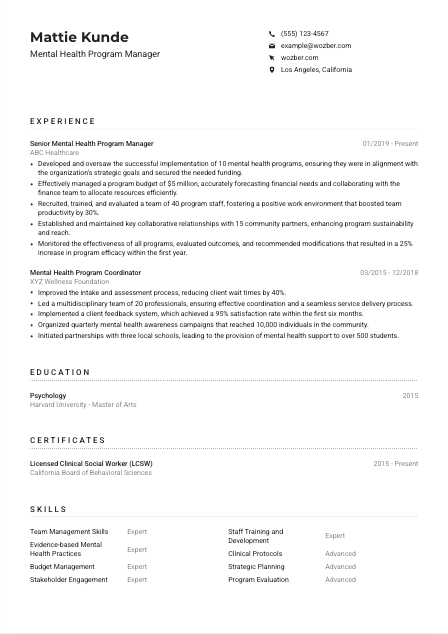
If you are applying for a Mental Health Program Manager position, place that title directly under your name when it accurately reflects your background. This helps frame you as a candidate with program ownership, not only clinical or coordination experience. In the example, using "Mental Health Program Manager" keeps the positioning aligned with the level of responsibility in the posting.
Include a reliable phone number and a professional email address. Check them carefully. Program leadership searches can move quickly when an organisation is filling a role tied to service continuity, grant timelines, or staff supervision, so any typo here creates an avoidable delay.
Some openings include a hard location filter. Here, the employer specifies Los Angeles, California, so listing "Los Angeles, California" in your header answers that question immediately. Treat this as targeted tailoring rather than a rule for every Mental Health Program Manager CV.
A LinkedIn profile or professional website can help if it reinforces your CV with consistent titles, licenses, speaking work, or program leadership highlights. Keep it current. If your online profile shows community partnerships, behavioral health initiatives, or cross-functional leadership that matches the role, it adds useful context.
This section should confirm the basics fast and remove friction from the review. Once your title, contact details, and any stated location requirement are clear, the CV can move straight into program outcomes and leadership scope.




This is the section that usually decides whether you are seen as a true program manager. Mental health employers look for ownership of services, staff, budgets, partnerships, and measurable outcomes, not only participation in program delivery.
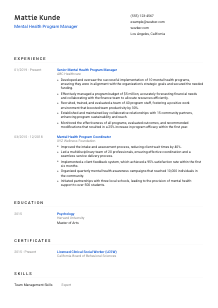
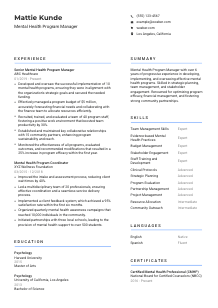
Study the posting and pull out the work that defines the role. Here, that includes program implementation, budget forecasting, staff supervision, community partnerships, and continuous quality improvement. Your bullets should mirror those responsibilities when they reflect your actual experience. The example does this well by showing direct oversight of mental health programs rather than describing general support work.
List your positions in reverse chronological order and make each entry easy to scan with organisation, title, and dates. Under each role, show the scale you managed where possible, such as number of programs, staff headcount, budget size, client reach, or partner network. That gives hiring teams a quick read on whether you have led work at the level they need.
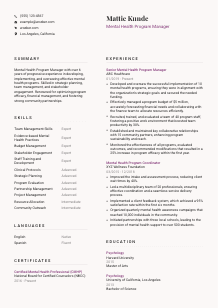
Mental health leadership CVs are stronger when bullets show what changed because of your decisions. Instead of saying you supervised staff or monitored services, show what your leadership improved. In the sample CV, "Recruited, trained, and evaluated a team of 40 program staff" works because it ties people management to a 30% productivity increase.
Numbers matter here, but they should sound native to the work. Strong metrics include budget totals, staffing levels, wait-time reduction, client satisfaction, reach of community campaigns, partner count, utilization, and outcome improvement. The example's $5 million budget, 25% increase in program efficacy, and 40% reduction in wait times are effective because they show both operational control and service impact.
Every bullet should support your case for leading mental health programs. Prioritise evidence of clinical protocol knowledge, evidence-based practice implementation, funding alignment, supervision, and stakeholder management. If an accomplishment does not help explain your readiness to oversee programs and teams, leave it out or rewrite it so the leadership value is clear.
Your experience section should leave no doubt that you can run mental health programs, guide staff, manage resources, and improve outcomes. Wozber's ATS optimisation tools can help you align this section with the posting's terminology so your scope shows up clearly in both ATS screening and human review.
For this role, education is usually a qualification screen before anyone looks closely at your leadership style. A master's degree in a relevant field is often a baseline requirement, so present it clearly and without extra clutter.
When the posting requires a master's degree in Psychology, Social Work, Public Health, or a related discipline, list that degree prominently at the top of the education section. In the example, the Master of Arts in Psychology directly addresses that requirement. If your field is adjacent, use the exact official degree title and field so the connection is easy to understand.
Use reverse chronological order with school, degree, field, and graduation year or date. This section does not need long descriptions unless a program concentration or thesis is highly relevant to behavioral health systems, trauma-informed care, or public health program design.
Do not assume the reviewer will infer relevance from the degree name alone. Spell out the discipline, such as Psychology, Social Work, or Public Health. That helps both ATS parsing and human reviewers who are checking quickly for educational alignment with mental health leadership roles.
Relevant coursework, capstone work, or research can be useful when it connects directly to program evaluation, behavioral health interventions, community mental health, or health equity. Keep it selective. This is most helpful for earlier-career candidates or for roles where your academic specialization closely matches the employer's service model.
If you have completed recent training in evidence-based mental health practices, quality improvement, trauma-informed care, crisis response, or related policy areas, include it when space allows. For program managers, current learning can reinforce that your practice knowledge has kept pace with changes in care delivery and compliance expectations.
This section should answer the education question in seconds. Once your master's degree and relevant field are clear, the reader can focus on the experience, licensure, and outcomes that carry more weight in manager-level hiring.
In mental health leadership, licenses and certifications often do more than decorate the CV. They can confirm clinical grounding, legal eligibility, and current engagement with the standards that shape program design and supervision.
If the role asks for a professional license such as LCSW, LPC, or an equivalent required by state law, place it first. In the example, the Licensed Clinical Social Worker credential is central because it lines up directly with the employer's stated requirement. When licensure is essential, do not bury it below secondary credentials.
Choose credentials that support the role's actual work, such as behavioral health, clinical supervision, quality improvement, trauma-informed care, or program administration. A shorter, better-targeted list reads more credibly than a long inventory of unrelated courses.
Include the issuing organisation and date or active range so reviewers can quickly see whether the credential is current. For regulated fields, that date detail matters. The sample's format, showing the California Board of Behavioral Sciences and an active date range, makes the license easy to interpret.
Mental health programs are shaped by changing clinical guidance, compliance standards, payer expectations, and community needs. Recent certifications or renewals can support your case when they show you stay current on evidence-based practice, service delivery models, or supervisory responsibilities.
For many Mental Health Program Manager roles, licensure is part of the qualification screen, not a side note. Present licenses and relevant certifications clearly so your clinical standing and professional currency are visible right away.
A Mental Health Program Manager skills section should read like the operating toolkit behind the results in your experience section. Focus on capabilities that support clinical quality, staff leadership, financial stewardship, and program performance.
Start with the language used in the job description. Here, the role calls for evidence-based mental health practices, clinical protocols, team leadership, budget management, and program evaluation. These are the terms worth reflecting if they match your background, because they connect your CV to how the employer defines the work.
Do not list only soft skills or only administrative functions. This role sits between service delivery and management, so your skills should show both sides. A useful mix might include program development, staff supervision, stakeholder engagement, budget forecasting, outcome evaluation, and knowledge of clinical protocols. The example handles this balance well by pairing evidence-based practice with budget management and partnership management.
Use concise skill names and avoid padding the section with vague items that could apply to any leadership job. Choose the abilities that hiring teams actually need to see in behavioral health management. Wozber's ATS-friendly CV format helps keep these skills structured so the most relevant terms are easy to pick up during ATS screening and recruiter review.
A sharper skills section reinforces the picture built by your experience: someone who can lead teams, manage programs, work within clinical frameworks, and improve outcomes. Relevance matters more than volume here.
Language ability can matter in mental health settings because communication affects intake, trust, family engagement, and community outreach. Still, this section should stay practical and tied to the role's stated needs.
If the posting requires proficiency in English, make that explicit. This role does, so English should appear clearly in your language section. Do not assume it is understood from the rest of the CV when the employer has named it as a requirement.
Extra languages can strengthen your application when programs serve multilingual communities or rely on community partnerships. In a large and diverse service area, an additional language such as Spanish may support outreach, coordination, and rapport with clients and families. Treat it as added value, not a replacement for core program management qualifications.
Label each language honestly with terms such as Native, Fluent, Advanced, or Conversational. Clear proficiency levels help employers understand whether you can handle stakeholder meetings, community engagement, or basic communication without overclaiming.
If a second language has been useful in program delivery, partnership building, or public-facing mental health initiatives, let that context appear elsewhere in the CV as well. Language skills are most convincing when they support real outcomes, such as stronger community participation or more accessible services.
Most Mental Health Program Manager positions do not require a long language section. Include what is true and relevant, then let your experience section carry the heavier case for leadership, program oversight, and service improvement.
This section works best when it quickly confirms required proficiency and highlights any added community-facing value. The main story should still be your ability to lead effective mental health programs.
The summary should tell a hiring team, in a few lines, what level of mental health program leadership you bring. Focus on years of experience, program scope, management strengths, and the kind of outcomes you improve.
Start with the role's main themes. For this posting, those include progressive program management experience, evidence-based practice knowledge, team leadership, budgeting, and outcome evaluation. Your summary should pull from that mix instead of relying on broad leadership language.
Your first sentence should quickly establish who you are and how much relevant experience you bring. The example does this effectively with "Mental Health Program Manager with over 6 years of progressive experience," which immediately places the candidate at the right level for a role asking for 5+ years.
Choose strengths that matter in this field and that you can support elsewhere on the CV. Strategic planning, staff leadership, stakeholder engagement, financial management, and program evaluation are all useful if they are backed by bullets later in the document. Phrases like improving program efficacy or building community partnerships work best when they connect to real metrics.
Aim for a short paragraph that can be read in seconds. Avoid generic adjectives and save detailed examples for the experience section. A concise summary with role-specific language gives the reviewer an immediate sense of your scope and prepares them to read the rest of the CV through the right lens.
A focused summary helps the reader understand from the start that you are applying as a program leader with clinical awareness, operational discipline, and measurable impact. Once that frame is set, the rest of the CV can prove it.
A well-tailored Mental Health Program Manager CV should make three things easy to see: the level of programs you have led, the teams and resources you have managed, and the service or quality outcomes you have improved. When those elements are clear, the hiring team can quickly place you in the right part of the candidate pool.
Use Wozber's ATS-friendly CV templates and ATS CV scanner to align your language with the posting, surface missing requirements, and strengthen ATS optimisation across each section. The finished CV should give a clear hiring read on your ability to lead effective mental health programs from strategy through day-to-day execution.




